![Elizabeth Llewellyn as Mimi and Gwyn Hughes-Jones as Rodolfo [Photo by Robert Workman courtesy of English National Opera]](http://www.operatoday.com/Boheme_ENO_2010_01.gif)
24 Oct 2010
La Bohème, ENO
ENO clearly expect high returns from Jonathan Miller’s La Bohème.
English Touring Opera are delighted to announce a season of lyric monodramas to tour nationally from October to December. The season features music for solo singer and piano by Argento, Britten, Tippett and Shostakovich with a bold and inventive approach to making opera during social distancing.
This tenth of ten Live from London concerts was in fact a recorded live performance from California. It was no less enjoyable for that, and it was also uplifting to learn that this wasn’t in fact the ‘last’ LfL event that we will be able to enjoy, courtesy of VOCES8 and their fellow vocal ensembles (more below …).
Ever since Wigmore Hall announced their superb series of autumn concerts, all streamed live and available free of charge, I’d been looking forward to this song recital by Ian Bostridge and Imogen Cooper.
Although Stile Antico’s programme article for their Live from London recital introduced their selection from the many treasures of the English Renaissance in the context of the theological debates and upheavals of the Tudor and Elizabethan years, their performance was more evocative of private chamber music than of public liturgy.
Evidently, face masks don’t stifle appreciative “Bravo!”s. And, reducing audience numbers doesn’t lower the volume of such acclamations. For, the audience at Wigmore Hall gave soprano Elizabeth Llewellyn and pianist Simon Lepper a greatly deserved warm reception and hearty response following this lunchtime recital of late-Romantic song.
For this week’s Live from London vocal recital we moved from the home of VOCES8, St Anne and St Agnes in the City of London, to Kings Place, where The Sixteen - who have been associate artists at the venue for some time - presented a programme of music and words bound together by the theme of ‘reflection’.
'Such is your divine Disposation that both you excellently understand, and royally entertaine the Exercise of Musicke.’
‘And there was war in heaven: Michael and his angels fought against the dragon; and the dragon fought and his angels, And prevailed not; neither was their place found any more in heaven … that old serpent … Satan, which deceiveth the whole world: he was cast out into the earth, and his angels were cast out with him.’
There was never any doubt that the fifth of the twelve Met Stars Live in Concert broadcasts was going to be a palpably intense and vivid event, as well as a musically stunning and theatrically enervating experience.
‘Love’ was the theme for this Live from London performance by Apollo5. Given the complexity and diversity of that human emotion, and Apollo5’s reputation for versatility and diverse repertoire, ranging from Renaissance choral music to jazz, from contemporary classical works to popular song, it was no surprise that their programme spanned 500 years and several musical styles.
The Academy of St Martin in the Fields have titled their autumn series of eight concerts - which are taking place at 5pm and 7.30pm on two Saturdays each month at their home venue in Trafalgar Square, and being filmed for streaming the following Thursday - ‘re:connect’.
The London Symphony Orchestra opened their Autumn 2020 season with a homage to Oliver Knussen, who died at the age of 66 in July 2018. The programme traced a national musical lineage through the twentieth century, from Britten to Knussen, on to Mark-Anthony Turnage, and entwining the LSO and Rattle too.
With the Live from London digital vocal festival entering the second half of the series, the festival’s host, VOCES8, returned to their home at St Annes and St Agnes in the City of London to present a sequence of ‘Choral Dances’ - vocal music inspired by dance, embracing diverse genres from the Renaissance madrigal to swing jazz.
Just a few unison string wriggles from the opening of Mozart’s overture to Le nozze di Figaro are enough to make any opera-lover perch on the edge of their seat, in excited anticipation of the drama in music to come, so there could be no other curtain-raiser for this Gala Concert at the Royal Opera House, the latest instalment from ‘their House’ to ‘our houses’.
"Before the ending of the day, creator of all things, we pray that, with your accustomed mercy, you may watch over us."
The doors at The Metropolitan Opera will not open to live audiences until 2021 at the earliest, and the likelihood of normal operatic life resuming in cities around the world looks but a distant dream at present. But, while we may not be invited from our homes into the opera house for some time yet, with its free daily screenings of past productions and its pay-per-view Met Stars Live in Concert series, the Met continues to bring opera into our homes.
Music-making at this year’s Grange Festival Opera may have fallen silent in June and July, but the country house and extensive grounds of The Grange provided an ideal setting for a weekend of twelve specially conceived ‘promenade’ performances encompassing music and dance.
There’s a “slide of harmony” and “all the bones leave your body at that moment and you collapse to the floor, it’s so extraordinary.”
“Music for a while, shall all your cares beguile.”
The hum of bees rising from myriad scented blooms; gentle strains of birdsong; the cheerful chatter of picnickers beside a still lake; decorous thwacks of leather on willow; song and music floating through the warm evening air.
ENO clearly expect high returns from Jonathan Miller’s La Bohème.
Premièred just over a year ago and here receiving its first ‘revival’, the management are surely justified in their faith that it will match the enduring successes of his perennial Mikado (which will make yet another appearance in spring 2010) and Rigoletto: this Bohème is an apt tale of poverty and paucity to fill the coffers in austere times. For, while Miller’s vision certainly doesn’t indulge in sentimentalism — his bohemians are a pretty solipsistic bunch — he and his ingenious designer, Isabella Bywater, present us with an ocular feast. Updating the action to 1930s Paris, they have drawn copiously on the visual records of the period — the sepia-tinted photographs of Cartier-Brassaï and Kertész, the cinematography of film noir — to powerfully recreate the zeitgeist of a Depression-era Europe hedonistically living for today in the face of an uncertain or bleak future.
Bywater’s inspired designs are superbly detailed and naturalistic. Within the monochrome greys of city life, contrasts and counter-currents are pointed: the lofty atelier, with assorted clutter, perches above an empty café; Mimi’s humble rooms lie to the right of twisting staircase; the glimpsed warmth of a café interior poignantly emphasises the literal and figurative chill of the wintry square where Mimi and Rodolfo play out their tragedy. The Act 1 set splits and spins artfully, revealing first a street scene and then twisting back to display the exterior and pavement tables of Café Momus — a scene of sparkling yet superficial vivacity, splashes of colour briefly dismissingly the steely grey. Later, another rotation reveals an employment office, a reminder of reality; a further revolution takes us back to the garret room. The cinematic continuity is effortlessly achieved — a neat realisation of Puccini’s verismo (one is reminded that the first production was screened by Sky Arts, different Sky channels simultaneously relaying the events on stage and the backstage action … a TV first for ENO).
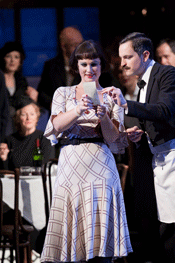 Mairead Buicke as Musetta
Miller uses the spaces well: in the early acts, many a riposte is shouted from the Bohemians’ bathroom, warnings cry out from the stair-well, a marching band sweeps across the stage at the Act 2 curtain call, creating a sense of space and air which contrasts with the claustrophobic death room of the final scene. Jean Kalman’s lighting is subtle and thoughtful, no more so than when reflections from lowered windows of the garret add fragile glitter and light to the somewhat desperate Christmas festivities of the Café Momus revellers.
Miller is ever alert to the impact of small gestures and details: shutters are quietly closed as someone leaves the room, a lovers’ argument is glimpsed through an upstairs window. But, despite this attention to detail — aided perhaps by the sympathetic spontaneity of the performers themselves — this is not an overly fussy production. Miller’s chief concern seems to be to tell a simple story in a straightforward way, and he succeeds … but this very simplicity does give rise to some difficulties.
Part of the problem is that the staging often raises the characters aloft, or pitches them afar. Thus, it’s difficult to establish who they really are — what they feel, if anything. A seemingly heartless bunch, they behave foolishly and suffer for their follies, but do we care? The first meeting of Rodolfo and Mimi is mutually contrived, and because their faces are essentially hidden from view, it’s hard to believe in their passion, or to be convinced that it would last more than one night! The orchestra may speak to us of romance, but our eyes witness a mercantile exchange, especially as Mimi begs continually for new gloves, a necklace … The result is a drama with fewer tragic pulses than the average TV soap — there should be scarcely a dry eye in the house at the close, but any tears were surely the product of the superlatively tender violin accompaniment to Mimi’s demise rather than regret for her passing?
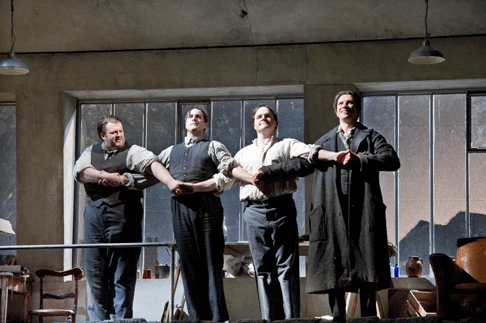 Gwyn Hughes Jones as Rodolfo, George von Bergen as Schaunard, Roland Wood as Marcello and Pauls Putninš as Colline
That’s not to say that the cast don’t put on a good show. Not least, we are introduced to Elizabeth Llewellyn, making her company debut as Mimi. A graduate of ENO Opera Works — a training opportunity for talented pre-professional singers who demonstrate potential, and designed specifically for those who come to the profession via unconventional routes — her warm, generous voice easily reached the rafters of the Coliseum, and was much appreciated by the audience. However, while this is an opera which always requires the audience to suspend their disbelief, it was hard to be persuaded that one of such remarkable vocal power was on the verge of consumption-afflicted demise … a little more balance between affecting power and vulnerability would have been welcome.
Perhaps the problem is Miller’s conception of the role, for this Mimi is a consumerist flirt who at times seems to have less integrity than Mairead Buicke’s Musetta. Buicke, sporting a neat bob and modish apparel, has great stage presence and relished the theatricality of the role; she had no problem with the virtuosic demands of the part, although she does occasionally sound piercing or shrill. Gywn Hughes-Jones’ Rodolfo is a rather self-pitying sniveller, afraid of his emotions, insecure in his relationships. Challenged, as were the entire cast, to project above an enthusiastic orchestral fabric, often from the far reaches of the stage, Hughes-Jones was strong-toned and confident, but had a tendency to bellow and to come at notes from the side or below.
The Bohemians’ banter and bickering was humorously directed, with four of the first cast returning to their original roles. Roland Wood’s Marcello is vocally a little light-weight, but his diction was clear and his delivery elegant; the spitefulness of his repartee with Musetta added a surprising and effective frisson. George von Bergen and Paul Putninš were charming enough but made little dramatic impact. More arresting was Simon Butteris, whose amusingly lecherous Benoit is a perfectly conceived caricature. Both he and Richard Angas delivered their lines clearly and directly.
Stephen Lord encouraged the ENO orchestra to produce a rich palette of swelling Puccinian rhetoric, injecting some passion into this rather cold-hearted concept. But, this is ‘easy-listening’ and ‘comfort-viewing’ — indeed, in style and substance, there’s not much to choose between these Bohemians and another set of ‘miserables’ elsewhere in the West End. Direct, unpretentious and unsentimental, Jonathan Miller has given ENO another sure-fire winner.
Claire Seymour