![Sasha Cooke [Photo by Nick Granito]](http://www.operatoday.com/Sasha-Cooke-2---photo-credi.gif)
29 Oct 2010
New York Festival of Song
“Don’t I have the coolest job in the world?” said Steven Blier.
English Touring Opera are delighted to announce a season of lyric monodramas to tour nationally from October to December. The season features music for solo singer and piano by Argento, Britten, Tippett and Shostakovich with a bold and inventive approach to making opera during social distancing.
This tenth of ten Live from London concerts was in fact a recorded live performance from California. It was no less enjoyable for that, and it was also uplifting to learn that this wasn’t in fact the ‘last’ LfL event that we will be able to enjoy, courtesy of VOCES8 and their fellow vocal ensembles (more below …).
Ever since Wigmore Hall announced their superb series of autumn concerts, all streamed live and available free of charge, I’d been looking forward to this song recital by Ian Bostridge and Imogen Cooper.
Although Stile Antico’s programme article for their Live from London recital introduced their selection from the many treasures of the English Renaissance in the context of the theological debates and upheavals of the Tudor and Elizabethan years, their performance was more evocative of private chamber music than of public liturgy.
Evidently, face masks don’t stifle appreciative “Bravo!”s. And, reducing audience numbers doesn’t lower the volume of such acclamations. For, the audience at Wigmore Hall gave soprano Elizabeth Llewellyn and pianist Simon Lepper a greatly deserved warm reception and hearty response following this lunchtime recital of late-Romantic song.
For this week’s Live from London vocal recital we moved from the home of VOCES8, St Anne and St Agnes in the City of London, to Kings Place, where The Sixteen - who have been associate artists at the venue for some time - presented a programme of music and words bound together by the theme of ‘reflection’.
'Such is your divine Disposation that both you excellently understand, and royally entertaine the Exercise of Musicke.’
‘And there was war in heaven: Michael and his angels fought against the dragon; and the dragon fought and his angels, And prevailed not; neither was their place found any more in heaven … that old serpent … Satan, which deceiveth the whole world: he was cast out into the earth, and his angels were cast out with him.’
There was never any doubt that the fifth of the twelve Met Stars Live in Concert broadcasts was going to be a palpably intense and vivid event, as well as a musically stunning and theatrically enervating experience.
‘Love’ was the theme for this Live from London performance by Apollo5. Given the complexity and diversity of that human emotion, and Apollo5’s reputation for versatility and diverse repertoire, ranging from Renaissance choral music to jazz, from contemporary classical works to popular song, it was no surprise that their programme spanned 500 years and several musical styles.
The Academy of St Martin in the Fields have titled their autumn series of eight concerts - which are taking place at 5pm and 7.30pm on two Saturdays each month at their home venue in Trafalgar Square, and being filmed for streaming the following Thursday - ‘re:connect’.
The London Symphony Orchestra opened their Autumn 2020 season with a homage to Oliver Knussen, who died at the age of 66 in July 2018. The programme traced a national musical lineage through the twentieth century, from Britten to Knussen, on to Mark-Anthony Turnage, and entwining the LSO and Rattle too.
With the Live from London digital vocal festival entering the second half of the series, the festival’s host, VOCES8, returned to their home at St Annes and St Agnes in the City of London to present a sequence of ‘Choral Dances’ - vocal music inspired by dance, embracing diverse genres from the Renaissance madrigal to swing jazz.
Just a few unison string wriggles from the opening of Mozart’s overture to Le nozze di Figaro are enough to make any opera-lover perch on the edge of their seat, in excited anticipation of the drama in music to come, so there could be no other curtain-raiser for this Gala Concert at the Royal Opera House, the latest instalment from ‘their House’ to ‘our houses’.
"Before the ending of the day, creator of all things, we pray that, with your accustomed mercy, you may watch over us."
The doors at The Metropolitan Opera will not open to live audiences until 2021 at the earliest, and the likelihood of normal operatic life resuming in cities around the world looks but a distant dream at present. But, while we may not be invited from our homes into the opera house for some time yet, with its free daily screenings of past productions and its pay-per-view Met Stars Live in Concert series, the Met continues to bring opera into our homes.
Music-making at this year’s Grange Festival Opera may have fallen silent in June and July, but the country house and extensive grounds of The Grange provided an ideal setting for a weekend of twelve specially conceived ‘promenade’ performances encompassing music and dance.
There’s a “slide of harmony” and “all the bones leave your body at that moment and you collapse to the floor, it’s so extraordinary.”
“Music for a while, shall all your cares beguile.”
The hum of bees rising from myriad scented blooms; gentle strains of birdsong; the cheerful chatter of picnickers beside a still lake; decorous thwacks of leather on willow; song and music floating through the warm evening air.
“Don’t I have the coolest job in the world?” said Steven Blier.
He was talking from the stage about the day mezzo Sasha Cooke walked into his office fresh off the boat from Texas and the day tenor Paul Appleby waltzed in from Indiana. And another hundred people just got off of the train…. If they are terrific singers, I hope they turned to the New York Festival of Song (NYFOS). I can’t imagine why they wouldn’t.
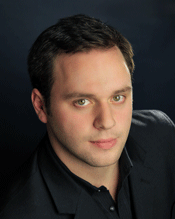 Paul Appleby [Photo by Ken Howard]
The first concert of this year’s series was devoted to youth, and
specialized accordingly in songs not merely about youth but often those
composed by very young composers, composers who went on to bigger things. But
those of us who love early Verdi operas and early Rodgers & Hart musicals
and the Grateful Dead before they were everywhere appreciated the
connoisseurship of reveling in very young Fauré and Schumann and Rorem and
Busoni and Grieg and Ives and Sondheim—and slightly older Gershwin and
Dylan. What themes inspire young composers to give a hint of how worthwhile
they will become? Is it all lindenbäumen and young love’s first
blight? Or is it … anticipation?
I first noticed Sasha Cooke when she sang the Sandman in the Met’s otherwise vocally undistinguished new Hänsel und Gretel, a moment of childlike magical glee, just right for Humperdinck. In a tiny hall like Merkin with its very live acoustic (when a small chorus sings there, you can hear each individual voice), she sounds quite different: Her voice is enormous, plush, lustrous, easily so, and perfectly supported. For most of a song recital, of course, she scales it back to merely very pretty, but whenever she reached an appropriate climax, restraint falls away like a superfluous shawl, and the results are resplendent—intimate, but hugely intimate. As an interpreter, she had the most fun becoming a small child for Ned Rorem’s “A Journey,” the bashful maiden boasting of her first conquest in Grieg’s “Verschwiegene Nachtigall,” where she slipped flawless little ornamental turns into the nightingale’s insinuating “Tandaradei,” the rather more sophisticated maiden of Hugo Wolf’s “Begegnung,” the aching hopefulness of Sondheim’s “Take Me to the World,” and—in duet with Appleby—the breathless expectant wonder and the contrasting, consummated coda of Charles Ives’s delicious “Memories” (“We’re sitting in the opera house”). She is a singing actress to anticipate and a voice to hear one of these days in a place where she can let it fly.
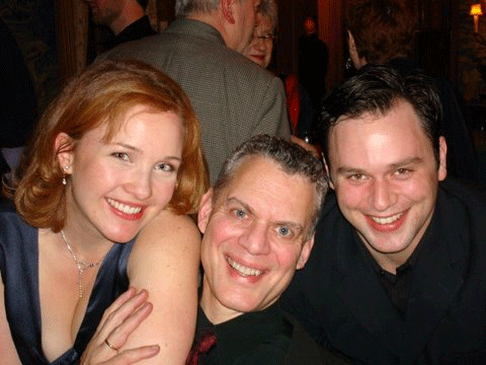 Sasha Cooke, Steven Blier and Paul Appleby
I haven’t heard Paul Appleby on the opera stage and, frankly, his voice seems (like Cooke’s) too delicious, too full-sized, too able to only be a concert singer, first rate as he is at that subtle skill. He has a smooth, supple delivery and inhabits his narrators: reveling in Schubert’s matchless invention in “Geheimnis” (Schubert was 19 at this point, almost an old master: the song is already D.491) and Vaughan Williams’s “Silent Noon.” Then, in moves and accent and exultant manner, he became with entire believability a Midwestern youth come to take the city by storm in Christopher Berg’s rollercoaster setting of Frank O’Hara’s “I’m Going to New York,” then cocky with adolescent sexual discovery in William Bolcom’s setting of Theodore Roethke’s “I Knew A Woman” and bitter with youthful disillusion in Marc Blitzstein’s “In the Clear.” His voice has power, but he holds it in reserve when portraying character; it comes out in songs like Paul Moravec’s setting of Wordsworth, “My Heart Leaps Up.”
Later concerts this season will be devoted to Songs of Gay Life and Songs of the Iberian Peninsula. Spain has been a NYFOS destination before, but we are unlikely to run low on little-known Iberian song literature anytime soon.
John Yohalem