Subscribe to
Opera Today

Receive articles and news via RSS feeds or email subscription.


twitter_logo[1].gif


UCP_9780226043425.gif

Recently in Performances

Brahms Third in San Francisco

Nicola Luisotti and the San Francisco Opera Orchestra climbed out of the War Memorial pit, braved the wind whipped bay and held spellbound an audience at Cal Performances’ Zellerbach Auditorium at UC Berkeley.

Glyndebourne: Ariadne auf Naxos

Utterly mad but absolutely right — Richard Strauss’s Ariadne auf Naxos started the Glyndebourne 2013 season with an explosion. Strauss could hardly have made his intentions more clear. Ariadne auf Naxos is not “about” Greek myth so much as a satire on art and the way art is made.

Wozzeck at ENO

“Man is an abyss. It makes one dizzy to look into it.” So utters Georg Büchner’s Woyzeck, repeating what was also a recurring motif in the playwright’s own letters.

Mulhouse: Rare Britten Well Done

National Opera Company of the Rhine has marked this year’s Benjamin Britten celebration with a remarkably compelling, often gripping new production of the seldom-seen Owen Wingrave.

Frankfurt's Intriguing Idomeneo

Once upon a time, Frankfurt Opera had the baddest ass reputation in Germany as “the” cutting edge producer of must-see opera.

Rigoletto at Lyric Opera of Chicago

Productions of Giuseppe Verdi’s Rigoletto can serve as a vehicle for individual singers to make a strong impression and become afterward associated with specific roles in the opera.

Britten Sinfonia with Ian Bostridge

Just in case we were not aware that the evening’s programme was ‘themed’, the Britten Sinfonia designed a visual accompaniment to their musical exploration of night, sleep and dreams.

Aida, Manitoba Opera

Poor Aida! She never seems to have anything go her way.

Superlative singing: Don Carlo, Royal Opera House

Is it possible to upstage Jonas Kaufmann? Kaufmann was brilliant in this Verdi Don Carlo at the Royal Opera House, London, but the rest of the cast was so good that he was but first among equals. Don Carlo is a vehicle for stars, but this time the stars were everyone on stage and in the pit. Even the solo arias, glorious as they are, grow organically out of perfect ensemble. This was a performance that brought out the true beauty of Verdi's music.

Sarah Connolly: French Song at Wigmore Hall

The big names were absent: Duparc, D’Indy, Debussy, Ravel … and while Fauré, Chausson, Roussel and several members of Les Six put in an appearance, in less than familiar guises, this survey of French song of the early 20th century and interwar years deliberately took us on a journey through infrequently travelled terrain.

Rare restoration: Handel’s Esther 1720

Composed between 1718 and 1720, Handel’s Esther is sometimes described as the ‘first English Oratorio’, but is in fact a hybrid form, mixing elements of oratorio, masque, pastoral and opera.

The Damnation of Faust, London

Hector Berlioz's légende dramatique, La Damnation de Faust, exists somewhere between cantata and opera. Berlioz's flexible attitude to dramatic form made the piece unworkable on the stages of early 19th century Paris and his music is so vivid that you wonder whether the piece needs staging at all.

Elizabeth Connell Memorial Concert, St John's Smith Square

St. John’s Smith Square was the site of Elizabeth Connell’s final London concert, intended as a farewell to London on her moving to Australia. It was rendered ultimately final by her unexpected death.

Aida with all the Trimmings, Even a Blue Silk Elephant!

With the building of the Suez Canal, Egypt became more interesting to Western Europeans. Khedive Ismail Pasha wanted a hymn by Verdi for the opening of a new opera house in Cairo, but the composer said he did not write occasional pieces.

Die Zauberflöte, Royal Opera

Back for its fourth revival, David McVicar’s 2003 production of Mozart’s Die Zauberflöte has much charm, beauty and artistry.

The Marriage of Figaro Ends Season at Arizona Opera

Wolfgang Amadeus Mozart's opera The Marriage of Figaro has a libretto by Lorenzo daPonte based on the French play La folle journée, ou le Mariage de Figaro (The Crazy Day or the Marriage of Figaro) by Pierre Caron de Beaumarchais (1732-1799).

Baden’s Flute Goes Barefoot in the Park

For its world class Easter Festival, Baden-Baden mounted a Die Zauberflöte that owed more to the grey penitential doldrums of Lent than to the unbridled jubilance of re-birth.

Bonjour M. Gauguin in Berkeley

Once Berkeley Opera, renamed West Edge Opera, this enterprising company offers the Bay Area’s only serious alternative to corporate opera, to wit Bonjour M. Gauguin.

Mahler Lieder, Wigmore Hall

In the first of pianist Julius Drake’s three-part series, ‘Perspectives’, our gaze was directed at Gustav Mahler’s eclectic musical responses to human experiences: from the trauma and distress of anguished love to the sweet contentment of true friendship, from the agonised introspection of the artist to the diverse dramas of human interaction.

Cinderella Goes to the Opera

The Los Angeles opera company marketed its spring production of Rossini's La Cenerentola as Cinderella though there is no opera by that name. The libretto of La Cenerentola is not the Cinderella story we know.

OPERA TODAY ARCHIVES »

Performances

Photo by English Touring Opera
12 Oct 2010

Promised End — English Touring Opera

In the final scene of Shakespeare’s King Lear, faced with the dreadful sight of the distraught Lear cradling in his arms the body of his dead daughter Cordelia, the Earl of Kent asks: “Is this the promised end?”

Alexander Goehr: Promised End

Lear: Roderick Earle; Goneril: Jacqueline Varsey; Regan: Julia Sporsen; Cordelia: Lisa Markeby; Gloucester: Nigel Robson; Edgar: Adrian Dwyer; Edmund: Nicholas Garrett; Knight/Servant: Jeffrey Stewart; Servant/Captain: Adam Tunnicliffe. Director: James Conway. Conductor: Ryan Wigglesworth. Designer: Adam Wiltshire. Lighting: Guy Hoare. English Touring Opera. The Aurora Orchestra. Linbury Studio, Royal Opera House, Covent Garden. Saturday 9th October 2010.

All photos courtesy of English Touring Opera


His words perhaps recall the aged Lear’s earlier hope that he might one day “Unburdened crawl towards death”. Or, as Edgar interprets, they may evoke the more terrifying image of the Day of Judgement. Whatever they infer, choosing Kent’s words as the title of an opera which — its sub-plots stripped away, its minor (and some major) characters shorn of significance — lasts less 90 minutes but which leaves the audience longing for the eponymous conclusion, is a potentially dangerous move.

It’s not that Alexander Goehr’s new opera has no musical or theatrical merits. Indeed, the first act moves briskly along and, for one unfamiliar with its poetical predecessor, raises a few interesting ideas. But, the second act rapidly loses focus; essentially this ‘personal take’ on Lear has little to say or reveal.

“It’s about old men who get it wrong when they have power and influence — and then get into a mess. That’s the reason I’m doing this opera. […] As an incipient old man myself, that’s what interest me about the story. I mean, I can do Romeo and Juliet now — I’m past that stage.’”

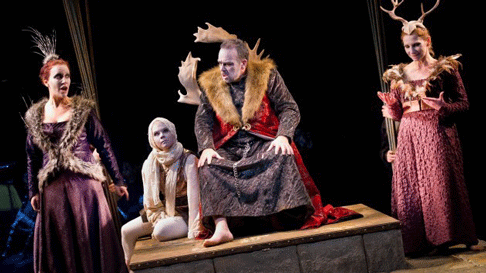
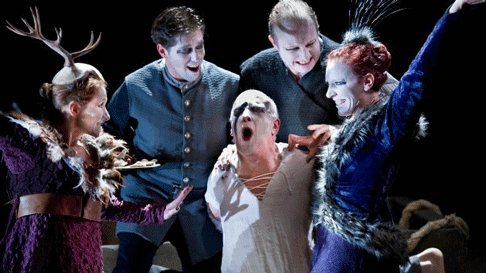
So Goehr declared in a recent interview in The Guardian, explaining his decision to tackle one of Shakespeare’s most complex, profound and disturbing plays, and one which defeated even Verdi and Britten, who abandoned long-held ambitions to compose an opera based on King Lear. Now aged 78, Goehr professes that the impetus to tackle Lear came when, suffering from depression upon retiring (reluctantly) from his Professorship at Cambridge University, he happened to have a dream in which the play was ‘staged as a Japanese Noh play’. The resulting opera mingles Noh stylizations with Elizabethan conceits but the sum of the parts lacks substance and coherence. One is reminded less of the successful cross-cultural integration of Noh practices with the medieval Mystery Plays in Britten’s church parables and rather more of the somewhat laboured device of the Male and Female Chorus in The Rape of Lucretia. Conway’s production — in which the chorus of principals stand (à la Brecht — another layer of cultural reference) white-faced and stock-still, motionlessly addressing the audience, ritually step through boxes of sand, and indulge in stylized dance movements (for example to accompany the blinding of Gloucester) — taps into the Noh clichés but offers little illumination.
Promised_End_03.gif

Indeed, the shadow of Britten hangs over this opera in more ways than one. The decision to use Shakespeare’s text verbatim recalls the approach of Britten and Pears when constructing the libretto of A Midsummer Night’s Dream. In this case, the eminent scholar, the late Frank Kermode, fashioned a libretto which Goehr has arranged in ’24 preludes’. But, while reducing the work to a manageable length — excising several (essential?) aspects of the drama and focusing on the central exchange between Lear and Gloucester — this still leaves the problem of how to find an appropriate melodic idiom for Shakespeare’s poetry. Goehr’s rather spiritless arioso simply does not convey the rich depths and meanings embodied in the sounds and rhythms of the spoken play. Moreover, the composer’s re-ordering of various episodes destroys the narrative coherence and makes it near impossible for anyone lacking knowledge of the original play to follow the psychological development.

The singers and players of English Touring Opera do their best. Lisa Markeby, playing both Cordelia and the Fool — a now familiar theatrical device — is appealing, but she is not given the opportunity to develop and express the full extent of her inner goodness. And, while the expressive focus of the opera is supposedly the meeting of the two foolish old men, Lear and Gloucester, now chastened and wiser as they reflect on their short-comings, the musical fabric fails to convey their supposed transformation. Roderick Earle bellows and blusters as an aggressive Lear, his scenes with Nigel Robson (Gloucester) lacking genuine emotional depth and sincerity. As Edgar, Adrian Dwyer is convincing and impressive. Goneril (Jacqueline Varsey) and Regan (Julia Sporsen) are not musically differentiated and have little dramatic role to play.
Promised_End_04.gif

Ryan Wigglesworth draws clear lines and textures from his band, the Aurora Orchestra. Goehr does create some interesting colours, not least through his use of the chamber organ and guitar — which evoke fittingly Elizabethan timbres — but the composite impression is one of episodic, unrelated colourings designed to fill the gaps between scenes.

In his programme note, Goehr asks for the audience’s indulgence: “So it remains only for me to say, that you will not be home too late and ask that by your clapping you show some approval for what has been done here.” This seems to me to be a patronising appeal to an audience that may long for a less superficial musical response to a play that interrogates essential questions of human existence.

Promised End is at the Linbury Studio at the Royal Opera House, London on 11, 14, 16 October and then tours until 26 November. For touring details see www.englishtouringopera.org.uk.

Claire Seymour
Send to a friend

Send a link to this article to a friend with an optional message.

Friend's Email Address: (required)

Your Email Address: (required)

Message (optional):