![Dmitri Hvorostovsky as Rigoletto [Photo by Johan Persson courtesy of Royal Opera]](http://www.operatoday.com/RIG-2010JP_00584-HVOROSTOVS.gif)
16 Oct 2010
Rigoletto at Covent Garden
Dame Joan Sutherland, ‘La Stupenda’, sang her first Gilda at Covent Garden in 1957 under the baton of Sir Edward Downes, and sang the role many times and to great acclaim on the ROH stage.
English Touring Opera are delighted to announce a season of lyric monodramas to tour nationally from October to December. The season features music for solo singer and piano by Argento, Britten, Tippett and Shostakovich with a bold and inventive approach to making opera during social distancing.
This tenth of ten Live from London concerts was in fact a recorded live performance from California. It was no less enjoyable for that, and it was also uplifting to learn that this wasn’t in fact the ‘last’ LfL event that we will be able to enjoy, courtesy of VOCES8 and their fellow vocal ensembles (more below …).
Ever since Wigmore Hall announced their superb series of autumn concerts, all streamed live and available free of charge, I’d been looking forward to this song recital by Ian Bostridge and Imogen Cooper.
Although Stile Antico’s programme article for their Live from London recital introduced their selection from the many treasures of the English Renaissance in the context of the theological debates and upheavals of the Tudor and Elizabethan years, their performance was more evocative of private chamber music than of public liturgy.
Evidently, face masks don’t stifle appreciative “Bravo!”s. And, reducing audience numbers doesn’t lower the volume of such acclamations. For, the audience at Wigmore Hall gave soprano Elizabeth Llewellyn and pianist Simon Lepper a greatly deserved warm reception and hearty response following this lunchtime recital of late-Romantic song.
For this week’s Live from London vocal recital we moved from the home of VOCES8, St Anne and St Agnes in the City of London, to Kings Place, where The Sixteen - who have been associate artists at the venue for some time - presented a programme of music and words bound together by the theme of ‘reflection’.
'Such is your divine Disposation that both you excellently understand, and royally entertaine the Exercise of Musicke.’
‘And there was war in heaven: Michael and his angels fought against the dragon; and the dragon fought and his angels, And prevailed not; neither was their place found any more in heaven … that old serpent … Satan, which deceiveth the whole world: he was cast out into the earth, and his angels were cast out with him.’
There was never any doubt that the fifth of the twelve Met Stars Live in Concert broadcasts was going to be a palpably intense and vivid event, as well as a musically stunning and theatrically enervating experience.
‘Love’ was the theme for this Live from London performance by Apollo5. Given the complexity and diversity of that human emotion, and Apollo5’s reputation for versatility and diverse repertoire, ranging from Renaissance choral music to jazz, from contemporary classical works to popular song, it was no surprise that their programme spanned 500 years and several musical styles.
The Academy of St Martin in the Fields have titled their autumn series of eight concerts - which are taking place at 5pm and 7.30pm on two Saturdays each month at their home venue in Trafalgar Square, and being filmed for streaming the following Thursday - ‘re:connect’.
The London Symphony Orchestra opened their Autumn 2020 season with a homage to Oliver Knussen, who died at the age of 66 in July 2018. The programme traced a national musical lineage through the twentieth century, from Britten to Knussen, on to Mark-Anthony Turnage, and entwining the LSO and Rattle too.
With the Live from London digital vocal festival entering the second half of the series, the festival’s host, VOCES8, returned to their home at St Annes and St Agnes in the City of London to present a sequence of ‘Choral Dances’ - vocal music inspired by dance, embracing diverse genres from the Renaissance madrigal to swing jazz.
Just a few unison string wriggles from the opening of Mozart’s overture to Le nozze di Figaro are enough to make any opera-lover perch on the edge of their seat, in excited anticipation of the drama in music to come, so there could be no other curtain-raiser for this Gala Concert at the Royal Opera House, the latest instalment from ‘their House’ to ‘our houses’.
"Before the ending of the day, creator of all things, we pray that, with your accustomed mercy, you may watch over us."
The doors at The Metropolitan Opera will not open to live audiences until 2021 at the earliest, and the likelihood of normal operatic life resuming in cities around the world looks but a distant dream at present. But, while we may not be invited from our homes into the opera house for some time yet, with its free daily screenings of past productions and its pay-per-view Met Stars Live in Concert series, the Met continues to bring opera into our homes.
Music-making at this year’s Grange Festival Opera may have fallen silent in June and July, but the country house and extensive grounds of The Grange provided an ideal setting for a weekend of twelve specially conceived ‘promenade’ performances encompassing music and dance.
There’s a “slide of harmony” and “all the bones leave your body at that moment and you collapse to the floor, it’s so extraordinary.”
“Music for a while, shall all your cares beguile.”
The hum of bees rising from myriad scented blooms; gentle strains of birdsong; the cheerful chatter of picnickers beside a still lake; decorous thwacks of leather on willow; song and music floating through the warm evening air.
Dame Joan Sutherland, ‘La Stupenda’, sang her first Gilda at Covent Garden in 1957 under the baton of Sir Edward Downes, and sang the role many times and to great acclaim on the ROH stage.
The pre-performance announcement by ROH’s director, Elaine Padmore, of the sad death of this great soprano added an extra layer of emotional urgency to this revival of David McVicar’s now almost canonical production of Verdi’s Rigoletto.
David McVicar’s eighteenth-century Mantua is a hothouse of Bacchanalian orgies and Machiavellian deceit. Michael Vale’s Olivier-award nominated sets — transparent, spinning edifices, all crumbling stone, shadowy recesses and askew perspectives — powerfully suggest the literal and figurative decay of a city on the verge of moral collapse, and are complemented by the flaming reds and oranges of Tanya McCallin’s raunchy costumes for the opening Scene 1 which evoke Dante’s infernal realms. Nudity and violence, often combined, abound. Out of these fiery depths leaps a black leather-clad Rigoletto - a horned devil, spitting fury and curses. Fearlessly physical, Dmitri Hvorostovsky, usually seen in rather more suave and sophisticated guises, emits a startling viciousness and ferocity, foreshadowing the inhumanity to which the eponymous jester’s desire for all-consuming vengeance will subsequently propel him. Boundless stamina combined with limitless variety — now sweetly tender when recalling his wife, then cruelly bitter as his obsessive rage engulfs him — characterise a remarkable performance. Hvorostovsky is not afraid to push his baritone to its rougher edges, while his ability to spin an endless lyrical line never ceases to amaze and thrill.
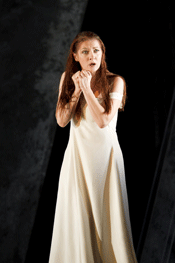 Patrizia Ciofi as Gilda
The shadow of the late lamented diva placed a heavy mantle on the shoulders
of Patrizia Ciofi as this production’s Gilda. She took a little time to
settle, occasionally sliding up or slipping down to notes at first, and at
times employing an overly wide vibrato which supported her projection but
muddied the intonation. But Ciofi is an experienced Gilda, well-versed in the
idiom, confident in delivery, and she soon found her focus; her pristine tone
captured the near-hysterical ecstasy of the young girl experiencing the pain of
passion for the first time, and she dispatched ‘Caro nome’ with
aplomb, revealing a true coloratura with seamless passagio. Paul
Constable’s imaginative lighting added some exquisite touches to poignant
moments. Thus at the end of Gilda’s first aria, the stage revolved
casting subtle shadows and revealing subdued corners, as Gilda slowly mounts
the crooked stairs to the attic hovel, her voice heartbreakingly waning with
the fading light. Clothed in virginal white against his darker hues,
Ciofi’s duets with Hvorostovsky were impassioned and penetrating, the
latter’s mastery of the uninterrupted, arching melodic curves of
Verdi’s score suggesting the heartfelt intensity of a paternal love which
both protects and suffocates.
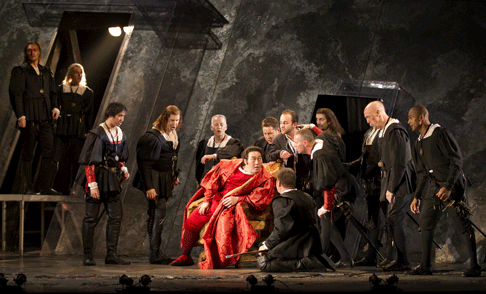 Wookyung Kim as Duke of Mantua
Korean tenor Wookyung Kim made his debut at the ROH in 2007 as the Duke of Mantua, and returned to reprise the role. Despite his musical prowess — unfailingly legato lines and even tone production — theatrically, he does not make for a natural Casanova. His interpretation is a little one-sided, fresh naivety not really matched by the requisite careless, even wicked, wilfulness.
Indeed, many of the cast were veterans of this production, and all held their own well in the company of the leading lights. The big, bold bass of Raymond Aceto emphasised Sparafucile’s sinister and twisted motivations. Mezzo-soprano Daniela Innamorati was a convincingly seductive Maddalena in the renowned quartet, her warm tone complementing the blending voices. Amid the ubiquitous debauchery and vice, it was hard for Michael Druiett as Monterone — who only appears twice in the opera — to make much of a mark as the voice of moral authority, but he was secure. Both of the Jette Parker Young Artists in this production also performed with accomplishment: Polish baritone, Lukas Jakobski, was a solid Ceprano, while the bright baritone of Zhenzhong Zhou as Marullo made a strong impression in a small role.
The young Israeli conductor, Dan Ettinger, making an impressive Covent Garden debut, really kept his foot on the pedal from the first downbeat, racing through the opening scene, injecting a terrifying air of menace, and sustaining the dramatic drive and frisson of risk and recklessness throughout. The opera rushed relentlessly on to its disturbing climax: Hvorostovsky’s terrible exultation over the dead body of his daughter. His perverted elation, in his belief that the dead Duke lies slain in the sack before him, is a disquieting moment of hubris.
McVicar presents a dystopian vision of crooked criminality and raw cruelty. If his vision underplays the balanced contrast between the light and the dark which, I believe, accounts for much of the emotional piquancy of Verdi’s opera, in favour of an unremittingly malevolence, it does so with an admirably precise and sustained focus. A first rate evening.
Claire Seymour