![Steven Page as Professor Filipp Filippovich Preobrazhensky [Photo by Stephen Cummiskey courtesy of English National Opera]](http://www.operatoday.com/DogHeart01.gif)
23 Nov 2010
A Dog’s Heart, ENO
Three cheers — at the very least — for the English National Opera!
English Touring Opera are delighted to announce a season of lyric monodramas to tour nationally from October to December. The season features music for solo singer and piano by Argento, Britten, Tippett and Shostakovich with a bold and inventive approach to making opera during social distancing.
This tenth of ten Live from London concerts was in fact a recorded live performance from California. It was no less enjoyable for that, and it was also uplifting to learn that this wasn’t in fact the ‘last’ LfL event that we will be able to enjoy, courtesy of VOCES8 and their fellow vocal ensembles (more below …).
Ever since Wigmore Hall announced their superb series of autumn concerts, all streamed live and available free of charge, I’d been looking forward to this song recital by Ian Bostridge and Imogen Cooper.
Although Stile Antico’s programme article for their Live from London recital introduced their selection from the many treasures of the English Renaissance in the context of the theological debates and upheavals of the Tudor and Elizabethan years, their performance was more evocative of private chamber music than of public liturgy.
Evidently, face masks don’t stifle appreciative “Bravo!”s. And, reducing audience numbers doesn’t lower the volume of such acclamations. For, the audience at Wigmore Hall gave soprano Elizabeth Llewellyn and pianist Simon Lepper a greatly deserved warm reception and hearty response following this lunchtime recital of late-Romantic song.
For this week’s Live from London vocal recital we moved from the home of VOCES8, St Anne and St Agnes in the City of London, to Kings Place, where The Sixteen - who have been associate artists at the venue for some time - presented a programme of music and words bound together by the theme of ‘reflection’.
'Such is your divine Disposation that both you excellently understand, and royally entertaine the Exercise of Musicke.’
‘And there was war in heaven: Michael and his angels fought against the dragon; and the dragon fought and his angels, And prevailed not; neither was their place found any more in heaven … that old serpent … Satan, which deceiveth the whole world: he was cast out into the earth, and his angels were cast out with him.’
There was never any doubt that the fifth of the twelve Met Stars Live in Concert broadcasts was going to be a palpably intense and vivid event, as well as a musically stunning and theatrically enervating experience.
‘Love’ was the theme for this Live from London performance by Apollo5. Given the complexity and diversity of that human emotion, and Apollo5’s reputation for versatility and diverse repertoire, ranging from Renaissance choral music to jazz, from contemporary classical works to popular song, it was no surprise that their programme spanned 500 years and several musical styles.
The Academy of St Martin in the Fields have titled their autumn series of eight concerts - which are taking place at 5pm and 7.30pm on two Saturdays each month at their home venue in Trafalgar Square, and being filmed for streaming the following Thursday - ‘re:connect’.
The London Symphony Orchestra opened their Autumn 2020 season with a homage to Oliver Knussen, who died at the age of 66 in July 2018. The programme traced a national musical lineage through the twentieth century, from Britten to Knussen, on to Mark-Anthony Turnage, and entwining the LSO and Rattle too.
With the Live from London digital vocal festival entering the second half of the series, the festival’s host, VOCES8, returned to their home at St Annes and St Agnes in the City of London to present a sequence of ‘Choral Dances’ - vocal music inspired by dance, embracing diverse genres from the Renaissance madrigal to swing jazz.
Just a few unison string wriggles from the opening of Mozart’s overture to Le nozze di Figaro are enough to make any opera-lover perch on the edge of their seat, in excited anticipation of the drama in music to come, so there could be no other curtain-raiser for this Gala Concert at the Royal Opera House, the latest instalment from ‘their House’ to ‘our houses’.
"Before the ending of the day, creator of all things, we pray that, with your accustomed mercy, you may watch over us."
The doors at The Metropolitan Opera will not open to live audiences until 2021 at the earliest, and the likelihood of normal operatic life resuming in cities around the world looks but a distant dream at present. But, while we may not be invited from our homes into the opera house for some time yet, with its free daily screenings of past productions and its pay-per-view Met Stars Live in Concert series, the Met continues to bring opera into our homes.
Music-making at this year’s Grange Festival Opera may have fallen silent in June and July, but the country house and extensive grounds of The Grange provided an ideal setting for a weekend of twelve specially conceived ‘promenade’ performances encompassing music and dance.
There’s a “slide of harmony” and “all the bones leave your body at that moment and you collapse to the floor, it’s so extraordinary.”
“Music for a while, shall all your cares beguile.”
The hum of bees rising from myriad scented blooms; gentle strains of birdsong; the cheerful chatter of picnickers beside a still lake; decorous thwacks of leather on willow; song and music floating through the warm evening air.
Three cheers — at the very least — for the English National Opera!
‘The current climate’ is a dreary, defeatist phrase, generally an excuse for enemies of all that it is to be human to diminish our humanity further; nevertheless, it seems to inform so much of what we do and even hope for at the moment, that to have a new opera by an un-starry Russian composer, of whom most of the audience most likely will never have heard, performed at the Coliseum is worth a cheer or two in itself. (The current practice of many companies and orchestras in parochially commissioning works only from British artists is unworthy of organisations that would claim a place upon the world stage.) A couple more cheers — again, at least — must be granted the show’s resounding theatrical success. For more than anything else this is a triumph for Simon McBurney and Complicite. After a number of false starts in its current mission to import values from the non-operatic theatre, however one wishes to term it, ENO, in collaboration with the co-producing Holland Festival, really hits the target this time.
A fuller synopsis can be found elsewhere, but briefly, A Dog’s Heart reworks Mikhail Bulgakov’s satire. Cesare Mazzonis’s libretto is here translated by Martin Pickard. The opera opens with a stray dog — the superb puppet work inspired by Alberto Giacometti (click here for the sculpture in question) — mistreated by men, apparently rescued and promised a dog’s paradise by a distinguished scientist, Professor Filipp Filippovich Preobrazhensky. The parallelism between the new workers’ state and the animal’s condition is revealingly maintained and deepened throughout, likewise the repellent superior pretensions of Preobrazhensky — the name will be familiar to students of Bolshevism and Stalinism — both as scientist and as human. Eventually, the professor sees his chance for true scientific glory. Having fed up the dog, whom he has named Sharik, he transplants human testicles and a pituitary gland, to create a ‘new man’, Sharikov. Sharikov’s antics leave him, the professor notes, at the most rudimentary evolutionary level, yet that is hardly Sharikov’s fault; indeed he garners hope from association with proletarian organisations, further horrifying his creator. The professor disowns him and conducts a second operation. The creature is once again a ‘mere’ dog. I could not help wondering about a potential English play on words: is the dog man another representation of our desire to create a god man?
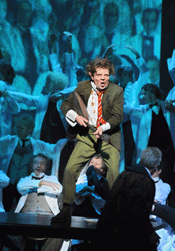 Peter Hoare as Sharikov
What marks A Dog’s Heart out from many collaborations is that
it was collaborative from the beginning, a joint project involving composer,
librettist, and Complicite. This tells; I suspected it must have been so before
I discovered that it was. A true sense of theatre is present from the very
outset, the opera opening without warning. Pacing is keen throughout and the
stage direction puts most to shame. The puppetry, previously mentioned, is
wonderful — this includes a cat, whom Sharikov cannot help but chase
— but so are mechanics such as scene changing, so often something hapless
to endure in the opera house. Sets from Michael Levine and his assistant, Luis
Carvalho, are exemplary: never fussy, but evocative both of period and of their
stage in the drama. The grandeur of the professor’s rooms — envied
by the proletarian house committee, but our scientist has friends in high
places — provides an apt link with an older Moscow, whilst Finn
Ross’s NEP-style projections make clear what has changed. The silhouetted
— in part — operation was very well handled, bringing subsequent
gore into greater relief.
This is, to my knowledge, the only opera whose first act closes with the injunction, ‘Suck my cock!’ Why, in the supertitles, coyly write ‘c*unt’ thus, when everyone could hear the word, and why suppose, especially in such a context, that the sensibilities of Daily Mail readers should be considered? The ‘profane language’ is not, in that bizarre circumlocution, ‘gratuitous’, but integral to the plot, above all to the dog-man’s characterisation. Where it can somewhat irritate in Ligeti’s Le grand macabre — though there is, of course, Dadaist (un-)reason for it there too — it would be several suburbanisms too far for anyone to object in the present case.
Music, it must be said, takes second billing, though that is not a unique phenomenon: Gérard Mortier’s parting shot at the Opéra national de Paris, Am Anfang, billed Anselm Kiefer’s installation before Jörg Widmann’s score, and Widmann is a more famed composer than Alexander Raskatov. And yet, though I flatter myself that I can be called a musician, I did not mind, which must say something about the sum of the parts. It was far from easy to discern where one ‘contribution’ began and another stopped. For instance, doubling of parts seemed to have a point beyond economy. This is not Lulu; there was none of Berg’s carefully-crafted parallelism and symmetry. But the taking on of different roles said something about anonymity, appearance from and disappearance into the proletarian crowd, and Warhol-like moments in the limelight.
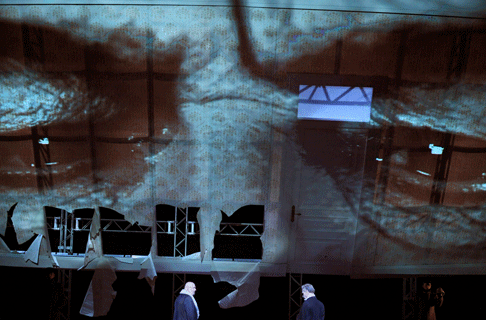 Steven Page as Professor Filipp Filippovich Preobrazhensky and Graeme Danby as Fyodor/Newspaper Seller/Big Boss
I cannot imagine wishing to hear to Raskatov’s score outside the theatre — and whilst I should definitely be tempted by a subsequent dramatic project, I should find it difficult to evince enthusiasm for hearing his music in the concert hall. Nevertheless, it works in the theatre. (People say that of Verdi, but that apparent success has always eluded me.) It is recognisably ‘Russian’- sounding, closer perhaps to Schnittke than anyone else, though there may be other influences of whose work I am simply unaware. Often somewhat cartoonish, it occupies its (relatively) subordinate role cheerfully and has its individualistic moments, for instance in the use of bass guitar. Connections to earlier Russian composers are manifest too. This is not Prokofiev (certainly not Prokofiev at his operatic best, for instance The Gambler or The Fiery Angel), but it is a good deal more entertaining than most Shostakovich — or Schnittke, for that matter. I cannot say that I could hear much, or any, influence from late Stravinsky or Webern, such as David Nice suggested in his otherwise helpful programme note. (Incidentally — actually, not incidentally, but importantly — the programme features, McBurney’s contributions included, were of an unusually high standard.) Thinning of textures on certain occasions aside, it was difficult to discern any kinship with the iron discipline of those serialist masters. But Raskatov’s closed forms, whilst obvious, exert their own dramatic impetus in tandem with the events on stage, even if the vocal writing — melismata, scalic passages, and so on — swiftly becomes predictable. A passcaglia signals darkening of mood, likewise the odd Mussorgskian choral moment: again, perhaps, predictable, yet again, perhaps, ‘effective’: a word I recall my A-level music teacher counselling against using, but here undeniably ‘effective’.
Garry Walker’s command of the score sounded exemplary. The sweeping dramatic drive he imparted made me keen to hear him back at the Coliseum very soon. He certainly knew how to bring the best out of the excellent ENO Orchestra — who deserved a good number of cheers of their own. The musicians played their hearts out — perhaps an unfortunate metaphor in the context of the present work — so much as to make one tempted truly to believe in Raskatov’s score. Steven Page presented a convincing dramatic portrayal of Preobrazhensky’s dilemma: no hint of caricature here, though the vibrato may have proved a little much for some tastes. Peter Hoare did likewise, albeit in very different manner, for Sharikov, repelling and provoking sympathy. Other noteworthy performances included the aburdist coloratura part of Zina the maid (Nancy Allen Lundy) and the grotesque cameo of Frances McCafferty’s elderly Second Patient. How could anyone refuse? How could anyone not? The dog as dog has two voices: unpleasant, the distorted, loud-speaker-hailing soprano Elena Vassileva (also impressive as the professor’s housekeeper, Darya Petrovna), and pleasant, the fine counter-tenor, Andrew Watts. There was certainly no finer musicianship on stage than that of Watts, whose plangent tones inspired the most genuine sympathy of all without sentimentalising.
The theatre seemed full and the audience responded enthusiastically. I saw two composers — Raskatov aside — so I suspect there will have been more. So no, this was not a musical event to rank with the recent premiere of Alexander Goehr’s Promised End — English Touring Opera’s initiative rightly described by Michael Tanner in The Spectator as ‘astoundingly heroic’ — but as a musico-theatrical event, it scored very highly. Unlike, say, the dismal recent Rufus Norris Don Giovanni, which, had ‘theatre people’ come to see it, might well have put them off opera for life, this might just have intrigued some of them to explore musical drama further. Our political and financial masters would never understand this, let alone agree, but that is something to which one cannot affix a price.
Mark Berry