![Plácido Domingo as Cyrano de Bergerac [Photo by Cory Weaver courtesy of San Francisco Opera]](http://www.operatoday.com/Domingo1.png)
02 Nov 2010
Cyrano de Bergerac in San Francisco
Franco Alfano’s Cyrano de Bergerac at the San Francisco Opera has little chance of measuring up to a Cyrano standard once set here in Fog City.
English Touring Opera are delighted to announce a season of lyric monodramas to tour nationally from October to December. The season features music for solo singer and piano by Argento, Britten, Tippett and Shostakovich with a bold and inventive approach to making opera during social distancing.
This tenth of ten Live from London concerts was in fact a recorded live performance from California. It was no less enjoyable for that, and it was also uplifting to learn that this wasn’t in fact the ‘last’ LfL event that we will be able to enjoy, courtesy of VOCES8 and their fellow vocal ensembles (more below …).
Ever since Wigmore Hall announced their superb series of autumn concerts, all streamed live and available free of charge, I’d been looking forward to this song recital by Ian Bostridge and Imogen Cooper.
The Sixteen continues its exploration of Henry Purcell’s Welcome Songs for Charles II. As with Robert King’s pioneering Purcell series begun over thirty years ago for Hyperion, Harry Christophers is recording two Welcome Songs per disc.
Although Stile Antico’s programme article for their Live from London recital introduced their selection from the many treasures of the English Renaissance in the context of the theological debates and upheavals of the Tudor and Elizabethan years, their performance was more evocative of private chamber music than of public liturgy.
In February this year, Albanian soprano Ermonela Jaho made a highly lauded debut recital at Wigmore Hall - a concert which both celebrated Opera Rara’s 50th anniversary and honoured the career of the Italian soprano Rosina Storchio (1872-1945), the star of verismo who created the title roles in Leoncavallo’s La bohème and Zazà, Mascagni’s Lodoletta and Puccini’s Madama Butterfly.
Evidently, face masks don’t stifle appreciative “Bravo!”s. And, reducing audience numbers doesn’t lower the volume of such acclamations. For, the audience at Wigmore Hall gave soprano Elizabeth Llewellyn and pianist Simon Lepper a greatly deserved warm reception and hearty response following this lunchtime recital of late-Romantic song.
Collapsology. Or, perhaps we should use the French word ‘Collapsologie’ because this is a transdisciplinary idea pretty much advocated by a series of French theorists - and apparently, mostly French theorists. It in essence focuses on the imminent collapse of modern society and all its layers - a series of escalating crises on a global scale: environmental, economic, geopolitical, governmental; the list is extensive.
For this week’s Live from London vocal recital we moved from the home of VOCES8, St Anne and St Agnes in the City of London, to Kings Place, where The Sixteen - who have been associate artists at the venue for some time - presented a programme of music and words bound together by the theme of ‘reflection’.
'Such is your divine Disposation that both you excellently understand, and royally entertaine the Exercise of Musicke.’
Amongst an avalanche of new Mahler recordings appearing at the moment (Das Lied von der Erde seems to be the most favoured, with three) this 1991 Mahler Second from the 2nd Kassel MahlerFest is one of the more interesting releases.
‘And there was war in heaven: Michael and his angels fought against the dragon; and the dragon fought and his angels, And prevailed not; neither was their place found any more in heaven … that old serpent … Satan, which deceiveth the whole world: he was cast out into the earth, and his angels were cast out with him.’
If there is one myth, it seems believed by some people today, that probably needs shattering it is that post-war recordings or performances of Wagner operas were always of exceptional quality. This 1949 Hamburg Tristan und Isolde is one of those recordings - though quite who is to blame for its many problems takes quite some unearthing.
There was never any doubt that the fifth of the twelve Met Stars Live in Concert broadcasts was going to be a palpably intense and vivid event, as well as a musically stunning and theatrically enervating experience.
‘Love’ was the theme for this Live from London performance by Apollo5. Given the complexity and diversity of that human emotion, and Apollo5’s reputation for versatility and diverse repertoire, ranging from Renaissance choral music to jazz, from contemporary classical works to popular song, it was no surprise that their programme spanned 500 years and several musical styles.
The Academy of St Martin in the Fields have titled their autumn series of eight concerts - which are taking place at 5pm and 7.30pm on two Saturdays each month at their home venue in Trafalgar Square, and being filmed for streaming the following Thursday - ‘re:connect’.
The London Symphony Orchestra opened their Autumn 2020 season with a homage to Oliver Knussen, who died at the age of 66 in July 2018. The programme traced a national musical lineage through the twentieth century, from Britten to Knussen, on to Mark-Anthony Turnage, and entwining the LSO and Rattle too.
With the Live from London digital vocal festival entering the second half of the series, the festival’s host, VOCES8, returned to their home at St Annes and St Agnes in the City of London to present a sequence of ‘Choral Dances’ - vocal music inspired by dance, embracing diverse genres from the Renaissance madrigal to swing jazz.
Just a few unison string wriggles from the opening of Mozart’s overture to Le nozze di Figaro are enough to make any opera-lover perch on the edge of their seat, in excited anticipation of the drama in music to come, so there could be no other curtain-raiser for this Gala Concert at the Royal Opera House, the latest instalment from ‘their House’ to ‘our houses’.
"Before the ending of the day, creator of all things, we pray that, with your accustomed mercy, you may watch over us."
Franco Alfano’s Cyrano de Bergerac at the San Francisco Opera has little chance of measuring up to a Cyrano standard once set here in Fog City.
There are those of us who remember the San Francisco American Conservatory Theater’s Peter Donat as Cyrano and his Roxanne, Marsha Mason, unleashing floods of spellbinding lyricism in the Geary Theater. This was back in the 1970‘s, the mere recollection sets the local Cyrano benchmark impossibly high.
Cyrano the seventeenth century dramatist and Cyrano, Edmund Rostrand’s Belle Époque hero dealt in the spoken word. The rhythm and music is already there. Franco Alfano, a twentieth century post-Romantic opera composer adds only more opulence to Rostrand’s 1898 already opulently verbal masterpiece but he cannot surmount Rostrand’s lyrical flights — his extravagant music simply overwhelms the more modest art form.
Near the end of his long life Henri Caïn (Massenet’s well-experienced librettist) provided Alfano with this easily workable libretto of Rostrand’s Cyrano, each act with its central lyrical episode surrounded by lively battle scenes. Alfano’s advanced Romantic compositional technique responded to these scenes with music that rivals Meistersinger’s midsummer night’s riot and Otello’s storm, and this complex, descriptive music is indeed effective. But when Alfano wishes to describe emotions his music teeters on the edge of insincerity as its sheer size and sheen betrays all intimacy.
Enter the grand old man of opera, Plácido Domingo, veteran of opera’s greatest lyric moments! Though now he is too old to be Cyrano his presence alone is enough to enliven the lyric muse. And perhaps he has always been Cyrano, his art coming so easily to him that it can become real only in the person of another, a character he plays. In the Rostrand Cyrano it is handsome, young Christian who takes his voice. But Domingo is no longer young, and perhaps this does not matter as Rostrand has his Cyrano die fourteen years after this torrid love poetry is spoken, and now, near death most movingly repeated by the aged tenorissimo.
Just last year this Cyrano was produced at the Châtelet theater in Paris. It is rare that the Châtelet produces, preferring to search out productions of opera and music theater that are famous or infamous and need therefore to be seen in Paris. So this Cyrano was conceived as a boutique production to compete with the rarest and finest of Europe’s opera productions.
It has survived its translocation to San Francisco, no longer a boutique production here but as part of a repertory season. It profits greatly from San Francisco Opera’s superb orchestra that overcame with ease the difficult score and made Alfano’s descriptive music glow at the direction of St. Etienne’s Patrick Fournillier, a Massenet specialist. Both the Roxanne, Ainhoa Arteta, and her lover Christian, Thiago Arancam are from the Domingo cadre. Mme. Arteta provides a lovely figure as Cyrano’s muse but her fine soprano does not possess the beauty of tone one could wish for Roxanne. The same could be said of tenor Arancam who otherwise made a good Christian.
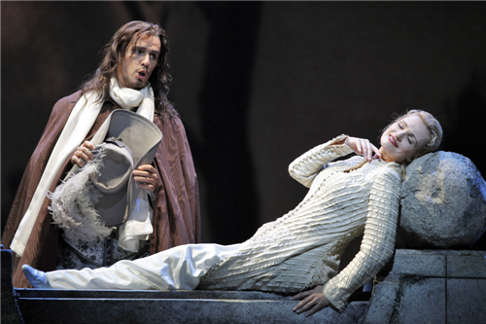 Thiago Arancam as Christian and Ainhoa Arteta as Roxane
The supporting roles may not have a panache equal to their Parisian counterparts but showed San Francisco Opera as a truly fine ensemble company, specifically the villain De Guiche sung by Stephen Powell, the baker Ragueneau sung by Brian Mulligan who here proves that he belongs in character roles, and the lieutenant Le Bret sung by Timothy Mix. The drunken Bojan Knezevic stands out as well, as do Adler Fellows Austin Kness and Maya Lahyani in various roles.
The Châtelet Cyrano is above all else cinematic, a style that well fits the swashbuckling Cyrano (well, he did manage some fairly quick moves) with very flashy swordsmanship surprisingly executed without mishap by eight fencing acrobats. The cinematic staging also pointed out the cinematic nature of Alfani’s intimate music, small movements of spirit sonically magnified to full-screen proportion. What was once verismo was by the mid 1930‘s neo-verismo well on its way to becoming movie melodrama.
Romanian opera director Petrika Ionesco staged this Cyrano de Bergerac in the way that Parisians love — nostalgic longing for the bloodiest and the artiest moments of their history, and a dose of kitsch as well. Mr. Ionesco has staged both Aida and Nabucco at the 80,000 seat Stadt de France and The Millennium Project and Continents on Parade at EuroDisney (near Paris). Here is a man that knows pageantry.
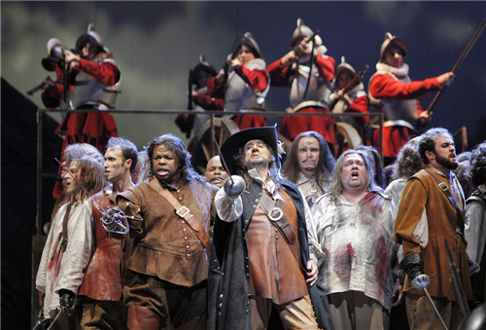 Lester Lynch as Carbon, Plácido Domingo as Cyrano de Bergerac and the soldiers
Colorful theater, good opera and one of San Francisco Opera’s finer recent moments.
Roberto Alagna was the Cyrano in the Opéra National de Montpellier’s Alfano Cyrano in 2008. No doubt a San Francisco debut by this tenor would generate an enthusiasm equal to that of this Domingo return (if not the nostalgia). For the record the Festival de Radio France et Montpellier revived several late verismo operas in the early years of this new century, notably operas by Alfani, Franchetti, and Mascagni.
Michael Milenski