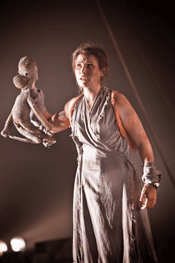
![Elisabeth Meister as Constanza [Photo by Johan Persson courtesy of The Royal Opera]](http://www.operatoday.com/ISOLA---00086-MEISTER-AS-CO.gif)
02 Nov 2010
Haydn: L’isola disabitata, London
Haydn’s L’isola disabitata is ideally suited to the modern taste for chamber opera. This is Haydn for those who think they don’t like his operas or even baroque form.
English Touring Opera are delighted to announce a season of lyric monodramas to tour nationally from October to December. The season features music for solo singer and piano by Argento, Britten, Tippett and Shostakovich with a bold and inventive approach to making opera during social distancing.
This tenth of ten Live from London concerts was in fact a recorded live performance from California. It was no less enjoyable for that, and it was also uplifting to learn that this wasn’t in fact the ‘last’ LfL event that we will be able to enjoy, courtesy of VOCES8 and their fellow vocal ensembles (more below …).
Ever since Wigmore Hall announced their superb series of autumn concerts, all streamed live and available free of charge, I’d been looking forward to this song recital by Ian Bostridge and Imogen Cooper.
The Sixteen continues its exploration of Henry Purcell’s Welcome Songs for Charles II. As with Robert King’s pioneering Purcell series begun over thirty years ago for Hyperion, Harry Christophers is recording two Welcome Songs per disc.
Although Stile Antico’s programme article for their Live from London recital introduced their selection from the many treasures of the English Renaissance in the context of the theological debates and upheavals of the Tudor and Elizabethan years, their performance was more evocative of private chamber music than of public liturgy.
In February this year, Albanian soprano Ermonela Jaho made a highly lauded debut recital at Wigmore Hall - a concert which both celebrated Opera Rara’s 50th anniversary and honoured the career of the Italian soprano Rosina Storchio (1872-1945), the star of verismo who created the title roles in Leoncavallo’s La bohème and Zazà, Mascagni’s Lodoletta and Puccini’s Madama Butterfly.
Evidently, face masks don’t stifle appreciative “Bravo!”s. And, reducing audience numbers doesn’t lower the volume of such acclamations. For, the audience at Wigmore Hall gave soprano Elizabeth Llewellyn and pianist Simon Lepper a greatly deserved warm reception and hearty response following this lunchtime recital of late-Romantic song.
Collapsology. Or, perhaps we should use the French word ‘Collapsologie’ because this is a transdisciplinary idea pretty much advocated by a series of French theorists - and apparently, mostly French theorists. It in essence focuses on the imminent collapse of modern society and all its layers - a series of escalating crises on a global scale: environmental, economic, geopolitical, governmental; the list is extensive.
For this week’s Live from London vocal recital we moved from the home of VOCES8, St Anne and St Agnes in the City of London, to Kings Place, where The Sixteen - who have been associate artists at the venue for some time - presented a programme of music and words bound together by the theme of ‘reflection’.
'Such is your divine Disposation that both you excellently understand, and royally entertaine the Exercise of Musicke.’
Amongst an avalanche of new Mahler recordings appearing at the moment (Das Lied von der Erde seems to be the most favoured, with three) this 1991 Mahler Second from the 2nd Kassel MahlerFest is one of the more interesting releases.
‘And there was war in heaven: Michael and his angels fought against the dragon; and the dragon fought and his angels, And prevailed not; neither was their place found any more in heaven … that old serpent … Satan, which deceiveth the whole world: he was cast out into the earth, and his angels were cast out with him.’
If there is one myth, it seems believed by some people today, that probably needs shattering it is that post-war recordings or performances of Wagner operas were always of exceptional quality. This 1949 Hamburg Tristan und Isolde is one of those recordings - though quite who is to blame for its many problems takes quite some unearthing.
There was never any doubt that the fifth of the twelve Met Stars Live in Concert broadcasts was going to be a palpably intense and vivid event, as well as a musically stunning and theatrically enervating experience.
‘Love’ was the theme for this Live from London performance by Apollo5. Given the complexity and diversity of that human emotion, and Apollo5’s reputation for versatility and diverse repertoire, ranging from Renaissance choral music to jazz, from contemporary classical works to popular song, it was no surprise that their programme spanned 500 years and several musical styles.
The Academy of St Martin in the Fields have titled their autumn series of eight concerts - which are taking place at 5pm and 7.30pm on two Saturdays each month at their home venue in Trafalgar Square, and being filmed for streaming the following Thursday - ‘re:connect’.
The London Symphony Orchestra opened their Autumn 2020 season with a homage to Oliver Knussen, who died at the age of 66 in July 2018. The programme traced a national musical lineage through the twentieth century, from Britten to Knussen, on to Mark-Anthony Turnage, and entwining the LSO and Rattle too.
With the Live from London digital vocal festival entering the second half of the series, the festival’s host, VOCES8, returned to their home at St Annes and St Agnes in the City of London to present a sequence of ‘Choral Dances’ - vocal music inspired by dance, embracing diverse genres from the Renaissance madrigal to swing jazz.
Just a few unison string wriggles from the opening of Mozart’s overture to Le nozze di Figaro are enough to make any opera-lover perch on the edge of their seat, in excited anticipation of the drama in music to come, so there could be no other curtain-raiser for this Gala Concert at the Royal Opera House, the latest instalment from ‘their House’ to ‘our houses’.
"Before the ending of the day, creator of all things, we pray that, with your accustomed mercy, you may watch over us."
Haydn’s L’isola disabitata is ideally suited to the modern taste for chamber opera. This is Haydn for those who think they don’t like his operas or even baroque form.
Written in 1799, just before the three best known operas, L’isola disabitata is enjoying a major revival all of its own, thanks to the 2007 edition used at the Young Artists production in the Linbury Studio at the Royal Opera House, London. It’s short, snappy and there are no high male voices.
 Anna Devin as Silvia
Its beauty lies in its Spartan simplicity. This is a deserted island, after all. As with so much pre 19th century music, elaboration masks strong basic themes. L’isola disabitata is remarkably clear sighted. It’s about keeping faith, despite adversity.
Constanza (Elisabeth Meister) is a woman who has been on an isolated island for 13 years. She thinks she’s been deserted by her husband Genandro (Steven Ebel). The name “Constanza” means “constancy”, but Constanza is no passive saint like Penelope in Greek myth who kept faith with Odysseus when he wandered. Constanza gets angry, so mad that she almost becomes mad with bitterness. She passes the years by incising an inscription deeper and deeper into the surface of a rock. It’s a powerfully potent curse. Her love has turned to unrelenting hate.
When Constanza was abandoned, she held her infant sister in her arms. Silvia (Anna Devlin) is a feral child, who has grown up in isolation, knowing nothing of “civilized” society. She’s had no role model other than Constanza, so she’s been taught to fear men. While Constanza turns inward, Silvia enjoys the island, living with nature (symbolized in this production by a toy animal which also indicates her innocence).
Mysteriously, Gernando (Steven Ebel), her husband returns to the island. He hadn’t deserted Constanza of his own free will, but had been kidnapped by marauding soldiers. Recognizing the surroundings, he sets out to search for her and save her. Eventually they are reunited. Constanza destroys the curse, realizing it was wrong. Faith triumphs, against all odds.
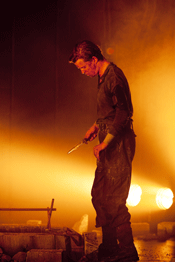 Daniel Grice as Enrico
Silvia who has been taught to hate men, encounters Gernando’s companion, Enrico (Daniel Grice). At first she fears him, but they fall in love. Silvia and Enrico form a standard love interest sub plot, which enlivens the otherwise grim tale of Constanza’s suffering. But Haydn’s also commenting on the idea of society in Arcadian surroundings. He’s very much in tune with the philosophy of Jean-Jacques Rousseau. Although L’isola disabitata predicates on marital fidelity, there are deeper, less explicit political implications.
Perhaps it’s no surprise then that this opera should appeal to modern audiences. Although Haydn worked for Prince Esterházy, he wasn’t subservient, as his Symphony no 45, “The Farewell” indicates. The American Revolution showed how potent Rousseau’s political concepts could be, the French Revolution signaled the end of Absolute Monarchy. Musically, too, Haydn understood the Zeitgeist. Classical poise tempered baroque opulence. The Sturm und Drang movement, which so influenced Haydn was a precursor of what we now called Romanticism, which ushered in further revolutions in the arts and society.
Although L’isola disabitata is set on an island, the island is in fact no more than a structural concept indicating a situation cut off from the reality of normal society. Haydn uses a contemporary text, by Pietro Metastasio, which refers to barren rocks and smoke — metaphors of oppression, and of Constanza’s moral confusion. Hence the layer of smoke that filled the Linbury Studio Theatre for this production by the Royal Opera House Young Artists programme, enveloping set and singers in the mist. Suddenly there’s a sound of running water. Until the conductor (Volker Krafft) climbs out of the pit, you’re not sure whether the first part of the opera is over or not. Just as Constanza’s disoriented, so are we.
A friend observed that the set “looks like a bomb site”. She’s right, for Constanza must have felt that she’d been hit by disaster. The designs (Jamie Vartan) reflect Constanza’s emotional landscape. She’s desolate, ruined, shattered. She’s lost faith because she invested in the trappings of marriage, rather than love.
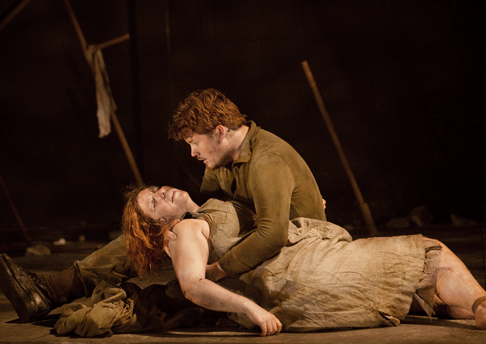 Elisabeth Meister as Constanza and Gernando Steven Ebel as Gernando
The spartan designs in this production also reflect Haydn’s music. L’isola disabitata uses only four voices, each distinctly defined and characterized. Until they’re united at the end, they sing alone, reflecting the characters’ inability to link up. The orchestra’s small — nineteen strings, with only two horns, two oboes, bassoon and flute. Minimalist by 19th century standards.
Musically, it’s also “modern”, in the sense that the voice parts are direct and communicate without excess adornment. The orchestral writing follows the words intimately. Sometimes one instrument shadows a voice, delicately picking up details. It’s word painting, almost as sensitive as Lieder would become.
Elisabeth Meister and Steven Ebel excel. Both have been prominent in the Jette Parker Young Artists scheme for some time, and have been heard many times in smaller roles in the main House. Meister memorably stepped in at short notice to sing the Fox in The Cunning Little Vixen. She sang with Ebel in Ebel’s The Truth about Love at the Linbury last year. He also sang Rimenes in Arne’s Atarxerxes. All these have been reviewed in Opera Today — please follow the links.
Daniel Grice’s Enrico was also good — I’d like to hear more of him. Anna Devin’s singing was rather obscured because she had to jump about so much. It’s in keeping with the idea of Silvia as a wild child unfettered by society, so director Rodula Gaitanou and movement director Mandy Demetriou are making a valid point, though overdone.
But the point of Young Artists presentations is learning through experience. There’s more to performance than technical prowess. Life skills count too. Please read “Polishing gemstones” where Simona Mihai and Kai Rüütel speak on the benefits of the Programme, one of the most highly regarded in Europe. The scheme also trains people in all aspects of opera, such as the conductor Volker Krafft, the director, designer, lighting and fighting. It’s tough being a creative artist especially in this financial climate. But if this excellent performance of Haydn L’isola disabitata is anything to go by, the Young Artists have proved themselves.
Anne Ozorio