![Marcelo Álvarez as Manrico and Patricia Racette as Leonora [Photo by Ken Howard courtesy of Metropolitan Opera]](http://www.operatoday.com/TROVATORE_Alvarez_and_Racette_7018a.png)
08 Nov 2010
Il Trovatore, Metropolitan Opera
It’s difficult to be reasonable about Il Trovatore. Reason is the last quality we expect from any of its characters or situations.
English Touring Opera are delighted to announce a season of lyric monodramas to tour nationally from October to December. The season features music for solo singer and piano by Argento, Britten, Tippett and Shostakovich with a bold and inventive approach to making opera during social distancing.
This tenth of ten Live from London concerts was in fact a recorded live performance from California. It was no less enjoyable for that, and it was also uplifting to learn that this wasn’t in fact the ‘last’ LfL event that we will be able to enjoy, courtesy of VOCES8 and their fellow vocal ensembles (more below …).
Ever since Wigmore Hall announced their superb series of autumn concerts, all streamed live and available free of charge, I’d been looking forward to this song recital by Ian Bostridge and Imogen Cooper.
Although Stile Antico’s programme article for their Live from London recital introduced their selection from the many treasures of the English Renaissance in the context of the theological debates and upheavals of the Tudor and Elizabethan years, their performance was more evocative of private chamber music than of public liturgy.
Evidently, face masks don’t stifle appreciative “Bravo!”s. And, reducing audience numbers doesn’t lower the volume of such acclamations. For, the audience at Wigmore Hall gave soprano Elizabeth Llewellyn and pianist Simon Lepper a greatly deserved warm reception and hearty response following this lunchtime recital of late-Romantic song.
For this week’s Live from London vocal recital we moved from the home of VOCES8, St Anne and St Agnes in the City of London, to Kings Place, where The Sixteen - who have been associate artists at the venue for some time - presented a programme of music and words bound together by the theme of ‘reflection’.
'Such is your divine Disposation that both you excellently understand, and royally entertaine the Exercise of Musicke.’
‘And there was war in heaven: Michael and his angels fought against the dragon; and the dragon fought and his angels, And prevailed not; neither was their place found any more in heaven … that old serpent … Satan, which deceiveth the whole world: he was cast out into the earth, and his angels were cast out with him.’
There was never any doubt that the fifth of the twelve Met Stars Live in Concert broadcasts was going to be a palpably intense and vivid event, as well as a musically stunning and theatrically enervating experience.
‘Love’ was the theme for this Live from London performance by Apollo5. Given the complexity and diversity of that human emotion, and Apollo5’s reputation for versatility and diverse repertoire, ranging from Renaissance choral music to jazz, from contemporary classical works to popular song, it was no surprise that their programme spanned 500 years and several musical styles.
The Academy of St Martin in the Fields have titled their autumn series of eight concerts - which are taking place at 5pm and 7.30pm on two Saturdays each month at their home venue in Trafalgar Square, and being filmed for streaming the following Thursday - ‘re:connect’.
The London Symphony Orchestra opened their Autumn 2020 season with a homage to Oliver Knussen, who died at the age of 66 in July 2018. The programme traced a national musical lineage through the twentieth century, from Britten to Knussen, on to Mark-Anthony Turnage, and entwining the LSO and Rattle too.
With the Live from London digital vocal festival entering the second half of the series, the festival’s host, VOCES8, returned to their home at St Annes and St Agnes in the City of London to present a sequence of ‘Choral Dances’ - vocal music inspired by dance, embracing diverse genres from the Renaissance madrigal to swing jazz.
Just a few unison string wriggles from the opening of Mozart’s overture to Le nozze di Figaro are enough to make any opera-lover perch on the edge of their seat, in excited anticipation of the drama in music to come, so there could be no other curtain-raiser for this Gala Concert at the Royal Opera House, the latest instalment from ‘their House’ to ‘our houses’.
"Before the ending of the day, creator of all things, we pray that, with your accustomed mercy, you may watch over us."
The doors at The Metropolitan Opera will not open to live audiences until 2021 at the earliest, and the likelihood of normal operatic life resuming in cities around the world looks but a distant dream at present. But, while we may not be invited from our homes into the opera house for some time yet, with its free daily screenings of past productions and its pay-per-view Met Stars Live in Concert series, the Met continues to bring opera into our homes.
Music-making at this year’s Grange Festival Opera may have fallen silent in June and July, but the country house and extensive grounds of The Grange provided an ideal setting for a weekend of twelve specially conceived ‘promenade’ performances encompassing music and dance.
There’s a “slide of harmony” and “all the bones leave your body at that moment and you collapse to the floor, it’s so extraordinary.”
“Music for a while, shall all your cares beguile.”
The hum of bees rising from myriad scented blooms; gentle strains of birdsong; the cheerful chatter of picnickers beside a still lake; decorous thwacks of leather on willow; song and music floating through the warm evening air.
It’s difficult to be reasonable about Il Trovatore. Reason is the last quality we expect from any of its characters or situations.
They are extreme people, yielding unreflectively to extreme passions. Verdi’s score expresses just that element (richly evident in its source, a blood-and-thunder Gutierrez drama somewhat watered down for the libretto in order to appease papal censors), and the singing should emerge with just this sort of unreasoning passion. We may not believe that X loves Y, but we ought to believe their minds are at fever pitch: “I’m going to hit that orgasmic high note if it kills me.” No, you never hear a Trovatore like that any more, but back when all theater was live theater and Il Trovatore was the most popular theater piece on Earth, that’s the sort of excitement you could hope for. If you want it now, you might want to check out the old RCA recording with Milanov, Barbieri, Bjoerling and Warren. And that was an everyday Metropolitan Opera cast!
The Met’s current David McVicar production in Charles Edwards’s unattractive but functional sets (time period: Spain during a civil war — any old civil war — there were plenty to choose from, but anyway it’s not the one in 1410 where Gutierrez set it) is not without its absurdities. (Why are all those floozies hanging around the soldiers’ camp, acting so very camp, when the general is formally reviewing his troops?) But the job gets done and sets up the singers to play their parts with minimal fuss.
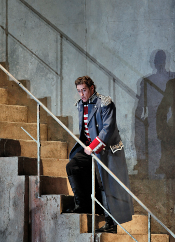 Alexander Tsymbalyuk as Ferrando
One particular thing struck me about the leading singers on this occasion:
None of them had their eyes glued to the conductor. Singers who sing to lovers,
tormenters, wounded children or God while keeping an eye on the baton the whole
time are often a necessary evil, a whimsy one grows used to, but it was a
pleasure to have the stars of this revival, though they never lost the beat
(and conductor Marco Armiliato never let Verdi’s powerful rhythms fade or
grow less than propulsive), looking at each other the entire night. They were
in it, they were on it. This is one of those professional touches you hardly
notice if you’re not looking for it — and are accustomed to too
many singers who can’t manage it.
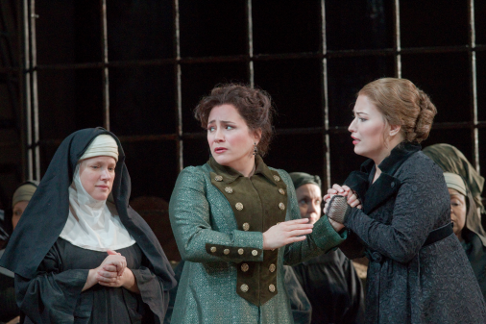 Patricia Racette as Leonora and Renée Tatum as Inez
You seldom get four top stars in top form in a Trovatore, but the opera calls for just that. On this occasion no one sang badly but the glitter was seldom gold. The men had it rather over the women; their voices seemed better designed for singing Verdi. One felt in especially good hands with the Count di Luna of Željko Lučić, who makes one think the great days of the Verdi baritone live again. His “Il balen” was flawless, the long, long line filling the house without effort, each note on the proper pitch as though his throat could not consider putting it anywhere else. I don’t remember there being quite so much bladework in this production, but Lučić certainly startled the house when he drew his sword through his hand, drenching it in blood, in his determination to possess Leonora. He held his own in the confrontational duets and trios, too.
Marcelo Álvarez sang his offstage serenades beautifully (to the accompaniment of a harp that never appeared — hey, guys, he’s a troubadour, y’know?) but his double aria in the besieged fortress seemed on the gruff side and he ran out of voice by the time of the dungeon scene. Hoarseness seemed to be the problem; perhaps, like Franco Corelli, he should conceal glasses of water around the set. His canteen in Act IV seemed not to have been filled, and he needed it. He looked a romantic enough figure whenever he did not stand in profile.
Patricia Racette’s Leonora is not the loopy teenager jumping around the set played by Sondra Radvanovsky in this production: Leonora may be a teenager, but she’s a lady of high Spanish birth, and she knows it; Racette knows it, too. Spanish grandezza used to mean something, and Verdi’s Leonora is that sort of dignified character.
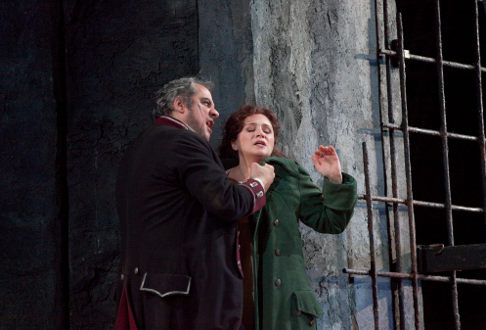 Željko Lučić as Count di Luna and Patricia Racette as Leonora
Racette is such an intelligent singer, so persuasive in her understanding of predicament, that I wish I liked her voice better. Her instrument always seems too small for the Met. She manages very professionally, but the voluptuous floods of sound that other sopranos have brought to the role, the voice that seems to define Leonora’s desperate heart and new-awakened passions, are not at Racette’s disposal. Her “Tacea la notte” was fascinating as vocal storytelling, but the tidal rise at its conclusion did not overflow. “Di tale amor” was, as it usually is, a bit of a mess, drawing no applause — Sutherland is the only soprano I ever heard sing it flawlessly, and the rest of her performance was inert. (“Di tale amor” is one of the few cases where I’d like to take his Orsinitá the composer aside and say, sternly, “Maestro, this tune isn’t good enough; go write a new one.”) The convent scene was no celestial flight, and Racette seemed out of breath in much of Act IV; there were many thin notes and others not precisely where one wanted them. Racette coped with the part but she did not take joy in it, or exploit its opportunities.
Marianne Cornetti has the heft for Azucena, but it takes her an awfully long time to warm up. Her “Stride le vampe” was loud but pitchless. Only at the end of the “Condotta” did she give evidence of the ferocity of a maddened Gypsy — her final notes actually brought forth the first responsive “echo” I’ve ever heard at the Met! The dungeon serenade, however, gave Cornetti place for her most beautiful singing of the night.
Alexander Tsymbalyuk, as Ferrando, has a clear, persuasive young bass but he bleats a bit. Renée Tatum was not the first confidante in my experience to make us all wish Inez had more to sing. The monks’ offstage “Miserere” in Act IV was downright heavenly, evidence of what those guys can accomplish when they’re not swashbuckling around shirtless, fighting with knives and spitting in each other’s faces, as they were obliged to do at other times.
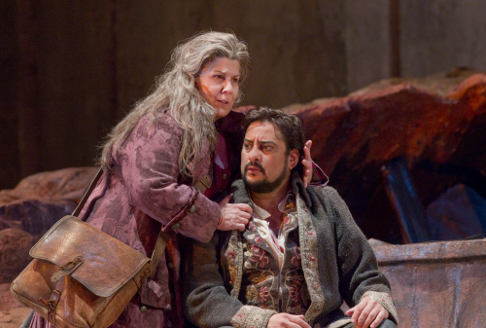 Marianne Cornetti as Azucena and Marcelo Álvarez as Manrico
The acting from all hands gave evidence of a bent towards melodrama. This is not out of place in Trovatore, of all operas, but many were the moments (“Ah sì, ben mio,” for example) when I felt the singers would give Verdi his due and us a better time if they’d stand and deliver in the old-fashioned way, instead of emoting like antsy banshees, losing their breath and tripping over their own feet.
The omission of nearly all cabaletta repeats implied a desire not so much to energize the occasion as to get it over with. That’s no way to do Trovatore; Trovatore must breathe.
John Yohalem