![Scene from Rigoletto [Photo courtesy of Opera Australia]](http://www.operatoday.com/OA_Rigoletto.gif)
29 Nov 2010
Rigoletto, Opera Australia
Not revived too frequently this 1991 production by Elijah Moshinsky updates the story to the 1960s and the films of Federico Fellini inspire the sets and costumes.
English Touring Opera are delighted to announce a season of lyric monodramas to tour nationally from October to December. The season features music for solo singer and piano by Argento, Britten, Tippett and Shostakovich with a bold and inventive approach to making opera during social distancing.
This tenth of ten Live from London concerts was in fact a recorded live performance from California. It was no less enjoyable for that, and it was also uplifting to learn that this wasn’t in fact the ‘last’ LfL event that we will be able to enjoy, courtesy of VOCES8 and their fellow vocal ensembles (more below …).
Ever since Wigmore Hall announced their superb series of autumn concerts, all streamed live and available free of charge, I’d been looking forward to this song recital by Ian Bostridge and Imogen Cooper.
Although Stile Antico’s programme article for their Live from London recital introduced their selection from the many treasures of the English Renaissance in the context of the theological debates and upheavals of the Tudor and Elizabethan years, their performance was more evocative of private chamber music than of public liturgy.
Evidently, face masks don’t stifle appreciative “Bravo!”s. And, reducing audience numbers doesn’t lower the volume of such acclamations. For, the audience at Wigmore Hall gave soprano Elizabeth Llewellyn and pianist Simon Lepper a greatly deserved warm reception and hearty response following this lunchtime recital of late-Romantic song.
For this week’s Live from London vocal recital we moved from the home of VOCES8, St Anne and St Agnes in the City of London, to Kings Place, where The Sixteen - who have been associate artists at the venue for some time - presented a programme of music and words bound together by the theme of ‘reflection’.
'Such is your divine Disposation that both you excellently understand, and royally entertaine the Exercise of Musicke.’
‘And there was war in heaven: Michael and his angels fought against the dragon; and the dragon fought and his angels, And prevailed not; neither was their place found any more in heaven … that old serpent … Satan, which deceiveth the whole world: he was cast out into the earth, and his angels were cast out with him.’
There was never any doubt that the fifth of the twelve Met Stars Live in Concert broadcasts was going to be a palpably intense and vivid event, as well as a musically stunning and theatrically enervating experience.
‘Love’ was the theme for this Live from London performance by Apollo5. Given the complexity and diversity of that human emotion, and Apollo5’s reputation for versatility and diverse repertoire, ranging from Renaissance choral music to jazz, from contemporary classical works to popular song, it was no surprise that their programme spanned 500 years and several musical styles.
The Academy of St Martin in the Fields have titled their autumn series of eight concerts - which are taking place at 5pm and 7.30pm on two Saturdays each month at their home venue in Trafalgar Square, and being filmed for streaming the following Thursday - ‘re:connect’.
The London Symphony Orchestra opened their Autumn 2020 season with a homage to Oliver Knussen, who died at the age of 66 in July 2018. The programme traced a national musical lineage through the twentieth century, from Britten to Knussen, on to Mark-Anthony Turnage, and entwining the LSO and Rattle too.
With the Live from London digital vocal festival entering the second half of the series, the festival’s host, VOCES8, returned to their home at St Annes and St Agnes in the City of London to present a sequence of ‘Choral Dances’ - vocal music inspired by dance, embracing diverse genres from the Renaissance madrigal to swing jazz.
Just a few unison string wriggles from the opening of Mozart’s overture to Le nozze di Figaro are enough to make any opera-lover perch on the edge of their seat, in excited anticipation of the drama in music to come, so there could be no other curtain-raiser for this Gala Concert at the Royal Opera House, the latest instalment from ‘their House’ to ‘our houses’.
"Before the ending of the day, creator of all things, we pray that, with your accustomed mercy, you may watch over us."
The doors at The Metropolitan Opera will not open to live audiences until 2021 at the earliest, and the likelihood of normal operatic life resuming in cities around the world looks but a distant dream at present. But, while we may not be invited from our homes into the opera house for some time yet, with its free daily screenings of past productions and its pay-per-view Met Stars Live in Concert series, the Met continues to bring opera into our homes.
Music-making at this year’s Grange Festival Opera may have fallen silent in June and July, but the country house and extensive grounds of The Grange provided an ideal setting for a weekend of twelve specially conceived ‘promenade’ performances encompassing music and dance.
There’s a “slide of harmony” and “all the bones leave your body at that moment and you collapse to the floor, it’s so extraordinary.”
“Music for a while, shall all your cares beguile.”
The hum of bees rising from myriad scented blooms; gentle strains of birdsong; the cheerful chatter of picnickers beside a still lake; decorous thwacks of leather on willow; song and music floating through the warm evening air.
Not revived too frequently this 1991 production by Elijah Moshinsky updates the story to the 1960s and the films of Federico Fellini inspire the sets and costumes.
The revival is even more welcome thanks to the outstanding performances of Michael Lewis and Rigoletto and Emma Matthews as Gilda.
The swinging, cynical sixties Moshinsky creates is the perfect world for the Duke. Paparazzi swarm around his act one party where showgirls dance with bishops.
Act one springs along in this updated guise, the circus-like party music even sounding like the sort of music Fellini’s regular composer Nino Rota would have written had he lived a century earlier.
Michael Yeargan’s revolving ‘doll house’ set shows the Duke’s palace, the street where Rigoletto meets Sparafucile, Rigoletto’s house and Sparafucile’s inn. A quick quarter turn in acts two and four and you have some open space for Gilda’s abduction and the final father-daughter duet. It all works splendidly and is another of Opera Australia’s landmark productions. The set also concentrates the action close to the front of the stage so, when the many set pieces come along, the characters are conveniently up stage nicely placed to deliver their arias.
Michael Lewis is a model Verdi baritone, perfect diction, smooth legato and clear, ringing top. Lewis exploits every note of the music, sung and unsung, to convey character. Seen during the prelude, applying a grotesque clown make-up (anticipating Heath Ledger’s Joker from Batman), Lewis’s Rigoletto then stands to show this Rigoletto’s extra handicap. Crippled, Lewis beetles about on walking sticks. Lewis’s thirty years singing the role bring insights into the character’s words and music illuminate every dimension of Rigoletto’s tragedy big and small from his terrified freeze at Monterone’s curse to the perfectly timed pause and wild yowl when Gilda dies.
Emma Matthews is radiant as Gilda. Mentored in the role by Joan Sutherland, she now takes the highest alternatives at the close of “Caro nomo”, singing with a security and sophistication that would make her late, great predecessor proud. Matthews’s acting matches her singing and she creates an understandably fatalistic young woman out of Gilda. Her murder scene is actually shocking; she strides fearlessly into the tavern so Maddalena seems to see it is a woman, not a man, and shrieks with horror as Gilds is stabbed. Jacqueline Dark, in the unlikely double act of Gilda’s untrustworthy guardian and then co-assassin brings a Freudian undertone perfectly in keeping with the story.
Rosario la Spina makes less of the Duke than his colleagues seeming to sing without much involvement but this has the advantage of suggesting the Duke’s detachment from his many victims.
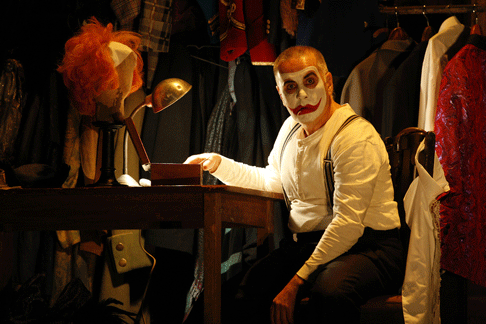 Michael Lewis as Rigoletto [Photo by Jeff Busby courtesy of Opera Australia]
Conductor Marko Letonja and Orchestra Victoria do some splendid work with shaping the tender moments. The Rigoletto/Gilda duets are as lovingly shaped as they are sung and the often-repeated ‘curse’ theme and storm music are thrilling without being bombastic.
Michael Magnusson