![Tosca poster [Manitoba Opera]](http://www.operatoday.com/Tosca_tall_ManitobaOpera.gif)
23 Nov 2010
Tosca, Manitoba Opera
What some people won’t do for a standing ovation! Saturday night at the opera was a showcase of excesses.
English Touring Opera are delighted to announce a season of lyric monodramas to tour nationally from October to December. The season features music for solo singer and piano by Argento, Britten, Tippett and Shostakovich with a bold and inventive approach to making opera during social distancing.
This tenth of ten Live from London concerts was in fact a recorded live performance from California. It was no less enjoyable for that, and it was also uplifting to learn that this wasn’t in fact the ‘last’ LfL event that we will be able to enjoy, courtesy of VOCES8 and their fellow vocal ensembles (more below …).
Ever since Wigmore Hall announced their superb series of autumn concerts, all streamed live and available free of charge, I’d been looking forward to this song recital by Ian Bostridge and Imogen Cooper.
Although Stile Antico’s programme article for their Live from London recital introduced their selection from the many treasures of the English Renaissance in the context of the theological debates and upheavals of the Tudor and Elizabethan years, their performance was more evocative of private chamber music than of public liturgy.
Evidently, face masks don’t stifle appreciative “Bravo!”s. And, reducing audience numbers doesn’t lower the volume of such acclamations. For, the audience at Wigmore Hall gave soprano Elizabeth Llewellyn and pianist Simon Lepper a greatly deserved warm reception and hearty response following this lunchtime recital of late-Romantic song.
For this week’s Live from London vocal recital we moved from the home of VOCES8, St Anne and St Agnes in the City of London, to Kings Place, where The Sixteen - who have been associate artists at the venue for some time - presented a programme of music and words bound together by the theme of ‘reflection’.
'Such is your divine Disposation that both you excellently understand, and royally entertaine the Exercise of Musicke.’
‘And there was war in heaven: Michael and his angels fought against the dragon; and the dragon fought and his angels, And prevailed not; neither was their place found any more in heaven … that old serpent … Satan, which deceiveth the whole world: he was cast out into the earth, and his angels were cast out with him.’
There was never any doubt that the fifth of the twelve Met Stars Live in Concert broadcasts was going to be a palpably intense and vivid event, as well as a musically stunning and theatrically enervating experience.
‘Love’ was the theme for this Live from London performance by Apollo5. Given the complexity and diversity of that human emotion, and Apollo5’s reputation for versatility and diverse repertoire, ranging from Renaissance choral music to jazz, from contemporary classical works to popular song, it was no surprise that their programme spanned 500 years and several musical styles.
The Academy of St Martin in the Fields have titled their autumn series of eight concerts - which are taking place at 5pm and 7.30pm on two Saturdays each month at their home venue in Trafalgar Square, and being filmed for streaming the following Thursday - ‘re:connect’.
The London Symphony Orchestra opened their Autumn 2020 season with a homage to Oliver Knussen, who died at the age of 66 in July 2018. The programme traced a national musical lineage through the twentieth century, from Britten to Knussen, on to Mark-Anthony Turnage, and entwining the LSO and Rattle too.
With the Live from London digital vocal festival entering the second half of the series, the festival’s host, VOCES8, returned to their home at St Annes and St Agnes in the City of London to present a sequence of ‘Choral Dances’ - vocal music inspired by dance, embracing diverse genres from the Renaissance madrigal to swing jazz.
Just a few unison string wriggles from the opening of Mozart’s overture to Le nozze di Figaro are enough to make any opera-lover perch on the edge of their seat, in excited anticipation of the drama in music to come, so there could be no other curtain-raiser for this Gala Concert at the Royal Opera House, the latest instalment from ‘their House’ to ‘our houses’.
"Before the ending of the day, creator of all things, we pray that, with your accustomed mercy, you may watch over us."
The doors at The Metropolitan Opera will not open to live audiences until 2021 at the earliest, and the likelihood of normal operatic life resuming in cities around the world looks but a distant dream at present. But, while we may not be invited from our homes into the opera house for some time yet, with its free daily screenings of past productions and its pay-per-view Met Stars Live in Concert series, the Met continues to bring opera into our homes.
Music-making at this year’s Grange Festival Opera may have fallen silent in June and July, but the country house and extensive grounds of The Grange provided an ideal setting for a weekend of twelve specially conceived ‘promenade’ performances encompassing music and dance.
There’s a “slide of harmony” and “all the bones leave your body at that moment and you collapse to the floor, it’s so extraordinary.”
“Music for a while, shall all your cares beguile.”
The hum of bees rising from myriad scented blooms; gentle strains of birdsong; the cheerful chatter of picnickers beside a still lake; decorous thwacks of leather on willow; song and music floating through the warm evening air.
What some people won’t do for a standing ovation! Saturday night at the opera was a showcase of excesses.
Puccini’s Tosca has everything: passionate love, consuming jealousy, undisguised lust, evil deceit, even murder and suicide. Manitoba Opera’s (MO) mostly Canadian cast rose to the occasion, leaving the audience emotionally spent but invigorated.
Conductor Tyrone Paterson led the Winnipeg Symphony Orchestra from the pit in Puccini’s marvellously dramatic score that foreshadows much of the onstage action. Vigorous playing and superb solo section work throughout provided exactly the added finesse required, making this a first-rate performance.
Veteran director Val Kuinka worked her magic with the help of an exemplary cast. Wendy Nielsen as Tosca and Richard Margison as artist Cavaradossi outdid themselves, portraying the tragic figures with realism and relish. Margison hasn’t lost a step as his extensive career continues. With a tenor voice that’s easy to listen to, he floated effortlessly to his upper range in “Recondita armonia.”
His wistful rendition of the celebrated aria “E lucevan le stelle” in the final act almost broke our hearts, his powerful voice aching with love for his adored Tosca. Totally convincing and touching, Margison crafted this into a real tearjerker and the clarinet solo introducing it was splendidly sensitive, enhancing our anticipation of this favourite.
Talk about art imitating life! Nielsen was outstanding as Tosca — a great actress, putting her entire being into the demanding role of the opera singer title character. With her lovely, refined soprano, she lent her full vibrato and flexible style to the twists and turns of the plot, moving fluidly from jealous lover to desperate murderess. In “Non la sospiri, la nostra casetta,” she showed a diaphanous lightness to her voice, barely alighting on each note before flitting to the next.
Rich phrasing and fervent zeal highlighted her “Visse d’arte, vissi d’amore,” as she sang, collapsed on the floor, disconsolate and despairing, beseeching God for deserting her despite her lifelong piety and humanity. Nielsen is the consummate opera star, with a reliable, mature voice that is completely satisfying. Powerful beyond belief, her dramatic cries of pain reached right into the audience’s hearts.
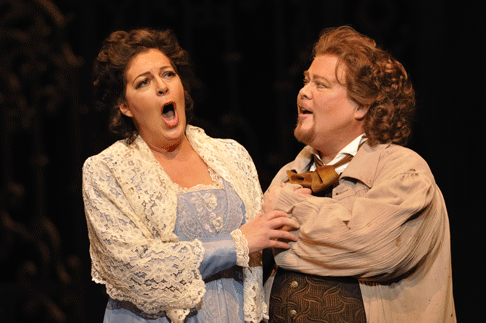 Wendy Nielsen as Tosca and Richard Margison as Cavaradossi [Photo by R. Tinker courtesy of Manitoba Opera]
Baritone Gaétan Laperrière returned to MO in the role of villainous chief of police Baron Scarpia. Dressed to the nines in black with gold braiding and trim, he looked every inch a self-indulgent scoundrel bent on getting his way. Yet Laperrière’s first entry was soft - barely discernible. His “Va Tosca!” was overly subtle, lacking power. And while his voice had agreeable resonance and flow, one wanted him to boom a little more, and strike fear into our hearts. Laperrière’s actions and words were suitably despicable, but his delivery belied his villainy. Frequent wooden movements were also questionable.
Peter Strummer’s droll Sacristan, on the other hand, was completely endearing. Announcing his arrival onstage with several healthy sneezes, he was a natural in this comic role. His bass-baritone made “E sempre lava!” a breath of fresh air before the drama to come. He has his gestures down to an art and gave us the only laughs of the evening.
Supporting roles by David Watson (Angelotti/Sciarrone), Keith Klassen (Spoletto) and Howard Rempel (jailer) were all solid and credible and Carson Milberg was a sweet-voice shepherd boy offstage. Acoustics can be tricky with offstage singing and it may be wise to station Milberg closer to the curtain to ensure the audience can fully appreciate this musical lad’s talents.
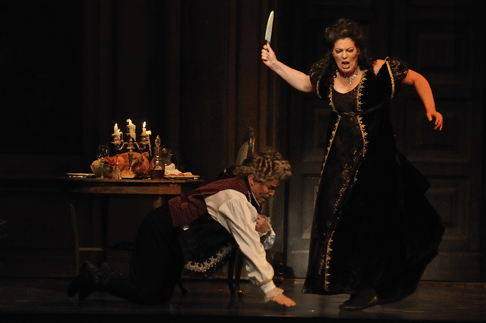 Wendy Nielsen as Tosca and Gaétan Laperrière as Scarpia [Photo by R. Tinker courtesy of Manitoba Opera]
The chorus is not especially busy in Tosca but certainly came through well when called upon and costuming was truly impressive.
The three sets were amazingly ornate and detailed, transporting us easily to 19th century Rome, and but for some shaky spotlighting, Bill Williams lighting was mood-setting splendour.