![Lorina Gore as Tytania and Joshua Tate as The Indian Prince [Photo by Jeff Busby courtesy of Opera Australia]](http://www.operatoday.com/MSDN_Australia_05.gif)
06 Dec 2010
A Midsummer Night’s Dream, Opera Australia
Transplanting Britten’s Shakespeare opera to an Indian setting seems at first an illogical step by Hollywood director Baz Luhrmann.
English Touring Opera are delighted to announce a season of lyric monodramas to tour nationally from October to December. The season features music for solo singer and piano by Argento, Britten, Tippett and Shostakovich with a bold and inventive approach to making opera during social distancing.
This tenth of ten Live from London concerts was in fact a recorded live performance from California. It was no less enjoyable for that, and it was also uplifting to learn that this wasn’t in fact the ‘last’ LfL event that we will be able to enjoy, courtesy of VOCES8 and their fellow vocal ensembles (more below …).
Ever since Wigmore Hall announced their superb series of autumn concerts, all streamed live and available free of charge, I’d been looking forward to this song recital by Ian Bostridge and Imogen Cooper.
Although Stile Antico’s programme article for their Live from London recital introduced their selection from the many treasures of the English Renaissance in the context of the theological debates and upheavals of the Tudor and Elizabethan years, their performance was more evocative of private chamber music than of public liturgy.
Evidently, face masks don’t stifle appreciative “Bravo!”s. And, reducing audience numbers doesn’t lower the volume of such acclamations. For, the audience at Wigmore Hall gave soprano Elizabeth Llewellyn and pianist Simon Lepper a greatly deserved warm reception and hearty response following this lunchtime recital of late-Romantic song.
For this week’s Live from London vocal recital we moved from the home of VOCES8, St Anne and St Agnes in the City of London, to Kings Place, where The Sixteen - who have been associate artists at the venue for some time - presented a programme of music and words bound together by the theme of ‘reflection’.
'Such is your divine Disposation that both you excellently understand, and royally entertaine the Exercise of Musicke.’
‘And there was war in heaven: Michael and his angels fought against the dragon; and the dragon fought and his angels, And prevailed not; neither was their place found any more in heaven … that old serpent … Satan, which deceiveth the whole world: he was cast out into the earth, and his angels were cast out with him.’
There was never any doubt that the fifth of the twelve Met Stars Live in Concert broadcasts was going to be a palpably intense and vivid event, as well as a musically stunning and theatrically enervating experience.
‘Love’ was the theme for this Live from London performance by Apollo5. Given the complexity and diversity of that human emotion, and Apollo5’s reputation for versatility and diverse repertoire, ranging from Renaissance choral music to jazz, from contemporary classical works to popular song, it was no surprise that their programme spanned 500 years and several musical styles.
The Academy of St Martin in the Fields have titled their autumn series of eight concerts - which are taking place at 5pm and 7.30pm on two Saturdays each month at their home venue in Trafalgar Square, and being filmed for streaming the following Thursday - ‘re:connect’.
The London Symphony Orchestra opened their Autumn 2020 season with a homage to Oliver Knussen, who died at the age of 66 in July 2018. The programme traced a national musical lineage through the twentieth century, from Britten to Knussen, on to Mark-Anthony Turnage, and entwining the LSO and Rattle too.
With the Live from London digital vocal festival entering the second half of the series, the festival’s host, VOCES8, returned to their home at St Annes and St Agnes in the City of London to present a sequence of ‘Choral Dances’ - vocal music inspired by dance, embracing diverse genres from the Renaissance madrigal to swing jazz.
Just a few unison string wriggles from the opening of Mozart’s overture to Le nozze di Figaro are enough to make any opera-lover perch on the edge of their seat, in excited anticipation of the drama in music to come, so there could be no other curtain-raiser for this Gala Concert at the Royal Opera House, the latest instalment from ‘their House’ to ‘our houses’.
"Before the ending of the day, creator of all things, we pray that, with your accustomed mercy, you may watch over us."
The doors at The Metropolitan Opera will not open to live audiences until 2021 at the earliest, and the likelihood of normal operatic life resuming in cities around the world looks but a distant dream at present. But, while we may not be invited from our homes into the opera house for some time yet, with its free daily screenings of past productions and its pay-per-view Met Stars Live in Concert series, the Met continues to bring opera into our homes.
Music-making at this year’s Grange Festival Opera may have fallen silent in June and July, but the country house and extensive grounds of The Grange provided an ideal setting for a weekend of twelve specially conceived ‘promenade’ performances encompassing music and dance.
There’s a “slide of harmony” and “all the bones leave your body at that moment and you collapse to the floor, it’s so extraordinary.”
“Music for a while, shall all your cares beguile.”
The hum of bees rising from myriad scented blooms; gentle strains of birdsong; the cheerful chatter of picnickers beside a still lake; decorous thwacks of leather on willow; song and music floating through the warm evening air.
Transplanting Britten’s Shakespeare opera to an Indian setting seems at first an illogical step by Hollywood director Baz Luhrmann.
But the result made for a popular production. Dating from 1993 Luhrmann directed this long before his rise to fame but his flair for exotica and rich visuals was apparent even then. Luhrmann’s relocating of the story from ancient Athens to 1920s India cashed-in on the trend at the time for Bollywood movies and Indian inspired fashion and décor.
The world of Indian mysticism does, however, seem more suited to the mysterious world Britten creates in his score. These spirit beings are to be feared and to enter their realm should therefore be far more disturbing. Ravel did the same in L’Enfant et les Sortileges, his enchanted garden is an alluring but fearful place. So is Britten’s forest.
Having the fairies as Indian gods and the mortals as British Raj may confuse the text and storyline and Luhrmann’s tendency to keep the action busy often spoils the nocturnal, dreaminess of some of the music. An English bandstand set in a park somewhere in India in 1923 dominates the set. The roof becomes a platform where Oberon oversees his magical ministrations while on stage level there is a pond below the bandstand where fairies and mortals meet. The orchestra have been relocated from the pit to the middle level and, dressed in military band uniform, are constantly in view as are the subtleties and inventiveness of Britten’s score.
The loveliest of the opera’s scenes, where Tytania awakens to the transformed Bottom is beautifully done here. Lorina Gore’s increasing ecstatic and extravagant vocal lines float around Conal Coad’s trombone accompanied bellowing and braying as Bottom.
With his genial, rollicking bass, Coad leads the mechanicals in their three scenes with great success. In the guise of an army entertainment troop, the effect is straight out of an English Music Hall parody of Italian opera along the lines that Britten and librettist Peter Pears intended.
The quartet of lovers is superb. Henry Choo’s ardent and honey-voiced Lysander sounds very much in the British tenor tradition. Choo’s first scene with Hermia is beautifully sung. Even more so as he sang the repeated “I swear to thee” phrases running up and down a staircase! Lisa Harper-Brown’s plaintive soprano beautifully contrasts with Dominica Matthews’s mezzo in the famous squabble that, here, becomes a cat-fight ending with both splashing about in the pool. The physical prowess of Opera Australia’s singers often matches their vocal prowess.
The most physical performance of all is Tyler Coppin’s as Puck. Nobody seems to cast a boy in this part anymore as using an adult actor gives greater opportunity to create a character. With his small stature Coppin has the best of both worlds however, looking like an adult trapped in boy’s body. His slapstick performance contrasts nicely with Tobias Cole’s stealthy, almost sinister Oberon. Perched above the stage with waist length dreadlocks, white face, blue, clawed hands and backed by Britten’s melismatic music Cole’s performance reinforces this role as still one of the best in modern operatic literature for a counter-tenor.
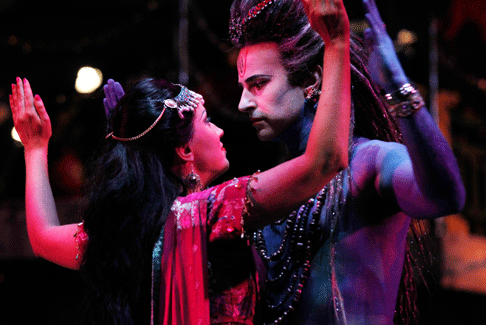 Tobias Cole as Oberon and Lorina Gore as Tytania
In a sound-world all of its own, Oberon’s music benefited from Cole’s restrained performance. With their prominence on the stage Orchestra Victoria, lead by Britten authority Paul Kildea, were able to make every nuance of the fairies' scenes as well as the deliberately lumpen scenes for the rustics and their play.
This Midsummer Night’s Dream was a run-away success when first staged and, unlike any other production of a Britten opera, played to full houses. The production was so popular it was presented at the 1994 Edinburgh Festival. The sheer vitality of the playing, singing and production in this revival make any qualms about the logic of the setting fall away thanks to the hallmark ensemble work of this company.
Michael Magnusson
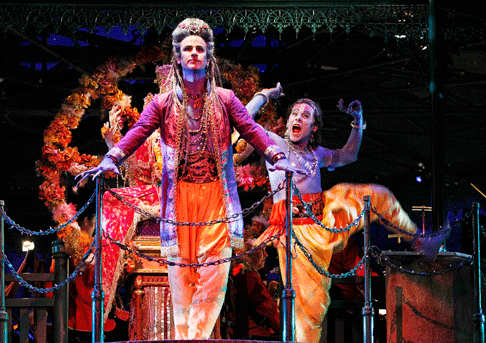 Tobias Cole as Oberon and Tyler Coppin as Puck