11 Dec 2010
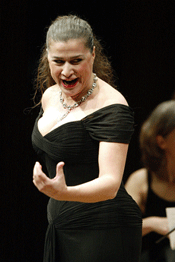
Cecilia Bartoli at the Barbican Centre, London
Cecilia Bartoli is something of a phenomenon, capable of attracting an enthusiastic capacity crowd.
English Touring Opera are delighted to announce a season of lyric monodramas to tour nationally from October to December. The season features music for solo singer and piano by Argento, Britten, Tippett and Shostakovich with a bold and inventive approach to making opera during social distancing.
This tenth of ten Live from London concerts was in fact a recorded live performance from California. It was no less enjoyable for that, and it was also uplifting to learn that this wasn’t in fact the ‘last’ LfL event that we will be able to enjoy, courtesy of VOCES8 and their fellow vocal ensembles (more below …).
Ever since Wigmore Hall announced their superb series of autumn concerts, all streamed live and available free of charge, I’d been looking forward to this song recital by Ian Bostridge and Imogen Cooper.
Although Stile Antico’s programme article for their Live from London recital introduced their selection from the many treasures of the English Renaissance in the context of the theological debates and upheavals of the Tudor and Elizabethan years, their performance was more evocative of private chamber music than of public liturgy.
Evidently, face masks don’t stifle appreciative “Bravo!”s. And, reducing audience numbers doesn’t lower the volume of such acclamations. For, the audience at Wigmore Hall gave soprano Elizabeth Llewellyn and pianist Simon Lepper a greatly deserved warm reception and hearty response following this lunchtime recital of late-Romantic song.
For this week’s Live from London vocal recital we moved from the home of VOCES8, St Anne and St Agnes in the City of London, to Kings Place, where The Sixteen - who have been associate artists at the venue for some time - presented a programme of music and words bound together by the theme of ‘reflection’.
'Such is your divine Disposation that both you excellently understand, and royally entertaine the Exercise of Musicke.’
‘And there was war in heaven: Michael and his angels fought against the dragon; and the dragon fought and his angels, And prevailed not; neither was their place found any more in heaven … that old serpent … Satan, which deceiveth the whole world: he was cast out into the earth, and his angels were cast out with him.’
There was never any doubt that the fifth of the twelve Met Stars Live in Concert broadcasts was going to be a palpably intense and vivid event, as well as a musically stunning and theatrically enervating experience.
‘Love’ was the theme for this Live from London performance by Apollo5. Given the complexity and diversity of that human emotion, and Apollo5’s reputation for versatility and diverse repertoire, ranging from Renaissance choral music to jazz, from contemporary classical works to popular song, it was no surprise that their programme spanned 500 years and several musical styles.
The Academy of St Martin in the Fields have titled their autumn series of eight concerts - which are taking place at 5pm and 7.30pm on two Saturdays each month at their home venue in Trafalgar Square, and being filmed for streaming the following Thursday - ‘re:connect’.
The London Symphony Orchestra opened their Autumn 2020 season with a homage to Oliver Knussen, who died at the age of 66 in July 2018. The programme traced a national musical lineage through the twentieth century, from Britten to Knussen, on to Mark-Anthony Turnage, and entwining the LSO and Rattle too.
With the Live from London digital vocal festival entering the second half of the series, the festival’s host, VOCES8, returned to their home at St Annes and St Agnes in the City of London to present a sequence of ‘Choral Dances’ - vocal music inspired by dance, embracing diverse genres from the Renaissance madrigal to swing jazz.
Just a few unison string wriggles from the opening of Mozart’s overture to Le nozze di Figaro are enough to make any opera-lover perch on the edge of their seat, in excited anticipation of the drama in music to come, so there could be no other curtain-raiser for this Gala Concert at the Royal Opera House, the latest instalment from ‘their House’ to ‘our houses’.
"Before the ending of the day, creator of all things, we pray that, with your accustomed mercy, you may watch over us."
The doors at The Metropolitan Opera will not open to live audiences until 2021 at the earliest, and the likelihood of normal operatic life resuming in cities around the world looks but a distant dream at present. But, while we may not be invited from our homes into the opera house for some time yet, with its free daily screenings of past productions and its pay-per-view Met Stars Live in Concert series, the Met continues to bring opera into our homes.
Music-making at this year’s Grange Festival Opera may have fallen silent in June and July, but the country house and extensive grounds of The Grange provided an ideal setting for a weekend of twelve specially conceived ‘promenade’ performances encompassing music and dance.
There’s a “slide of harmony” and “all the bones leave your body at that moment and you collapse to the floor, it’s so extraordinary.”
“Music for a while, shall all your cares beguile.”
The hum of bees rising from myriad scented blooms; gentle strains of birdsong; the cheerful chatter of picnickers beside a still lake; decorous thwacks of leather on willow; song and music floating through the warm evening air.
Cecilia Bartoli is something of a phenomenon, capable of attracting an enthusiastic capacity crowd.
You sense that many people would be happy to listen to her whatever the repertoire. So, it was heartening to find that for her Barbican Centre concert, Bartoli devoted so much time and care to Handel’s operatic output and generating such enthusiasm for material which can still be regarded as specialist.
After exploring the life and work of Maria Malibran and the music written in Italy for the castrati, Cecilia Bartoli was back on more familiar territory at her concert at the Barbican Centre, London on Wednesday 8th December. She sang a sequence of arias from Handel’s Italian operas including substantial extracts from Giulio Cesare with Argentinian counter-tenor Franco Fagioli, accompanied by the Basel Chamber Orchestra.
Handel’s major operas were written for some of the greatest singers of the day; great talents can articulate the drama within music and present the emotion behind the showers of notes. Technically Bartoli is amazing, if idiosyncratic, but her greatest strength is neither as a technician nor as a stylist (thought she is strong in both these areas). Where she excels is in telling a story and drawing the listener in.
When not singing her stage manner was a little too winsome for my taste. But when the music started she was transformed. Rarely have I been at a recital where each aria was so strongly presented with its own character. For the opening sequence, the overture and two of Armida’s arias from Rinaldo she was transformed into the sorceress, her musical gestures matched by flashing eyes and dramatic arm movements.
This drama was then contrasted with a light bright aria from Lotario, a charming simile aria where Handel’s plays with the text (about a little boat in the breeze on the ocean) by adding running passages in the music.
The orchestra then played the Allegro from Veracini’s Overture No. 6 in G minor. Veracini was a violinist, contemporary of Handel, who came to London and had some success with his concerts. He also ventured into the operatic sphere, with less success, though his operatic version of As You Like It sounds intriguing.
Bartoli then returned with “Ah! Mio cor” from Alcina, sung with great power but also a strong sense of line. In this aria, Bartoli presented Alcina as a quicksilver, captivating woman and you wanted to hear more of her in the role. Her mercurial take on the aria was in fascinating contrast to Inga Kalna’s account of it at the recent complete performance of Alcina at the Barbican.
The orchestra then played two short overtures by Porpora, another contemporary and rival of Handel’s. Both from cantatas written late in his career after he had left London. Full of dramatic contrasts and striking orchestrations, they seemed effective preludes rather then works in their own right.
In “M’adora l’idol mio” from Teseo, Bartoli was paired brilliantly with solo oboe, the pair creating a sparkling duet partnership in the complex passage-work in the aria. Whilst it would be fascinating to hear Bartoli as the sorceress Medea from this opera, her account of this aria for the opera’s heroine Agilea was everything that it should be. But she turned to another evil sorceress, Melissa from Amadigi di Gaula for the closing item in part one, “Destero dall’empia Dite” in which Melissa threatens to raise every fury from hell, with the help of solo oboe and trumpet. Another bravura showpiece which Bartoli turned into a mini drama.
Both this and the preceding item were performed with recitative .I think this makes all the difference to a baroque aria and could have wished that Bartoli had included more; she is after all Italian and her was with the words is vivid.
Bartoli’s Cleopatra, a role which she has sung on stage, was richly coloured and fascinatingly varied, giving us a tantalising glimpse of what her performance of the full role might be like. “V’adoro pupille” was erotic but aristocratic, though it was a shame that the accompaniment lacked Handel’s full orchestration here. “Se pieta” was perfectly judged, showcasing Bartoli’s marvellous way with line, musical and dramatically involving. Finally “Da tempeste” was all that you could imagine, brilliant, charming and vivid.
Fagioli’s Cesare was not quite yet in the same league. He has an attractive, high counter-tenor voice with a strong vibrato and quite a feminine cast. His voice lacks the edge which some counter-tenors have and this was something that I missed in this music. “Va tacito” was superbly sung with fine solo horn playing, but lacked that element of danger which needs to underlay the music. His voice seemed too soft grained for the dramatics of “Al lamp dell’armi” but he did interpolate some superb high notes in the da capo. But the lyric beauty of “Aure, deh, per pieta” suited his voice perfectly. Finally Bartoli and Fagioli joined a lively performance of Cesare and Cleopatra’s duet from the opera.
This was a long and generous programme with Bartoli singing 8 substantial arias plus duet. In response to the enthusiasm of the audience at the end we were treated to 3 encores, one from each singer and a duet from Rinaldo.
Bartoli’s choice of arias seemed to highlight two particular ways she has of performing baroque music. Lyrical music was sung with gloriously long lines, floated beautifully and emphasising high quietness. There were moments which reminded me of Caballe’s habit of opening recitals by singing a group of arie antiche with the music placed high in the voice and floated in a glorious pianissimo. There was something of this showing off in the way Bartoli placed many of the high lying passages. In contrast passage-work was sung in her distinctive, robust manner. This is something you either love or hate, the way that her intense, vibrato laden voice moves round the running passages at high speed creating a remarkable, and distinctive effect. I must confess that on disc I have found this sometimes rather difficult to take, but that heard live the effect was less disturbing and I could relax and appreciate the artistry that was going into the performance.
The Basel Chamber Orchestra, leader Julia Schröder performed without conductor, a nice sized group with 18 string players. From the first notes of the overture to Rinaldo they gave the music a fresh, crisp, newly minted feel. All the solo instrumental parts were superbly played and we even got a wind machine in the opening aria. The group were far more than just support and made themselves fine partners in Bartoli’s performances.
Bartoli held the audience spellbound for this long programme of baroque arias, something not every singer could do. All I wish for now is that we could hear her in a complete opera.
Robert Hugill