The drawback, of
course, is that the works are presented in concert rather than staged. On
Saturday 4th December, Mark Minkowski and Les Musiciens du Louvre-Grenoble
appeared on the final leg of a short tour performing Handel’s
Alcina in concert. This tour followed performances at the Vienna State
Opera, staged by Adrian Noble. Noble chose to set the opera in the context of
the historical Georgiana, Duchess of Devonshire, who lived some 40 years after
the premiere of Handel’s opera, so perhaps seeing the work in concert
wasn’t such a bad thing after all.
In fact, Minkowski and his cast gave us a highly dramatic concert reading,
with one exception all the cast were off the book and made the correct
entrances and exits. Not only that, but whilst sitting on stage at the side
they continued to react to what was going on. The result was a vivid and highly
involving presentation of Handel’s opera and, for me, an almost ideal way
to experience opera seria without having a director trying to
translate it for me into contemporary dramatic terms.
There had been notices of cast changes well before the date of the concert,
with Romina Basso apparently taking over the role of Bradamante only for the
concert performances. Basso did use a score, but for much of the time she
barely looked at it and her performance was no less dramatic than the rest.
In the title role there was another, last minute, substitution; Latvian
soprano Inga Kalna took over from an ailing Anja Harteros. Kalna had already
replaced Harteros on an earlier leg of the tour and there was no sense that she
was a stand in, she gave a beautifully rounded, fully dramatic account of this
fascinating role.
The role of Alcina could easily have been another one of Handel’s bad
girl sorceresses such as Medea in Teseo or Melissa in Amadigi di
Gaula. But Handel seems to have fallen a little in love with his heroine
and instead presents us with a tragic figure who is really in love and who
loses her magic powers as a consequence.
Kalna had something of the rather old-fashioned grand manner on stage,
perhaps no bad thing when it comes to establishing a character presence on the
concert stage. Her voice is rich and her repertoire includes Verdi and Strauss.
But she has a lovely focussed tone which meant that all of Handel’s
passagework was taken neatly and expressively, her moments of dramatic fire
were terrific. But the role is about much more than this and Kalna’s
expressive spinning of a line meant that she captured exactly the feeling of
melancholy which imbues much of Alcina’s music. So that ‘Ah, mio
cor’ (her first aria in Act 2), had a brilliantly intense contrast
between the lamenting of the opening section and the angry central section.
Minkowski placed the single interval after this aria and it was a terrific way
to close the first half.
But for me Kalna’s finest moment was the closing scene of Act 2, when
Alcina discovers that she can no longer use her powers. A long recitative is
followed by the aria ‘Ombre pallide’ in which Kalna spun lines of
quiet intensity. Alcina isn’t actually the major role in the opera;
Alcina gets 6 arias plus a trio whereas Ruggiero gets 8 arias plus a trio. But
Handel’s sympathy for Alcina ensured that it is Alcina whom we focus on,
and Kalna conveyed this with dignity and intensity.
The sign of a good performance of opera seria is not the technical ability
to sing all the notes accurately, but the way the singers use the notes
expressively. One of the big advantages of this performance was the way all the
cast used Handel’s music to project character.
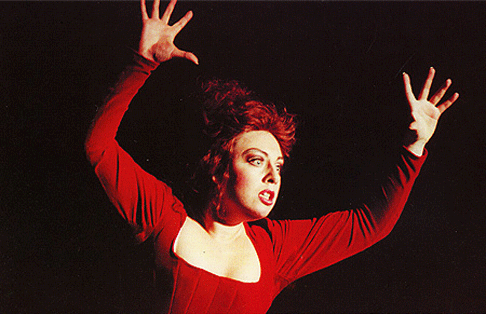 Inga Kalna as Alcina (Riga) [Photo courtesy of the artist]
This was particularly true of Vesselina Kassarova who sang Ruggiero,
Alcina’s love interest. Kassarova seemed to be on better form than I have
heard recently, with a brilliant upper voice and lovely dark lower register.
The drawback seemed to be that these two registers were not always neatly
joined; there were occasional alarming gear shifts. But Kassarova knows how to
use baroque music for expressive purposes, her notes really meant something. In
the early part of the opera, where Ruggerio is under Alcina’s magic
influence, her Ruggiero wasn’t a particularly nice person and we saw
quite clearly how he was transformed when the magic was removed. Of course,
‘Sta nell’Ircana’ was a great tour de force, but Kassarova
was as impressive in Ruggiero’s other arias. I have a confession though,
by the end of the evening I was trying not to look at Kassarova as her
excessive expressive mugging during her arias was off-putting.
Romina Basso as Bradamante was equally impressive. Whereas Kassarova was
playing a man, Basso was playing a woman playing a man as Ruggiero’s
fiancée Bradamante is disguised as her brother Ricciardo. Basso had a slightly
lighter voice than Kassarova, providing a nice contrast, with a lovely neat way
with Bradamante’s passagework. Her technical brilliance was shown off in
Vorrei vendicarmi which Minkowski took at a terrific pace. The original singer
of the role also specialised in singing male roles and this shows in the strong
way Handel that presents her. Bradamante doesn’t get any of the
opera’s big show pieces, but Handel gave her some fine music and Basso
created a strong, fully rounded character.
Alcina’s sister Morgana is the soubrette role. For much of the opera
she plays with love, discarding Oronte (Benjamin Bruns) when Ricciardo
(Basso’s Bradamente in disguise) comes along; then at the end, returning
to Oronte with a glorious outpouring of grief in ‘Credete al mio
dolore’. Veronica Cangemi was a bit serious in the earlier parts of the
opera, underplaying the soubrette; there was a danger of her being too like
Alcina. There were times when her upper register seemed a little wayward, but
Cangemi is a highly musical singer and her account of ‘Tornami a
vagheggiar’, which closes Act 1, was simply brilliant.
Oronte isn’t a huge part, but it is an important one dramatically; in
fact the role was written for the 21 year old John Beard who would go on to
inspire some of the major tenor roles in Handel’s oratorios. In his first
aria I thought that Benjamin Bruns, as Oronte, had a voice which was too big,
rather too modern and forward placed for the role. But he settled in nicely and
gave a beautifully shaded account of Oronte’s final aria, ‘Un
momento di contento’.
The role of Oberto was a late addition to the opera. Handel’s source
for the libretto (Broschi’s L’Isola di Alcina)
didn’t have the role in at all. Oberto was specifically added for the boy
soprano William Savage. Savage would carry on singing for Handel as an adult,
but his baritone voice does not seem to have been as impressive as his treble
one. Handel created 3 simple, direct arias for the character, all lightly
accompanied. Usually the role is sung by a female soprano, but Minkowski used a
boy treble, Shintaro Nakajima, from the Vienna Boys Choir. Nakajima was
immensely impressive as Oberto, singing Handel’s music fluently and with
an unaffected directness. He had a very self-possessed stage presence and was
seriously in danger of stealing the show.
Ruggiero’s tutor, Melisso, is a role which Handel reduced when writing
the opera, so that the character gets only 1 aria. Baritone Luca Tinttoto
accounted himself well in the aria and made you wish he’d been given more
to do.
When Handel wrote Teseo, based on a French tragedie
lyrique there are indications that he intended to create a mixture of
dance and singing in the manner of the French opera, but economics seems to
have put paid to this. In Alcina he had Marie Salle and her dance
troupe available, so that dance plays a big part in the opera, though is often
cut in modern performance. Minkowski gave us all the dances, so that Act 2,
after Alcina’s ‘Ombre pallide’ we get dances for
‘divers specters’. Then at the end of Act 3, there are dances for
the men who had been turned into stones by Alcina. Here also, the soloists
joined in with the singers of the chorus as would have happened in
Handel’s day.
Les Musiciens du Louvre — Grenoble were present in strength, with 32
strings and triple woodwind. It was heartening to hear this great music played
by stylishly such a large body of players. There were plenty of fine solo
moments, including obbligato violin and cello
Minkowski has been conducting Handel with his ensemble for many years and I
enjoy his way with the music. His performances seem to more direct, lacking the
French accent of some of his colleagues. Speeds were sometimes brisk and the
recitatives flowed nicely, but he never went beyond his singers technical
abilities and the opera never felt rushed.
In an ideal world, we would have been able to experience Adrian
Noble’s staging of the opera in the Barbican Theatre. But Minkowski and
his ensemble gave such a fluently dramatic and involving account of
Alcina that you hardly noticed the lack of a staging.
Robert Hugill
Handel’s Alcina is the first of a major series of baroque operas at the
Barbican Centre, London. All feature specialist European baroque orchestras and
major singers. Vivaldi’s Orlando Furioso will appear on 26th March 2011 with Lemieux,
Larmore, Jaroussky, Stotijn, Cangemi, Basso and Senn. (Ensemble
Matheus/Spinosi). Handel’s Ariodante follows on 25th May with DiDonato, Gauvin,
Phan, Lemieux, and others (Il complesso barocco/Curtis) For more details please
see the Barbican website.
![Vesselina Kasarova {Photo by Marco Borggreve/Sony BMG]](http://www.operatoday.com/Kasarova.gif)