Recently in Performances
English Touring Opera are delighted to announce a season of lyric monodramas to tour nationally from October to December. The season features music for solo singer and piano by Argento, Britten, Tippett and Shostakovich with a bold and inventive approach to making opera during social distancing.
This tenth of ten Live from London concerts was in fact a recorded live performance from California. It was no less enjoyable for that, and it was also uplifting to learn that this wasn’t in fact the ‘last’ LfL event that we will be able to enjoy, courtesy of VOCES8 and their fellow vocal ensembles (more below …).
Ever since Wigmore Hall announced their superb series of autumn concerts, all streamed live and available free of charge, I’d been looking forward to this song recital by Ian Bostridge and Imogen Cooper.
Although Stile Antico’s programme article for their Live from London recital introduced their selection from the many treasures of the English Renaissance in the context of the theological debates and upheavals of the Tudor and Elizabethan years, their performance was more evocative of private chamber music than of public liturgy.
Evidently, face masks don’t stifle appreciative “Bravo!”s. And, reducing audience numbers doesn’t lower the volume of such acclamations. For, the audience at Wigmore Hall gave soprano Elizabeth Llewellyn and pianist Simon Lepper a greatly deserved warm reception and hearty response following this lunchtime recital of late-Romantic song.
For this week’s Live from London vocal recital we moved from the home of VOCES8, St Anne and St Agnes in the City of London, to Kings Place, where The Sixteen - who have been associate artists at the venue for some time - presented a programme of music and words bound together by the theme of ‘reflection’.
'Such is your divine Disposation that both you excellently understand, and royally entertaine the Exercise of Musicke.’
‘And there was war in heaven: Michael and his angels fought against the dragon; and the dragon fought and his angels, And prevailed not; neither was their place found any more in heaven … that old serpent … Satan, which deceiveth the whole world: he was cast out into the earth, and his angels were cast out with him.’
There was never any doubt that the fifth of the twelve Met Stars Live in Concert broadcasts was going to be a palpably intense and vivid event, as well as a musically stunning and theatrically enervating experience.
‘Love’ was the theme for this Live from London performance by Apollo5. Given the complexity and diversity of that human emotion, and Apollo5’s reputation for versatility and diverse repertoire, ranging from Renaissance choral music to jazz, from contemporary classical works to popular song, it was no surprise that their programme spanned 500 years and several musical styles.
The Academy of St Martin in the Fields have titled their autumn series of eight concerts - which are taking place at 5pm and 7.30pm on two Saturdays each month at their home venue in Trafalgar Square, and being filmed for streaming the following Thursday - ‘re:connect’.
The London Symphony Orchestra opened their Autumn 2020 season with a homage to Oliver Knussen, who died at the age of 66 in July 2018. The programme traced a national musical lineage through the twentieth century, from Britten to Knussen, on to Mark-Anthony Turnage, and entwining the LSO and Rattle too.
With the Live from London digital vocal festival entering the second half of the series, the festival’s host, VOCES8, returned to their home at St Annes and St Agnes in the City of London to present a sequence of ‘Choral Dances’ - vocal music inspired by dance, embracing diverse genres from the Renaissance madrigal to swing jazz.
Just a few unison string wriggles from the opening of Mozart’s overture to Le nozze di Figaro are enough to make any opera-lover perch on the edge of their seat, in excited anticipation of the drama in music to come, so there could be no other curtain-raiser for this Gala Concert at the Royal Opera House, the latest instalment from ‘their House’ to ‘our houses’.
"Before the ending of the day, creator of all things, we pray that, with your accustomed mercy, you may watch over us."
The doors at The Metropolitan Opera will not open to live audiences until 2021 at the earliest, and the likelihood of normal operatic life resuming in cities around the world looks but a distant dream at present. But, while we may not be invited from our homes into the opera house for some time yet, with its free daily screenings of past productions and its pay-per-view Met Stars Live in Concert series, the Met continues to bring opera into our homes.
Music-making at this year’s Grange Festival Opera may have fallen silent in June and July, but the country house and extensive grounds of The Grange provided an ideal setting for a weekend of twelve specially conceived ‘promenade’ performances encompassing music and dance.
There’s a “slide of harmony” and “all the bones leave your body at that moment and you collapse to the floor, it’s so extraordinary.”
“Music for a while, shall all your cares beguile.”
The hum of bees rising from myriad scented blooms; gentle strains of birdsong; the cheerful chatter of picnickers beside a still lake; decorous thwacks of leather on willow; song and music floating through the warm evening air.
Performances
![David Daniels as Oberon and Esteban Andres Cruz as Puck [Photo by Dan Rest courtesy of Lyric Opera of Chicago]](http://www.operatoday.com/MSDN_Chicago_03.gif)
03 Dec 2010
Midsummer Night’s Dream, Lyric Opera of Chicago
In a seamless realization with an ideal cast Lyric Opera of Chicago celebrates the magical antics and foibles of both human and fairy in its premiere production of Benjamin Britten’s Midsummer Night’s Dream.
From the first sounds of the string introduction to the final leap
of Puck into a stage gone dark not a moment of Britten’s score is
neglected in a well-thought match of music and drama. Leading the realm of
fairies as King and Queen David Daniels sings the role of Oberon and Anna
Christy that of Tytania. The mortal lovers who interact with the figures of the
other world and play out their own sets of problems are performed by Elizabeth
DeShong and Shawn Mathey as Hermia and Lysander, and by Erin Wall and Lucas
Meachem as Helena and Demetrius. The amateur group of actors, led by the Bottom
of Peter Rose, works well as an ensemble in this production and gives yet a
third dimension to the strivings and complications of the personalities
enmeshed in supernatural and human squabbles. In a significant debut at Lyric
Opera, Rory Macdonald conducts the score as a moving canvas with the varying
elements coalescing into a unified whole.
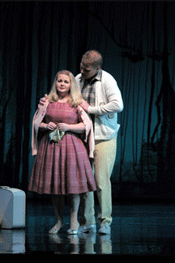 Elizabeth DeShong as Hermia and Shawn Mathey as Lysander
In this production, where successive locales and scenes in the forest drift
from one to another, the first two acts are performed as a continuum without
intermission. Once the orchestral introduction begins, the wavering string
themes are paired by an undulating sash hanging across the stage bathed in an
aqua light. The sash will also move vertically during individual scenes to
envelop and to reveal characters and their entanglements. Around the sides of
the stage cloth panels in shades of woodland green are occasionally
illuminated, so that the fairies’ movements are witnessed as if through
an arbor. At the opening those fairies, performed by the Anima-Young Singers of
Greater Chicago, welcome Robin Goodfellow, or Puck. This speaking role, played
throughout the production with great physical and thespian agility by Esteban
Andres Cruz, leads now into the arrival of Oberon and Tytania. As both give
vent to their disagreement over supervision of an Indian boy, the vocal
embellishments so effectively employed by Ms. Christy and Mr. Daniels mirror
their growing agitation. The words “Spring” and
“Summer” receive such decoration followed by Ms. Christy’s
downward runs on the word “mortal,” when she describes the Indian
boy’s heritage. Mr. Daniels sings the countertenor part of Oberon with
graceful ease, especially impressive and secure as he moves toward middle and
low notes and layers these with dramatic import. Once the Queen departs, Oberon
negotiates with Puck on finding an herb with magical properties to be used
against Tytania. The suspended basket in which Oberon has delivered his royal
instruction moves upward, so that the empty stage can welcome the mortals
fleeing Athens.
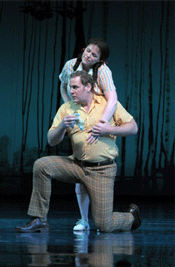 Lucas Meachem as Demetrius and Erin Wall as Helena
In their roles as the young lovers the two pairs appear — as distinct
from the otherworldly characters in the forest — in casual dress
reminiscent of the 1950s. Both pairs are distraught on varying grounds.
Lysander and Hermia form a vocal unity against the court which stands in
opposition to their love. In this, Ms. DeShong and Mr. Mathey express their
affection with pathos and sincerity in the duet with repeated “I swear to
thee.” Their plans are, at first, as neatly arranged as this vocal
harmony. This initial set of lovers gives way to Demetrius and Helena,
Demetrius in pursuit of Hermia yet himself being pursued by Helena. Once Oberon
witnesses the agitated relationship of the second pair, he resolves to
intercede and cause Demetrius to return the love of Helena by having Puck drop
essence of the magic herb in the man’s eye. In his aria “Welcome
Wanderer” Mr. Daniels sings lush, varying scales on
“eglantine” when describing to Puck both the plan for Demetrius and
his intentions for Tytania. After an interlude in which the rustic players
march through the forest and announce their forthcoming comedy of Pyramus
and Thisbe both pairs of lovers return. At first Lysander and Hermia
exchange emotional vows, Mr Mathey communicating his devotion with touchingly
expressive high notes. Puck distributes the herb to the wrong man, so that
Lysander transfers his affections to Helena who immediately takes flight. Once
the stage is again cleared of the lovers, Tytania enters accompanied by her
fairies, whom Ms. Christy addresses with ardorous melismas sung on
“quaint spirits.” As she falls asleep the fairy youth assigned to
guard her and the Indian boy also succumbs to slumber. Puck is able to take
away the boy and Oberon applies the magic herb to the Queen.
Highlights of confusion in the next part, corresponding to the second act,
include the further rehearsals of the actors and the quarrels of the perplexed
and divided lovers. When the rustics confront Bottom who has been turned into
an ass by the amused Puck, they scatter in fear. Both groups of lovers re-enter
and argue fiercely, the men exchanging fists and the women likewise hurling
insults at each other. Here Ms. Wall as Helena stands out as she sings of past
“friendship warbling of one song,” while decorating her words to
mimic a warble. In the meantime Tytania has fallen in love with Bottom thanks
to the machinations of Oberon and Puck with the magical herb. The Queen and her
companion sleep in her bower beneath the undulating sash as the lovers enhaust
themselves in quarrel and disappear. Oberon now scolds Puck for having
administered the herb to the wrong lover, in this production the punishment
emanating from the King’s hands as he matches movement to music. Puck is
charged with recalling the lovers individually and with releasing Lysander by a
further dose of the herb. As the act closes, the lovers all sleep and Tytania
remains enamored of Bottom in her dream.
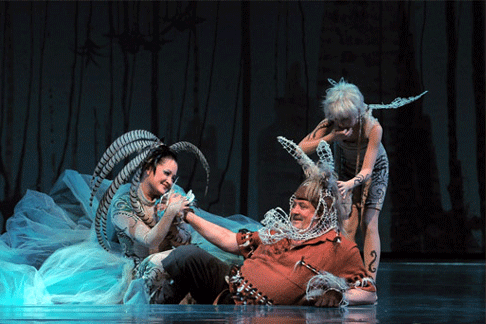 Anna Christy as Tytania and Peter Rose as Bottom
The final act in its two scenes sets the fairy rulers and the earthly lovers
once again “in amity.” As a means of celebrating by public event
the rustics ultimately perform their play before the royalty of Athens and
weddings ensue. In the first scene Tytania awakes and recounts what she
presumes to have been a dream. When Oberon directs her gaze to the sleeping
Bottom, she reacts in astonishment but is then reconciled to her King. As she
follows Oberon’s suggestion and declares “Music, ho…”
in order to foster sleep among the mortals, Ms. Christy’s voice gleams in
decorative gesture just as Bottom is again restored to human form. Once the
lovers awake, Demetrius is able to declare that he has “found fair Helena
like a jewel,” hence preparing for an amicable resolution among the four.
Mr. Meachem’s pronouncement is signaled by imbuing his voice with a warm,
lyrical tone as he sings together with the others in a harmonious round. Both
pairs are forgiven by the royal couple Theseus and Hippolyta as they prepare to
watch, in the final scene, the performance of Pyramus and Thisbe
enacted by the rustic players. Members of the Ryan Opera Center together with
Mr. Rose present a believably bumbling rendition of the play in costumes
matched to the parts they inhabit. All now married retire to sleep, as Puck
delivers the final words of apology, that “Robin shall restore
amends.”
Salvatore Calomino
Click here for additional information regarding this production.