![Paul Hindemith (1923) [Photo: Wikipedia]](http://www.operatoday.com/Paul_Hindemith_1923.gif)
14 Dec 2010
Paris: ‘Maler’ or ‘Malheur’?
No one could accuse the Paris Opera of pinching pennies (or Euro cents) in their lavishly expansive (and expensive) staging of Hindemith’s Mathis der Maler.
English Touring Opera are delighted to announce a season of lyric monodramas to tour nationally from October to December. The season features music for solo singer and piano by Argento, Britten, Tippett and Shostakovich with a bold and inventive approach to making opera during social distancing.
This tenth of ten Live from London concerts was in fact a recorded live performance from California. It was no less enjoyable for that, and it was also uplifting to learn that this wasn’t in fact the ‘last’ LfL event that we will be able to enjoy, courtesy of VOCES8 and their fellow vocal ensembles (more below …).
Ever since Wigmore Hall announced their superb series of autumn concerts, all streamed live and available free of charge, I’d been looking forward to this song recital by Ian Bostridge and Imogen Cooper.
Although Stile Antico’s programme article for their Live from London recital introduced their selection from the many treasures of the English Renaissance in the context of the theological debates and upheavals of the Tudor and Elizabethan years, their performance was more evocative of private chamber music than of public liturgy.
Evidently, face masks don’t stifle appreciative “Bravo!”s. And, reducing audience numbers doesn’t lower the volume of such acclamations. For, the audience at Wigmore Hall gave soprano Elizabeth Llewellyn and pianist Simon Lepper a greatly deserved warm reception and hearty response following this lunchtime recital of late-Romantic song.
For this week’s Live from London vocal recital we moved from the home of VOCES8, St Anne and St Agnes in the City of London, to Kings Place, where The Sixteen - who have been associate artists at the venue for some time - presented a programme of music and words bound together by the theme of ‘reflection’.
'Such is your divine Disposation that both you excellently understand, and royally entertaine the Exercise of Musicke.’
‘And there was war in heaven: Michael and his angels fought against the dragon; and the dragon fought and his angels, And prevailed not; neither was their place found any more in heaven … that old serpent … Satan, which deceiveth the whole world: he was cast out into the earth, and his angels were cast out with him.’
There was never any doubt that the fifth of the twelve Met Stars Live in Concert broadcasts was going to be a palpably intense and vivid event, as well as a musically stunning and theatrically enervating experience.
‘Love’ was the theme for this Live from London performance by Apollo5. Given the complexity and diversity of that human emotion, and Apollo5’s reputation for versatility and diverse repertoire, ranging from Renaissance choral music to jazz, from contemporary classical works to popular song, it was no surprise that their programme spanned 500 years and several musical styles.
The Academy of St Martin in the Fields have titled their autumn series of eight concerts - which are taking place at 5pm and 7.30pm on two Saturdays each month at their home venue in Trafalgar Square, and being filmed for streaming the following Thursday - ‘re:connect’.
The London Symphony Orchestra opened their Autumn 2020 season with a homage to Oliver Knussen, who died at the age of 66 in July 2018. The programme traced a national musical lineage through the twentieth century, from Britten to Knussen, on to Mark-Anthony Turnage, and entwining the LSO and Rattle too.
With the Live from London digital vocal festival entering the second half of the series, the festival’s host, VOCES8, returned to their home at St Annes and St Agnes in the City of London to present a sequence of ‘Choral Dances’ - vocal music inspired by dance, embracing diverse genres from the Renaissance madrigal to swing jazz.
Just a few unison string wriggles from the opening of Mozart’s overture to Le nozze di Figaro are enough to make any opera-lover perch on the edge of their seat, in excited anticipation of the drama in music to come, so there could be no other curtain-raiser for this Gala Concert at the Royal Opera House, the latest instalment from ‘their House’ to ‘our houses’.
"Before the ending of the day, creator of all things, we pray that, with your accustomed mercy, you may watch over us."
The doors at The Metropolitan Opera will not open to live audiences until 2021 at the earliest, and the likelihood of normal operatic life resuming in cities around the world looks but a distant dream at present. But, while we may not be invited from our homes into the opera house for some time yet, with its free daily screenings of past productions and its pay-per-view Met Stars Live in Concert series, the Met continues to bring opera into our homes.
Music-making at this year’s Grange Festival Opera may have fallen silent in June and July, but the country house and extensive grounds of The Grange provided an ideal setting for a weekend of twelve specially conceived ‘promenade’ performances encompassing music and dance.
There’s a “slide of harmony” and “all the bones leave your body at that moment and you collapse to the floor, it’s so extraordinary.”
“Music for a while, shall all your cares beguile.”
The hum of bees rising from myriad scented blooms; gentle strains of birdsong; the cheerful chatter of picnickers beside a still lake; decorous thwacks of leather on willow; song and music floating through the warm evening air.
No one could accuse the Paris Opera of pinching pennies (or Euro cents) in their lavishly expansive (and expensive) staging of Hindemith’s Mathis der Maler.
Unfortunately, sometimes more can be less, and the personal plight of the characters too often seemed secondary to the hulking, tracking set design created by Pierre-André Weitz. Not that it wasn’t well constructed and functional. It was. Mostly. But the massive three-story facade with staircases and platforms and ornate gleaming gold frou-frou dwarfed everything and everyone every time it appeared. It was meant to dazzle, and it did sparkle and gleam, but mostly it distracted as it rolled, sunk, rotated and did everything but stand on its head and whistle Dixie.
Having updated the period to just after the time of its composition (read: WW2), there were some coherent images that paralleled Matthias Grűnewald’s struggle for artistic expression in the repressive climate of his day with the challenges Hindemith faced as the Nazis gained control of the country. But there were many other ideas that just didn’t quite mesh with the tale of the beleaguered painter of the colorful Isenheim Alterpiece. And there were some downright oddities in scenic decisions.
Why did a functional, chest-high platform bearing a living quasi-tableau of the altarpiece have holes in its floor so that characters could stand up on the (lower) main stage floor, chest-high in the spaces? In fact, what on earth was director Oliver Py thinking when he had the cast bending over and crawling underneath said platform to get from behind it to the stage apron to sing? What was that about? St. Cunegonde’s cure for backaches? Too often the performers seemed to be singing to us, or about each other, rather than to each other.
The siege/attack/rebellion segments were physicalized by manually rolling on Panzers and tromping in storm troopers, and placing it all in bombed out mansions and government buildings, and lacing it heavily with swastikas. All well and good enough I suppose, but the dreariness of war-torn Germany made the occasionally ponderous writing even more turgid, and the resonance that the creative team had aspired to didn’t quite occur. Weitz fared better with his characterful 40’s costumes, although there was the odd 15th century garb hither and thither that garbled the physical impression.
In an apparent attempt to goose up the visuals, lighting designer Bertrand Kelly seemed to pull out all the stops with a riot of gobo effects, hazers, film loops, rotating prisms, Vari-Lites, you name it. It was not unlike a stage lighting trade show. In addition to some lively and evocative illumination, however, Mr. Kelly also turned blinding white lights on the audience on more than one occasion, causing patrons to physically turn their heads away, wince and squint, hold a hand up to shield their eyes, and generally react with considerable discomfort. Hmmmmm. Were the focus to be more sensibly adjusted, this would make the light plot emphatically the most satisfying design element, for it was otherwise well-considered.
The title role calls for heroic utterance and Herculean stamina. Matthias Goerne had quite enough of the latter if not the former. I greatly enjoy Mr. Goerne in recital, and was entertained by his Papageno in Salzburg. But precious nuance, and engaging charm are not what Mr. Hindemith is asking for. Our leading man is more often than not called upon to pour out pulsing, solid phrases over a multi- and thickly-layered orchestration. Our baritone was found slightly wanting on the lower conversational passages and the upper forte extremes of the part. The rich middle voice was deployed very conscientiously, although it has to be said that Goerne’s grainy tone did not always slice through the accompaniment with ease, if at all. The top was pressed when volume was needed and turned somewhat straight and dry. Happily, the final great monologue played to all of his considerable interpretive gifts, and he managed to limn a moving finale, limpid and introspective without being self-pitying. Matthias is undeniably a major artist but the role is simply a size too large for his instrument. Pity.
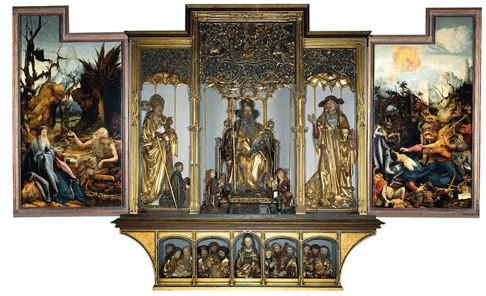 Isenheim Altarpiece by Matthias Grünewald (1506-1515)
Not so with the Albrecht von Brandenburg as sung by Scott MacAllister. The bright, incisive, clarion tenor may not have the elegant richness of say, James King, but McAllister nails the part. Is it quibbling to wish that he was capable of more variety of color when he sings it this well? I also admired Thorsten Gruen who utilized his vibrant, dark bass baritone to good musical effect as Lorenz von Pommersfelden. Every bit his equal, Michael Weinius offered a beautiful orotund bass in the service of Hans Schwalb. In the less grateful role of Wolfgang Capito, Wolfgang Ablinger-Sperrhacke was musically competent if dramatically flat, and did all that was required, if no more. Gregory Reinhart’s solid bass gave much pleasure as Riedinger, with veteran basso Antoine Garcin in thundering voice as Truchsess von Waldburg.
Melanie Diener has a fine career going with notable appearances at major houses. Hers is a meaty enough soprano, with a reedy quality and quicksilver vibrato that serves the role of Ursula very well indeed. She has a vibrant stage presence and is wholly involved in the drama. Her musical instincts are first rate, and her sound technique delivers whatever she (and the composer) asks of it. It is true, the cruelly high tessitura on a few angular phrases challenged her to modulate to a thinner, tighter production. But Ms. Diener delivered the goods, and projected the most fire of anyone on the stage. Curiously, she didn’t have quite the cumulative impact I imagined she should, but maybe it is a limitation of the writing? Altogether a first class performance none the less.
The lovely, lilting singing from lovely, blond Martina Welschenbach also brought much joy to the proceedings as Regina. Ms. Welschenbach also has a winning stage demeanor and dramatic savvy. Her well-schooled soprano rang out with good presence, and she assuredly contributed some of the evening’s most affecting phrasing. Nadine Weissman gave a solid, plummy account of the Countess of Helfenstein’s featured scenes.
Mathis der Maleris unquestionably better known as a greatly truncated symphonic piece and if we have any expectations coming into the auditorium, it is to hear the orchestral music thrilling played. Christoph Eschenbach and his splendid orchestra did not disappoint. The greater the challenge the better this group seems to play and they were riveting all night as they tossed off every fiendish requirement Hindemith could devise. Rich, complex banks of strings? You got it. Virtuosic solo turns? No problem. Heart-racing rhythmic effects? Check. Magnificent work from the pit. And kudos to the always fine chorus under the tutelage of Patrick Marie Aubert.
I have (perhaps overly) fond recollections of a beautifully sung, sparingly staged version of the piece in Wiesbaden many years ago, with the altarpiece itself forming almost the entire scenic concept. Masterful, I thought at the time. I found myself longing for its simpler, less bombastic pleasures. But still, it is always wonderful to have any opportunity at all to see Mathis der Maler and if Paris’s unruly design elements are really more “malheur” than “Maler” perhaps they could be tamed, the blocking quirks addressed, and the current staging might just yet be fully redeemed by its superior musical achievements.
James Sohre