![Nina Stemme as Brünnhilde and Vitalij Kowaljow as Wotan [Photo by Marco Brescia & Rudy Amisano, Archivio Fotografico del Teatro alla Scala]](http://www.operatoday.com/Walkure_LaScala_01.gif)
11 Dec 2010
Die Walküre at La Scala
The opening night of the new season at Teatro alla Scala Milan is a gala event, the most glamorous in the entire Italian opera year.
English Touring Opera are delighted to announce a season of lyric monodramas to tour nationally from October to December. The season features music for solo singer and piano by Argento, Britten, Tippett and Shostakovich with a bold and inventive approach to making opera during social distancing.
This tenth of ten Live from London concerts was in fact a recorded live performance from California. It was no less enjoyable for that, and it was also uplifting to learn that this wasn’t in fact the ‘last’ LfL event that we will be able to enjoy, courtesy of VOCES8 and their fellow vocal ensembles (more below …).
Ever since Wigmore Hall announced their superb series of autumn concerts, all streamed live and available free of charge, I’d been looking forward to this song recital by Ian Bostridge and Imogen Cooper.
The Sixteen continues its exploration of Henry Purcell’s Welcome Songs for Charles II. As with Robert King’s pioneering Purcell series begun over thirty years ago for Hyperion, Harry Christophers is recording two Welcome Songs per disc.
Although Stile Antico’s programme article for their Live from London recital introduced their selection from the many treasures of the English Renaissance in the context of the theological debates and upheavals of the Tudor and Elizabethan years, their performance was more evocative of private chamber music than of public liturgy.
In February this year, Albanian soprano Ermonela Jaho made a highly lauded debut recital at Wigmore Hall - a concert which both celebrated Opera Rara’s 50th anniversary and honoured the career of the Italian soprano Rosina Storchio (1872-1945), the star of verismo who created the title roles in Leoncavallo’s La bohème and Zazà, Mascagni’s Lodoletta and Puccini’s Madama Butterfly.
Evidently, face masks don’t stifle appreciative “Bravo!”s. And, reducing audience numbers doesn’t lower the volume of such acclamations. For, the audience at Wigmore Hall gave soprano Elizabeth Llewellyn and pianist Simon Lepper a greatly deserved warm reception and hearty response following this lunchtime recital of late-Romantic song.
Collapsology. Or, perhaps we should use the French word ‘Collapsologie’ because this is a transdisciplinary idea pretty much advocated by a series of French theorists - and apparently, mostly French theorists. It in essence focuses on the imminent collapse of modern society and all its layers - a series of escalating crises on a global scale: environmental, economic, geopolitical, governmental; the list is extensive.
For this week’s Live from London vocal recital we moved from the home of VOCES8, St Anne and St Agnes in the City of London, to Kings Place, where The Sixteen - who have been associate artists at the venue for some time - presented a programme of music and words bound together by the theme of ‘reflection’.
'Such is your divine Disposation that both you excellently understand, and royally entertaine the Exercise of Musicke.’
Amongst an avalanche of new Mahler recordings appearing at the moment (Das Lied von der Erde seems to be the most favoured, with three) this 1991 Mahler Second from the 2nd Kassel MahlerFest is one of the more interesting releases.
‘And there was war in heaven: Michael and his angels fought against the dragon; and the dragon fought and his angels, And prevailed not; neither was their place found any more in heaven … that old serpent … Satan, which deceiveth the whole world: he was cast out into the earth, and his angels were cast out with him.’
If there is one myth, it seems believed by some people today, that probably needs shattering it is that post-war recordings or performances of Wagner operas were always of exceptional quality. This 1949 Hamburg Tristan und Isolde is one of those recordings - though quite who is to blame for its many problems takes quite some unearthing.
There was never any doubt that the fifth of the twelve Met Stars Live in Concert broadcasts was going to be a palpably intense and vivid event, as well as a musically stunning and theatrically enervating experience.
‘Love’ was the theme for this Live from London performance by Apollo5. Given the complexity and diversity of that human emotion, and Apollo5’s reputation for versatility and diverse repertoire, ranging from Renaissance choral music to jazz, from contemporary classical works to popular song, it was no surprise that their programme spanned 500 years and several musical styles.
The Academy of St Martin in the Fields have titled their autumn series of eight concerts - which are taking place at 5pm and 7.30pm on two Saturdays each month at their home venue in Trafalgar Square, and being filmed for streaming the following Thursday - ‘re:connect’.
The London Symphony Orchestra opened their Autumn 2020 season with a homage to Oliver Knussen, who died at the age of 66 in July 2018. The programme traced a national musical lineage through the twentieth century, from Britten to Knussen, on to Mark-Anthony Turnage, and entwining the LSO and Rattle too.
With the Live from London digital vocal festival entering the second half of the series, the festival’s host, VOCES8, returned to their home at St Annes and St Agnes in the City of London to present a sequence of ‘Choral Dances’ - vocal music inspired by dance, embracing diverse genres from the Renaissance madrigal to swing jazz.
Just a few unison string wriggles from the opening of Mozart’s overture to Le nozze di Figaro are enough to make any opera-lover perch on the edge of their seat, in excited anticipation of the drama in music to come, so there could be no other curtain-raiser for this Gala Concert at the Royal Opera House, the latest instalment from ‘their House’ to ‘our houses’.
"Before the ending of the day, creator of all things, we pray that, with your accustomed mercy, you may watch over us."
The opening night of the new season at Teatro alla Scala Milan is a gala event, the most glamorous in the entire Italian opera year.
Because it’s so high profile it attracts inordinate extra-musical interest. This year the big news was a huge demonstration outside the theatre protesting a 37% cut in arts funding. Violence broke out, many were injured. When the President of Italy, Giorgio Napolitano, and his entourage took their seats in the royal box, festooned with ten thousand roses, Daniel Barenboim made an impromptu speech supporting the protesters. “In the names of the colleagues who play, sing, dance and work, not only here but in all theatres, I am here to tell you we are deeply worried for the future of culture in the country and in Europe.” Massive applause. The President joined in.
Barenboim’s never been afraid of standing up for what he believes in. He’s also a passionate believer in Wagner’s music and is one of its most committed interpreters. This performance of Wagner’s Die Walküre, broadcast live internationally, may not have been the most exemplary in orchestral terms, but there’s no denying Barenboim’s flair.
The cast was truly grand luxeas befitted the occasion. Rene Pape had cancelled a few weeks before but there were stars aplenty. Waltraud Meier, Nina Stemme, Ekaterina Gubanova, John Tomlinson, Simon O’Neill and Vitalij Kowaljow, replacing the indisposed Rene Pape.
Waltraud Meier is one of the greatest Wagnerians of all time. Any opportunity to hear her cannot be missed, for she has created all the roles and understands their place in the grand scheme. Although she’s no longer in the first bloom of youth, her artistry is such that she can create a Sieglinde so ravishing that she seems transfigured. Sieglinde’s past has been too traumatic for her to be an ingenue. so Meier’s interpretation emphasizes the way Seiglinde blossoms as love awakens her, like a parched plant unfurling after a long drought. When Meier sings “Du bist der Lenz”, her voice warms and opens outwards. It’s so expressive that she creates the idea of the world ash tree bursting into leaf despite the barren surroundings.
Wonderful as Meier is, even she is outclassed by Nina Stemme’s Brünnhilde. Stemme is so lively and vivacious that she completely dispels any memories of historic, matronly Brünnhildes, with metal breastplates, horned helmets and spears. Instead, she’s dressed in what could pass as a modern if quirky evening dress, a blend of lace and bombazine with hints of Goth and punk. The costume (Tim van Steenbergen) fixes Brünnhilde at once in Wagner’s world of political rebellion and in present day ideas of generation conflict.
Stemme’s youthful energy and spark highlight her idealism and high principles. She’s not intimidated by Wotan, however much she loves him. Here, already in germination, is the Brünnhilde of Götterdämmerung who will defy death itself to right the wrongs that have gone before. Stemme’s voice pulsates with intensity, and softens with tenderness, her control firm and measured. Stemme’s vigour might have been even more impressive against a more dominant Wotan, but Vitalij Kowaljow was adequate rather than brooding. Nonetheless, of the male singers in this performance, he held up best.
John Tomlinson’s Hunding was more genial than malevolent, more aging rock star (complete with pony tail) than abusive brigand. Sieglinde might have been more bored than cowed. Still, everyone loves Tomlinson and the role isn’t huge. More worrying was Simon O’Neill’s Siegmund. Apparently he’d been indisposed in rehearsal. Perhaps he should have cancelled, for he had vocal problems from the start, After his voice cracked on “Schwester!”, things deteriorated. Since O’Neill isn’t especially mobile physically, he couldn’t fall back on acting skills when the voice failed. There is no shame in cancellation, and it’s better not to risk long term damage.
Ekaterina Gubanova’s Fricka was superb, elevating the role from a minor part to something far more profound. Usually the role is unsympathetic as our feelings about Hunding are negative, and it’s Fricka who demands that he be revenged, even though he married Sieglinde by force. Gubanova looks and sings with youthful radiance, connected more to the idea of growth and refreshment than to barrenness and drought. After all she stands for moral principles, just as Brünnhilde does. Wotan defiles marriage by scattering offspring everywhere, destroying many lives. Fricka stands for good, even if she’s stern, as Gubanova’s interesting portrayal suggests.
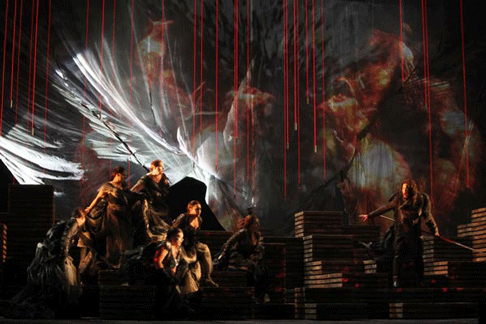 Scene from Act III
Unfortunately the direction and staging did little to develop the ideas inherent in the opera and in the superb performances by Meier, Stemme and Gubanova. Hunding’s house in the First Act was very well expressed - a cube of mirrors, glowing with light, encroached upon by dark chaos. Perhaps this was what Guy Cassiers, the director, referred to as the inward-looking paranoia of gated communities, when interviewed. After all, Hunding’s hearth is a down-market Valhalla and Hunding was a bandit, just as Wotan and Alberich got ahead through deception.
Yet this good idea didn’t develop. Act Three was a forest of vertical slivers lit by green light to suggest a forest, nothing more. The magic fire in Act Three was just silly. Nonetheless, compared to the recent Met Das Rheingold (Robert Lepage) Cassier’s direction had merit, especially in terms of Personenregie and vocal finesse. With experienced stars like Meier, Stemme and Gubanova, he could hardly go wrong. One could imagine a truly original ground-breaking interpretation of Die Walküre with stars like this but it’s too much to expect in reality. This La Scala Die Walküre wasn’t remarkable in itself (apart from the three leading female roles) but could spark off further insight that might bear fruit in future productions.
Anne Ozorio