‘A brief history of song’ is the subtitle of the 2020 Oxford Lieder Festival (10th-17th October), which will present an ambitious, diverse and imaginative programme of 40 performances and events.
‘Signor Piatti in a fantasia on themes from Beatrice di Tenda had also his triumph. Difficulties, declared to be insuperable, were vanquished by him with consummate skill and precision. He certainly is amazing, his tone magnificent, and his style excellent. His resources appear to be inexhaustible; and altogether for variety, it is the greatest specimen of violoncello playing that has been heard in this country.’
Eboracum Baroque is a flexible period instrument ensemble, comprising singers and instrumentalists, which was founded in York - as its name suggests, Eboracum being the name of the Roman fort on the site of present-day York - while artistic director Chris Parsons was at York University.
‘There could be no happier existence. Each morning he composed something beautiful and each evening he found the most enthusiastic admirers. We gathered in his room - he played and sang to us - we were enthusiastic and afterwards we went to the tavern. We hadn’t a penny but were blissfully happy.’
When soprano Eleanor Dennis was asked - by Ashok Klouda, one of the founders and co-directors of the Highgate International Chamber Music Festival - to perform some of Beethoven’s Scottish Songs Op.108 at this year’s Festival, as she leafed through the score to make her selection the first thing that struck her was the beauty of the poetry.
“At the start, one knows ‘bits’ of it,” says tenor Mark Padmore, somewhat wryly, when I meet him at the Stage Door of the Royal Opera House where the tenor has just begun rehearsals for David McVicar’s new production of Death in Venice, which in November will return Britten’s opera to the ROH stage for the first time since 1992.
When British opera director Nina Brazier tries to telephone me from Frankfurt, where she is in the middle of rehearsals for a revival of Florentine Klepper’s 2015 production of Martinů’s Julietta, she finds herself - to my embarrassment - ‘blocked’ by my telephone preference settings. The technical hitch is soon solved; but doors, in the UK and Europe, are certainly very much wide open for Nina, who has been described by The Observer as ‘one of Britain’s leading young directors of opera’.
“We need to stop talking about ‘diversity’ and think instead about ‘inclusivity’,” says Bill Bankes-Jones, when we meet to talk about the forthcoming twelfth Tête à Tête Opera Festival which runs from 24th July to 10th August.
For Peter Sellars, Mozart’s Idomeneo is a ‘visionary’ work, a utopian opera centred on a classic struggle between a father and a son written by an angry 25-year-old composer who wanted to show the musical establishment what a new generation could do.
“Physiognomy, psychology and technique.” These are the three things that determine the way a singer’s sound is produced, so Ken Querns-Langley explains when we meet in the genteel surroundings of the National Liberal Club, where the training programmes, open masterclasses and performances which will form part the third London Bel Canto Festival will be held from 5th-24th August.
“Sop. Page, attendant on the King.” So, reads a typical character description of the loyal page Oscar, whose actions, in Verdi’s Un ballo in maschera, unintentionally lead to his monarch’s death. He reveals the costume that King Gustavo is wearing at the masked ball, thus enabling the monarch’s secretary, Anckarstroem, to shoot him. The dying King falls into the faithful Oscar’s arms.
A mournful Princess forced by her father into an arranged marriage. A Prince who laments that no-one loves him for himself, and so exchanges places with his aide-de-camp. A melancholy dreamer who dons a deceased jester’s motley and finds himself imprisoned for impertinence.
‘Aloneness’ does not immediately seem a likely or fruitful subject for an opera. But, loneliness and isolation - an individual’s inner sphere, which no other human can truly know or enter - are at the core of Yasushi Inoue’s creative expression.
What links Wagner’s Das Rheingold, Donizetti’s Anna Bolena, Mozart’s Don Giovanni and Cavalli’s La Calisto? It sounds like the sort of question Paul Gambaccini might pose to contestants on BBC Radio 4’s music quiz, Counterpoint.
Though she won praise from the literary greats of her day, including Thomas Hardy, Virginia Woolf, Ezra Pound and Siegfried Sassoon, the Victorian poet Charlotte Mew (1869-1928) was little-known among the contemporary reading public. When she visited the Poetry Bookshop of Harold Monro, the publisher of her first and only collection, The Farmer’s Bride (1916), she was asked, “Are you Charlotte Mew?” Her reply was characteristically diffident and self-deprecatory: “I’m sorry to say I am.”
“It lives!” So cries Victor Frankenstein in Richard Brinsley Peake’s Presumption: or the Fate of Frankenstein on beholding the animation of his creature for the first time. Peake might equally have been describing the novel upon which he had based his 1823 play which, staged at the English Opera House, had such a successful first run that it gave rise to fourteen further adaptations of Mary Shelley’s 1818 novella in the following three years.
It sounds like a question from a BBC Radio 4 quiz show: what links Handel’s cantata for solo contralto, La Lucrezia, Samuel Beckett’s Krapp’s Last Tape, and the post-punk band Joy Division?
The first two instalments of the Academy of Ancient Music’s ‘Purcell trilogy’ at the Barbican Hall have posed plentiful questions - creative, cultural and political.
Elizabeth Futral has established herself as one of the major coloratura sopranos in the world today. With her stunning vocalism and vast dramatic range, she has embraced a diverse repertoire that includes Vivaldi, Handel, Mozart, Bellini, Donizetti, Rossini, Verdi, Glass, and Previn.
Elizabeth Futral — An Interview
By Sarah Luebke
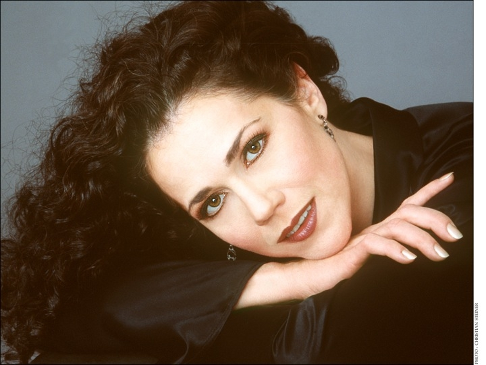
Above: Elizabeth Futral [Photo courtesy of Neil Funkhouser Artists Management]
At this season’s production of The Tales of Hoffmann by Florida Grand Opera, she takes on a tour-de-force portrayal of all four of Hoffmann’s loves. She spoke with Sarah Luebke.
SL: Offenbach intended that the same singer play the four female roles, for
Olympia, Giulietta and Antonia are three facets of Stella, Hoffmann’s
unreachable love. However, most houses use separate sopranos, a coloratura for
Olympia, a lyric for Antonia, and a dramatic soprano or mezzo for Giulietta.
What was the impetus for you to essay the music of all four Heroines?
EF: I was asked to do the roles once before in the past, about seven or eight
years ago, but had questions about the stamina aspects of getting through it
all. After I had done several performances of Traviata along with
bigger, more dramatic roles, I felt ready to sustain singing for the whole role
[in Hoffmann].
SL: With your voice classified as a fuller lyric coloratura soprano,
what have you found to be challenging vocally executing these roles in one
performance?
EF: It actually works really well. I have found in rehearsals that climbing
down from heights of Olympia to middle tessitura of Antonia can be
tricky. Between Olmypia and Antonia, during intermission, I need to allow my
voice and my mindset to settle, relaxing breath and body and throat, and
allowing the middle voice to come in easily without pressing. Guilietta is a
little lower, but not out of reach. She is more episodic, with recitative-like
passages, which is very different from the aria and trio of Antonia.
SL: Italian Bel Canto and Verismo opera seem to be your
go-to styles as of late. How has the shift to Offenbach’s style and the
French aesthetic changed the way you approach your musical and dramatic
preparation?
EF: I think [Hoffmann] falls into the world of the lyrical, romantic
style with a comedic edge. I have always loved singing in French; something to
do with the language helps with a natural vocal placement for healthy
production. The coloratura of Olympia is akin to Lakemé’s
“Bell Song” with lots of fireworks, but it starts with a healthy
sense of humor, especially in the out of control coda! Antonia is much more
beautiful melodic music. It’s very singable with sweeping French romantic
lines — very fun to sing.
SL: Anything unpredictable happening in Florida Grand Opera’s production
of Hoffmann?
EF: What I couldn’t have predicted with this production was how
difficult the costuming would be. It takes the whole intermission to take paint
off [of Olympia], and completely changing elaborate costumes, for both changes
from Olympia to Antonia and Antonia to Giulietta. I begin getting into costume,
and once I start I never have a moment to sit down; I’m on go the whole
time. It’s been a little crazy and more challenging that trying to sing
the thing! I really like [Florida Grand Opera’s] production. It’s
really fun and entertaining, and moving when it needs to be.
SL: In the beginning of your career in the mid-nineties, your career took off
with your performance of the title role of Lakme with New York City Opera. Many
of those early roles included Lucia, Violetta, Guilda, and Susannah. Will your
success in the Hoffmann Heroines give you the go-ahead to essay more
dramatic or fuller lyric roles?
EF: The natural maturation process of one’s voice leads to some
different things. This role has confirmed that I can do a broader range. Some
things I’m considering that might be more of a stretch include Blanche
[Dialogues des Carmelites], Marguerite [Faust]… also
the bigger Bel Canto roles such as Anna Bolena might work well for me.
It’s fun to think about new possibilities. I’ve always had a great
time learning new roles, and I love the challenge of creating a new character.
I get bored doing the same five roles over and over. This keeps me ticking, and
I’m thrilled that new things are opening up.
SL: You have such an interesting background embracing and premiering a variety
of new operas, including Andre Previn’s A Streetcar Named Desire
and Brief Encounter, Ricky Ian Gordon’s Orpheus and
Euridice and Ernst Krenek’s Die Nachtigall. You have also
appeared opposite Placido Domingo on a 2007 Met Live in HD broadcast of Tan
Dun’s First Emperor. Do you have any upcoming plans for
premiering new works?
EF: I’m learning a new opera by Finnish female composer Kaija Saariaho,
Émilie. This is a one women show I’ll be doing at the Spoletto
Festival USA in Charleston, SC. It’s a daunting piece to
learn…it’s all me, 80 minutes, 8 scenes. I’m on stage the
whole time. The music is challenging, and it’s a little challenging to
learn. But I’m just getting cracking at it now in between rehearsals and
performances. This is definitely exciting and a big thing for me.
![Elizabeth Futral [Photo courtesy of Neil Funkhouser Artists Management]](http://www.operatoday.com/Elizabeth_Futral_broadband.png)