![Sondra Radvanovsky as Tosca [Photo by Marty Sohl courtesy of The Metropolitan Opera]](http://www.operatoday.com/Tosca_Met_2010-11_01.gif)
16 Jan 2011
Tosca, Metropolitan Opera
They have been fiddling with Luc Bondy’s staging of Tosca. Scarpia doesn’t masturbate on the Madonna; he just sort of pinches her erotically.
English Touring Opera are delighted to announce a season of lyric monodramas to tour nationally from October to December. The season features music for solo singer and piano by Argento, Britten, Tippett and Shostakovich with a bold and inventive approach to making opera during social distancing.
This tenth of ten Live from London concerts was in fact a recorded live performance from California. It was no less enjoyable for that, and it was also uplifting to learn that this wasn’t in fact the ‘last’ LfL event that we will be able to enjoy, courtesy of VOCES8 and their fellow vocal ensembles (more below …).
Ever since Wigmore Hall announced their superb series of autumn concerts, all streamed live and available free of charge, I’d been looking forward to this song recital by Ian Bostridge and Imogen Cooper.
Although Stile Antico’s programme article for their Live from London recital introduced their selection from the many treasures of the English Renaissance in the context of the theological debates and upheavals of the Tudor and Elizabethan years, their performance was more evocative of private chamber music than of public liturgy.
Evidently, face masks don’t stifle appreciative “Bravo!”s. And, reducing audience numbers doesn’t lower the volume of such acclamations. For, the audience at Wigmore Hall gave soprano Elizabeth Llewellyn and pianist Simon Lepper a greatly deserved warm reception and hearty response following this lunchtime recital of late-Romantic song.
For this week’s Live from London vocal recital we moved from the home of VOCES8, St Anne and St Agnes in the City of London, to Kings Place, where The Sixteen - who have been associate artists at the venue for some time - presented a programme of music and words bound together by the theme of ‘reflection’.
'Such is your divine Disposation that both you excellently understand, and royally entertaine the Exercise of Musicke.’
‘And there was war in heaven: Michael and his angels fought against the dragon; and the dragon fought and his angels, And prevailed not; neither was their place found any more in heaven … that old serpent … Satan, which deceiveth the whole world: he was cast out into the earth, and his angels were cast out with him.’
There was never any doubt that the fifth of the twelve Met Stars Live in Concert broadcasts was going to be a palpably intense and vivid event, as well as a musically stunning and theatrically enervating experience.
‘Love’ was the theme for this Live from London performance by Apollo5. Given the complexity and diversity of that human emotion, and Apollo5’s reputation for versatility and diverse repertoire, ranging from Renaissance choral music to jazz, from contemporary classical works to popular song, it was no surprise that their programme spanned 500 years and several musical styles.
The Academy of St Martin in the Fields have titled their autumn series of eight concerts - which are taking place at 5pm and 7.30pm on two Saturdays each month at their home venue in Trafalgar Square, and being filmed for streaming the following Thursday - ‘re:connect’.
The London Symphony Orchestra opened their Autumn 2020 season with a homage to Oliver Knussen, who died at the age of 66 in July 2018. The programme traced a national musical lineage through the twentieth century, from Britten to Knussen, on to Mark-Anthony Turnage, and entwining the LSO and Rattle too.
With the Live from London digital vocal festival entering the second half of the series, the festival’s host, VOCES8, returned to their home at St Annes and St Agnes in the City of London to present a sequence of ‘Choral Dances’ - vocal music inspired by dance, embracing diverse genres from the Renaissance madrigal to swing jazz.
Just a few unison string wriggles from the opening of Mozart’s overture to Le nozze di Figaro are enough to make any opera-lover perch on the edge of their seat, in excited anticipation of the drama in music to come, so there could be no other curtain-raiser for this Gala Concert at the Royal Opera House, the latest instalment from ‘their House’ to ‘our houses’.
"Before the ending of the day, creator of all things, we pray that, with your accustomed mercy, you may watch over us."
The doors at The Metropolitan Opera will not open to live audiences until 2021 at the earliest, and the likelihood of normal operatic life resuming in cities around the world looks but a distant dream at present. But, while we may not be invited from our homes into the opera house for some time yet, with its free daily screenings of past productions and its pay-per-view Met Stars Live in Concert series, the Met continues to bring opera into our homes.
Music-making at this year’s Grange Festival Opera may have fallen silent in June and July, but the country house and extensive grounds of The Grange provided an ideal setting for a weekend of twelve specially conceived ‘promenade’ performances encompassing music and dance.
There’s a “slide of harmony” and “all the bones leave your body at that moment and you collapse to the floor, it’s so extraordinary.”
“Music for a while, shall all your cares beguile.”
The hum of bees rising from myriad scented blooms; gentle strains of birdsong; the cheerful chatter of picnickers beside a still lake; decorous thwacks of leather on willow; song and music floating through the warm evening air.
They have been fiddling with Luc Bondy’s staging of Tosca. Scarpia doesn’t masturbate on the Madonna; he just sort of pinches her erotically.
The firing squad doesn’t rehearse during the exquisite music Puccini wrote to illustrate a perfectly silent, motionless dawn in Rome; instead, the Jailer plays chess with Cavaradossi. The show is still hideously ugly, no incitement to any opera-lovers ever to return to this opera, but casting three terrific singing actors in the leads—one of them a role debut, another a surprise, last-minute house debut, no less—makes a world of difference to the Tosca experience (as perhaps the presentation should be entitled). Seeing any director monkey with a theatrical machine as carefully made as Tosca, with its precise alignments of movement to music (the window that must be shut just as the cantata cuts off, the candles placed beside the corpse, the sunrise with churchbells, and dozens more), you’d think, would give opera directors pause about attempting to “improve” on a classic. But it doesn’t. They just think how much of a reputation they can make by breaking the smoothly running parts. Why don’t they just piss on it out of our sight? That would contribute as much.
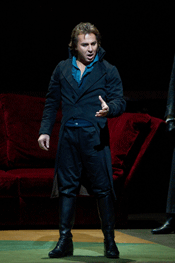 Roberto Alagna as Cavaradossi
However: Considering the train wreck of a year ago—was it
only?—my return to Tosca proved surprisingly satisfying.
Sondra Radvanovsky was singing her first Tosca at the Met—was it her first anywhere? She has a big voice—Met-sized, I’d call it. Too, she is a handsome woman and a passionate actress, with excellent stage instincts. She has been known to go overboard at times, and she did so here, in the outsize boohoos that ornamented her response to her lover’s apparent treachery in Act I, and in the “roll in the hay” under Cavaradossi on the church floor, but opera, especially Verismo opera, is an art with room for going overboard that is not often utilized these days, or not by singers, or not by singers with any gift for high style. I found her thrilling in the part.
My doubts about Radvanovsky have to do with a basic harshness of her instrument. The color does not always give pleasure in sensuous roles with a touch of bel canto to them, such as Leonora (her signature part) or Elena. But Tosca does not fall into that category: Even at her most sensuous, this woman is brittle, excited, suspicious, a little frantic. Radvanovsky inhabited Tosca as Tosca has not been inhabited in the Met for some time. Just don’t expect any Tebaldi or Caballé legatos.
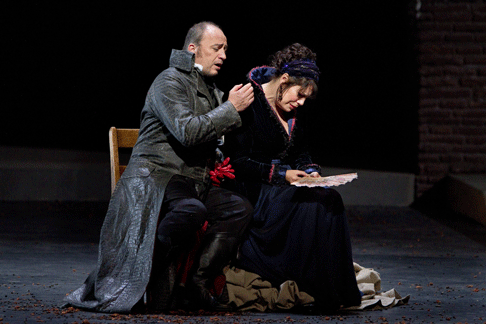 Falk Struckmann as Scarpia and Sondra Radvanovsky as Tosca
Marcelo Álvarez was to have sung Cavaradossi. He withdrew mere hours before the performance, and Roberto Alagna, who was in town to sing Don José and has never sung Cavaradossi here, stepped in for him. What a treat! It says a great deal for Mr. Alagna’s stage sense, which has never been in doubt, that he rarely seemed confused by this unpredictable and complicated staging. His singing, a bit tentative and low-powered at first, built in the course of the evening to the appropriate fire and polish for “Vittoria, vittoria!” His “E lucevan le stelle” was not the most sensuous or dreamy account one has heard of it, but it was gritty and real, poignant and despairing. There was genuine chemistry between him and his Floria, and genuine shock on her part when she found he was dead.
Falk Struckmann is more actor than voice, and Scarpia rewards such talent. He did not overdo the gross touches director Luc Bondy inserted into this staging, and his authority and brutality were in no doubt, but he used them suavely, not overbearingly: a commanding figure, not a gross one. This led to one moment of great humor: When Tosca informed him she intended to leave Rome (after yielding to his lust), Struckmann’s Scarpia parodied a tearful admirer, sentimentally brokenhearted by the news—sarcastically amused by her melodramatic reaction. Too, he was laughing when he assaulted her at last, so that we could enjoy his furious discomfiture the more.
Two further things added to my enjoyment: On this the first night in the production (and with no rehearsal for one of the leading singers), no one seemed to be staring at the conductor, Marco Armiliato, who pieced the well-molded parts of the Tosca jigsaw puzzle together with admirable skill and precision, drowning no one out, foreshadowing and echoing with precision. Second, they have figured out how to mime Tosca’s leap into space without forfeiting either probability or the desired shock.
John Yohalem