![Eva-Maria Westbroek as Anna Nicole [Photo by Bill Cooper courtesy of The Royal Opera]](http://www.operatoday.com/Anna_Nicole_01.png)
18 Feb 2011
Anna Nicole, London
From the sublime (Parsifal, the night before) to the not-even-ridiculous.
English Touring Opera are delighted to announce a season of lyric monodramas to tour nationally from October to December. The season features music for solo singer and piano by Argento, Britten, Tippett and Shostakovich with a bold and inventive approach to making opera during social distancing.
This tenth of ten Live from London concerts was in fact a recorded live performance from California. It was no less enjoyable for that, and it was also uplifting to learn that this wasn’t in fact the ‘last’ LfL event that we will be able to enjoy, courtesy of VOCES8 and their fellow vocal ensembles (more below …).
Ever since Wigmore Hall announced their superb series of autumn concerts, all streamed live and available free of charge, I’d been looking forward to this song recital by Ian Bostridge and Imogen Cooper.
Although Stile Antico’s programme article for their Live from London recital introduced their selection from the many treasures of the English Renaissance in the context of the theological debates and upheavals of the Tudor and Elizabethan years, their performance was more evocative of private chamber music than of public liturgy.
Evidently, face masks don’t stifle appreciative “Bravo!”s. And, reducing audience numbers doesn’t lower the volume of such acclamations. For, the audience at Wigmore Hall gave soprano Elizabeth Llewellyn and pianist Simon Lepper a greatly deserved warm reception and hearty response following this lunchtime recital of late-Romantic song.
For this week’s Live from London vocal recital we moved from the home of VOCES8, St Anne and St Agnes in the City of London, to Kings Place, where The Sixteen - who have been associate artists at the venue for some time - presented a programme of music and words bound together by the theme of ‘reflection’.
'Such is your divine Disposation that both you excellently understand, and royally entertaine the Exercise of Musicke.’
‘And there was war in heaven: Michael and his angels fought against the dragon; and the dragon fought and his angels, And prevailed not; neither was their place found any more in heaven … that old serpent … Satan, which deceiveth the whole world: he was cast out into the earth, and his angels were cast out with him.’
There was never any doubt that the fifth of the twelve Met Stars Live in Concert broadcasts was going to be a palpably intense and vivid event, as well as a musically stunning and theatrically enervating experience.
‘Love’ was the theme for this Live from London performance by Apollo5. Given the complexity and diversity of that human emotion, and Apollo5’s reputation for versatility and diverse repertoire, ranging from Renaissance choral music to jazz, from contemporary classical works to popular song, it was no surprise that their programme spanned 500 years and several musical styles.
The Academy of St Martin in the Fields have titled their autumn series of eight concerts - which are taking place at 5pm and 7.30pm on two Saturdays each month at their home venue in Trafalgar Square, and being filmed for streaming the following Thursday - ‘re:connect’.
The London Symphony Orchestra opened their Autumn 2020 season with a homage to Oliver Knussen, who died at the age of 66 in July 2018. The programme traced a national musical lineage through the twentieth century, from Britten to Knussen, on to Mark-Anthony Turnage, and entwining the LSO and Rattle too.
With the Live from London digital vocal festival entering the second half of the series, the festival’s host, VOCES8, returned to their home at St Annes and St Agnes in the City of London to present a sequence of ‘Choral Dances’ - vocal music inspired by dance, embracing diverse genres from the Renaissance madrigal to swing jazz.
Just a few unison string wriggles from the opening of Mozart’s overture to Le nozze di Figaro are enough to make any opera-lover perch on the edge of their seat, in excited anticipation of the drama in music to come, so there could be no other curtain-raiser for this Gala Concert at the Royal Opera House, the latest instalment from ‘their House’ to ‘our houses’.
"Before the ending of the day, creator of all things, we pray that, with your accustomed mercy, you may watch over us."
The doors at The Metropolitan Opera will not open to live audiences until 2021 at the earliest, and the likelihood of normal operatic life resuming in cities around the world looks but a distant dream at present. But, while we may not be invited from our homes into the opera house for some time yet, with its free daily screenings of past productions and its pay-per-view Met Stars Live in Concert series, the Met continues to bring opera into our homes.
Music-making at this year’s Grange Festival Opera may have fallen silent in June and July, but the country house and extensive grounds of The Grange provided an ideal setting for a weekend of twelve specially conceived ‘promenade’ performances encompassing music and dance.
There’s a “slide of harmony” and “all the bones leave your body at that moment and you collapse to the floor, it’s so extraordinary.”
“Music for a while, shall all your cares beguile.”
The hum of bees rising from myriad scented blooms; gentle strains of birdsong; the cheerful chatter of picnickers beside a still lake; decorous thwacks of leather on willow; song and music floating through the warm evening air.
From the sublime (Parsifal, the night before) to the not-even-ridiculous.
It would be difficult to come up with a more contrasting work than Mark-Anthony Turnage’s Anna Nicole, not simply, nor even principally, from a gendered standpoint. Written in collaboration with librettist, Richard Thomas, we have a new opera, which, as almost everyone by now will be aware, is based upon the life of Anna Nicole Smith. Having spoken to a considerable number of people over what must be approaching a year, I can only recall one having heard of her, but apparently she is more celebrated in other quarters. A woman who physically suffered and financially gained from excessive breast enhancement, Smith ‘apparently’ died from a drug overdose. Such is not the inspiration for Anna Nicole, in that little effort seems to have been expended to produce an independent artwork; rather we have something akin to a report of what the lawyers have permitted Thomas and Turnage to reproduce. Apparently changes had to be made very late in the day indeed, which may or may not be connected with the setting aside in January of this year of Howard K Stern’s conviction for providing Smith with controlled substances.
The music is more or less entirely without interest. One barely notices it, beyond dubious pastiche, in the first act. At best, it aurally resembles sub-sub-Broadway Weill, with hints of even further sub-sub-Berg. Closed forms are the order of the day, but they come across as short-winded, formulaic even, rather than polemical. Weirdly selected near-bits of Stravinsky are thrown in, for instance, passages for woodwind almost straight out of the Symphonies of Wind Instruments. And a parody that is barely a parody, of the Wedding March from Mendelssohn’s A Midsummer Night’s Dream music, covers over the cracks for Anna Nicole’s wedding to Old Man Marshall. The music for the second act, supposedly more tragic in tone, is mawkishly sentimental and, like everything else about the act, sounds over extended by at least half an hour. (Both acts last for about an hour.) Puccini might just have made something of this; Turnage cannot. Moreover, the writing for chorus, which makes up so much of the first act, suddenly disappears. Doubtless the claim will be that that ever so subtly marks a tightening of tragic focus. However, like the increasingly tired feel of the sets — even Richard Jones and his design team can only do so much with such material — the impression is of an attempt to spin out something that has long since been exhausted.
The jokey-cum-profane libretto is worse, attention-seeking and utterly banal. One tires of its childish provocations quickly, indeed within a few seconds. Incessant swearing tires rather than shocks. Perhaps someone finds a litany of alleged synonyms for breasts amusing; perhaps that would be the same person who has a real-life interest in this sorry tale. Nothing is remotely erotic; the opera is more akin to The Benny Hill Show. Anna Nicole is not, to put it mildly, Lulu. The legal wranglings arising from the deaths of Marshall and Smith might have made useful dramatic fodder, but these are not explored. Perhaps it as well, for one cannot imagine, to put it mildly, Anna Nicole becoming The Makropulos Case.
I am suspicious of any work that seems designed to disallow almost any adverse criticism. Stravinsky accomplished that magnificently in The Rake’s Progress; yet, as so often, he seems to be a glorious exception. Anna Nicole is not, etc. If one complains about the ‘musical’ element, one will doubtless be assailed as ‘élitist’, as if somehow wishing for the best were something of which to be ashamed. Likewise all the popular culture elements. If one questions the banality of the libretto, not only ‘élitism’ but prudishness will also be alleged. Far from it, in my case: I find much of what is said straightforwardly puerile, and not in the slightest shocking, let alone hilarious. (An audience that laughs uproariously at crudely rhyming ‘profanities’ may need to get out a little more.) Puerility will then doubtless be part of ‘the point’, but one can say that about anything. This seems merely trashy rather than ‘about trashiness’. Question the musical language, insofar as it may exist, and one will be accused of ideological ‘élitism’: the horror — the ghost of Darmstadt!
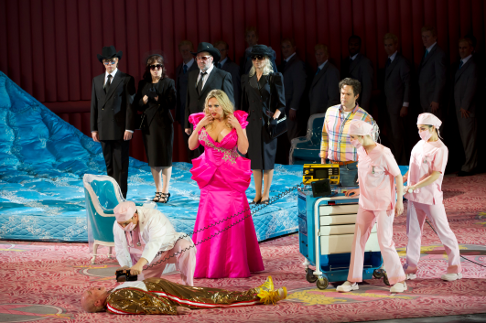 Alan Oke as J. Howard Marshall, Eva-Maria Westbroek as Anna Nicole, Gerald Finley as Stern and, in the background, Marshall’s family (from left to right: Grant Doyle, Loré Lixenberg, Jeremy White and Rebecca de Pont Davies)
Whether dealing with music or text, true characterisation approaches zero; everything is simply a matter of plot and situation. Is that the point? Again, if so, ‘the point’ is surely wrong. Certain works can operate very well, even achieve greatness, without conventional characterisation at their heart, instantiating in its place an idea. However, Anna Nicole, is not, to put it mildly, Fidelio. Not only Stern but even Anna Nicole herself seems a mere caricature, without the caricature making a dramatic point. Nor is there anything of interest in the way the story is told. Hopes rise when Anna Nicole’s mother, Virgie, dissents from the way Stern tells a part of the story — the death of Anna Nicole’s son, Daniel — and it seems as though we might be in for some sort of re-telling from a different perspective. It is really just a matter, however, of recounting her dissent. Anna Nicole is not, to put it mildly, The Mask of Orpheus.
The opera — it actually seems more like an attempt at a musical — is also offensively and, frankly, childishly anti-American. Many of the rest of us have noticed that capitalism is not a solely American phenomenon. The use of ‘American’ accents, sometimes more successfully Texan or indeed American than at others, is odd at best. We do not ask singers in an opera with a French setting to sing as if they were Inspector Clouseau. It all seems intended to make fun of a cultural setting of which the writers seem to have little more knowledge and understanding than many of the rest of us. Imagine the horror that would rightly be expressed, were someone to decide to do something similar about India, Zimbabwe, Argentina, or indeed just about anywhere else. This is, with apologies to Edward Said, Occidentalism that is not even interesting.
Everything, moreover, seems to hang on the fact that this is ‘based on a true story’. We seem to be led to believe — and I tend to believe it myself — that it would be of no interest to anyone, if the story were presented fictionally. At best, then, the work becomes reportage, concerning an unfortunate soul to be cruelly mocked; for those of us who have little or no interest in the life story of the aforesaid unfortunate soul, it is not clear what the point might be. At least an opera such as John Adams’s Nixon in China deals with a political event of considerable importance, whilst remaining musically negligible. In ‘historical’ operas worth their salt, the ‘history’ is not the sole point, but a spur to artistic invention. Anna Nicole is not, to put it mildly, L’incoronazione di Poppea. Perhaps worst of all, the treatment of Smith herself and, still more, her son seems straightforwardly exploitative. Is this a proper way to memorialise Daniel Wayne Smith? (I am unsure even whether to mention him here.) Does he deserve to be served up as entertainment? These people’s predicament is not, despite the presence of a press pack, really explored, let alone analysed; it is just retold.
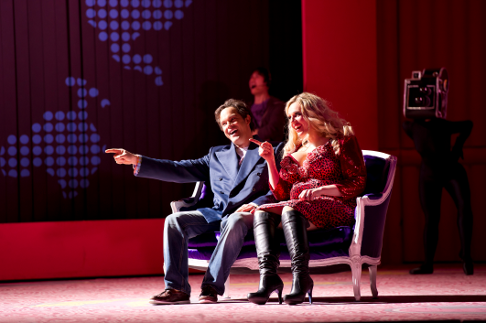 Gerald Finley as Stern and Eva-Maria Westbroek as Anna Nicole
Jones does what he can, with great attention to detail, and colourful sets, especially during the first half. Moreover, the opera is truly cast from strength, whether with respect to members of the Royal Opera Chorus, such as the Four Lap Dancers and the Meat Rack Quartet, or the starring roles. The cast is huge, putting one in mind of another recent Jones production, though Anna Nicole is not, to put it mildly, The Gambler. Yet the unsubtle amplification, whilst ensuring that every word can be heard, crystal-clear, begins to tire as much as the melodramatic antics of the plot. The ever-reliable Susan Bickley makes the best of what she is given as Virgie. Alan Oke proves frighteningly credible in age as Old Man Marshall and sings as well as we have come to expect — which is very well indeed. Eva-Maria Westbroek gives a truly bravura performance in the title role; the lack of characterisation is not hers. If Westbroek’s gifts were wasted, then I do not know what the term would be for the squandering of Finley’s resources. Antonio Pappano seemed to have the measure of the score, marshalling his forces with tight rhythmic control. The orchestra played with verve, as well drilled as one could imagine. To what end, though?
Was the increasing high pitch of the promotion — it seems to have worked, for performances have sold out — possibly related to a fear that the music and text were so weak? One has to take risks with new works; it is heartening that the Royal Opera was willing to do so. Let us hope that the next new work will prove more fruitful, and perhaps — dare I suggest it? — take the world, not just this country, as its compositional oyster. Previous commissions include works by Henze, Goehr, Birtwistle, and Berio. Just think of the time — I wish I could have been there — when Stockhausen’s Donnerstag received its premiere at Covent Garden. Better luck next time, I suppose…
Mark Berry