Subscribe to
Opera Today

Receive articles and news via RSS feeds or email subscription.


twitter_logo[1].gif


UCP_9780226043425.gif

Recently in Performances

Brahms Third in San Francisco

Nicola Luisotti and the San Francisco Opera Orchestra climbed out of the War Memorial pit, braved the wind whipped bay and held spellbound an audience at Cal Performances’ Zellerbach Auditorium at UC Berkeley.

Glyndebourne: Ariadne auf Naxos

Utterly mad but absolutely right — Richard Strauss’s Ariadne auf Naxos started the Glyndebourne 2013 season with an explosion. Strauss could hardly have made his intentions more clear. Ariadne auf Naxos is not “about” Greek myth so much as a satire on art and the way art is made.

Wozzeck at ENO

“Man is an abyss. It makes one dizzy to look into it.” So utters Georg Büchner’s Woyzeck, repeating what was also a recurring motif in the playwright’s own letters.

Mulhouse: Rare Britten Well Done

National Opera Company of the Rhine has marked this year’s Benjamin Britten celebration with a remarkably compelling, often gripping new production of the seldom-seen Owen Wingrave.

Frankfurt's Intriguing Idomeneo

Once upon a time, Frankfurt Opera had the baddest ass reputation in Germany as “the” cutting edge producer of must-see opera.

Rigoletto at Lyric Opera of Chicago

Productions of Giuseppe Verdi’s Rigoletto can serve as a vehicle for individual singers to make a strong impression and become afterward associated with specific roles in the opera.

Britten Sinfonia with Ian Bostridge

Just in case we were not aware that the evening’s programme was ‘themed’, the Britten Sinfonia designed a visual accompaniment to their musical exploration of night, sleep and dreams.

Aida, Manitoba Opera

Poor Aida! She never seems to have anything go her way.

Superlative singing: Don Carlo, Royal Opera House

Is it possible to upstage Jonas Kaufmann? Kaufmann was brilliant in this Verdi Don Carlo at the Royal Opera House, London, but the rest of the cast was so good that he was but first among equals. Don Carlo is a vehicle for stars, but this time the stars were everyone on stage and in the pit. Even the solo arias, glorious as they are, grow organically out of perfect ensemble. This was a performance that brought out the true beauty of Verdi's music.

Sarah Connolly: French Song at Wigmore Hall

The big names were absent: Duparc, D’Indy, Debussy, Ravel … and while Fauré, Chausson, Roussel and several members of Les Six put in an appearance, in less than familiar guises, this survey of French song of the early 20th century and interwar years deliberately took us on a journey through infrequently travelled terrain.

Rare restoration: Handel’s Esther 1720

Composed between 1718 and 1720, Handel’s Esther is sometimes described as the ‘first English Oratorio’, but is in fact a hybrid form, mixing elements of oratorio, masque, pastoral and opera.

The Damnation of Faust, London

Hector Berlioz's légende dramatique, La Damnation de Faust, exists somewhere between cantata and opera. Berlioz's flexible attitude to dramatic form made the piece unworkable on the stages of early 19th century Paris and his music is so vivid that you wonder whether the piece needs staging at all.

Elizabeth Connell Memorial Concert, St John's Smith Square

St. John’s Smith Square was the site of Elizabeth Connell’s final London concert, intended as a farewell to London on her moving to Australia. It was rendered ultimately final by her unexpected death.

Aida with all the Trimmings, Even a Blue Silk Elephant!

With the building of the Suez Canal, Egypt became more interesting to Western Europeans. Khedive Ismail Pasha wanted a hymn by Verdi for the opening of a new opera house in Cairo, but the composer said he did not write occasional pieces.

Die Zauberflöte, Royal Opera

Back for its fourth revival, David McVicar’s 2003 production of Mozart’s Die Zauberflöte has much charm, beauty and artistry.

The Marriage of Figaro Ends Season at Arizona Opera

Wolfgang Amadeus Mozart's opera The Marriage of Figaro has a libretto by Lorenzo daPonte based on the French play La folle journée, ou le Mariage de Figaro (The Crazy Day or the Marriage of Figaro) by Pierre Caron de Beaumarchais (1732-1799).

Baden’s Flute Goes Barefoot in the Park

For its world class Easter Festival, Baden-Baden mounted a Die Zauberflöte that owed more to the grey penitential doldrums of Lent than to the unbridled jubilance of re-birth.

Bonjour M. Gauguin in Berkeley

Once Berkeley Opera, renamed West Edge Opera, this enterprising company offers the Bay Area’s only serious alternative to corporate opera, to wit Bonjour M. Gauguin.

Mahler Lieder, Wigmore Hall

In the first of pianist Julius Drake’s three-part series, ‘Perspectives’, our gaze was directed at Gustav Mahler’s eclectic musical responses to human experiences: from the trauma and distress of anguished love to the sweet contentment of true friendship, from the agonised introspection of the artist to the diverse dramas of human interaction.

Cinderella Goes to the Opera

The Los Angeles opera company marketed its spring production of Rossini's La Cenerentola as Cinderella though there is no opera by that name. The libretto of La Cenerentola is not the Cinderella story we know.

OPERA TODAY ARCHIVES »

Performances

Anna Netrebko as Norina and Matthew Polenzani as Ernesto [Photo by Marty Sohl courtesy of Metropolitan Opera]
08 Feb 2011

Don Pasquale, New York

Witty and airy as an after-dinner anecdote over biscuits and cognac, Don Pasquale (1844) is, unlikely as it may seem, almost the last opera Donizetti completed before his descent into the madness of tertiary syphilis.

G. Donizetti: Don Pasquale

Norina: Anna Netrebko; Don Pasquale: John Del Carlo; Ernesto: Barry Banks; Dr. Malatesta: Mariusz Kwiecien. Metropolitan Opera, chorus and orchestra, conducted by James Levine. Performance of February 4.

Above: Anna Netrebko as Norina and Matthew Polenzani as Ernesto

All photos by Marty Sohl courtesy of Metropolitan Opera


He was 47, managing opera houses in Vienna and Paris, introducing new talents like Verdi, and could still turn out melodies to beat the band—so to speak—with ever more of a nod to tight scripts and psychological subtleties. With Rossini in retirement, Bellini dead, Verdi a tyro and Mercadante about to withdraw into academe, Donizetti was the most popular Italian composer in the world. Who knows where this would have led him had his career gone on (as Verdi’s, Mercadante’s, Pacini’s, Meyerbeer’s, Auber’s all did) till he was 65? Would he have composed operas for St. Petersburg, Berlin, London and New York? Can we doubt it?

Given the proper performers (Donizetti’s operas, even more than most, depend on the performer to put them over), Don Pasquale remains almost irresistible. The Met has had great success with Otto Schenk’s moderately updated production (O’Hearn-Merrill’s was better, funnier, lighter), and it is clear from last Friday’s performance that the touch-ups required for last fall’s HDTV movie theater broadcast have made it more stage-ready than ever. James Levine, in the pit, seemed especially to enjoy himself but the entire cast is infectiously frolicsome.

I had quibbles, however, with some of the singers: all good, but some a little graceless in their approach to this pearl-icing confection. Anna Netrebko is a prima donna, and her voice has gotten steadily larger and thicker while losing a top note or two. This makes her a good candidate for Anna Bolena, for example, a Donizetti role she is singing in its Met premiere next season, and even likelier as Bellini’s Sonnambula or Giulietta, in both of which roles she has been broadcast from Vienna. But the voice’s thickness, its inability to lighten up, is uncomfortable in a Norina. The lady must be laughing all the time, or we are disinclined to forgive her rather calculated assault on the wealth of the title character. Reri Grist, my first Met Norina, floated about the stage, almost pirouetting around a lovably flummoxed Fernando Corena, and the instant of her slap, the moment when she goes too far and knows it, was an instant transformation not merely in the music but in her attitude, as she pulled her hands to her cheeks in horror at what she’d done, and a genuine personality was displayed—as also affection for the old man. Netrebko can no longer manage that lightness, that speediness, and she cannot manage the top notes of her runs, which rise prettily only to stop short every time. (What is that note? D? She hasn’t even got a D?) The glittering final waltz did not glitter or twirl; Netrebko offered it … dutifully. Ljuba Petrova, who sang one performance of the opera here during the present production’s first season, was rather more what we are looking for: Not a dramatic prima donna but an old-fashioned canary coloratura whose charm and wit match her voice. And she had all the high notes!
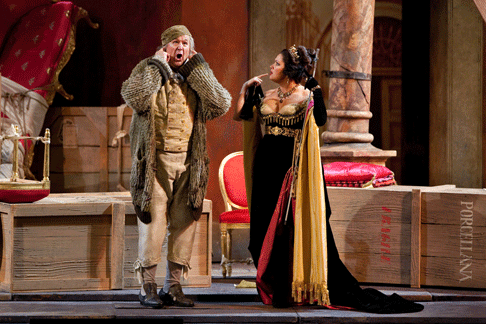
PASQUALE_Don_Carlo_and_Netr.gifJohn Del Carlo as the title role and Anna Netrebko as Norina

Ernesto was sung by Barry Banks, whose voice has also changed over the years, from the spectacular instrument of the Flute/Thisbe in the Met’s Midsummer Night’s Dream and the heroic Oreste in Ermione that amazed New York. His legato line no longer flows comfortably; it is a tolerable but charmless substitute for the proper tenor elegance.

Buffo basses can get by for years with far less voice than John Del Carlo still possesses. He wittily deploys his great height and bulk and mugs in the very finest fettle. You can’t have Don Pasquale without a Pasquale, and the Met is right to hang on to this one.

The star of the show for dapper farce-performance, suave vocalism and bring-down-the-house sex appeal was Mariusz Kwiecien as Dr. Malatesta. There is nothing to object to in his singing (he doesn’t scream in this opera, as he tends to in Lucia or L’Italiana) or his scampering or his appeal, except that this is Dr. Malatesta and the opera is called Don Pasquale and the lovers are Ernesto and Norina. Why is the doctor the one we wait for, listen to, watch on stage? Most Malatestas “feed” their Norinas (without picking them up and tossing them about like throw pillows), accompany their Pasquales, take a line in the concerted passages. The character is a catalyst, not the focus of the opera, but Otto Schenk has got nothing so wrong as building this character up. If Malatesta is the center of attention, and has such a rich relationship with Norina … why do we need the tenor at all? He fades into the woodwork if Malatesta does not.
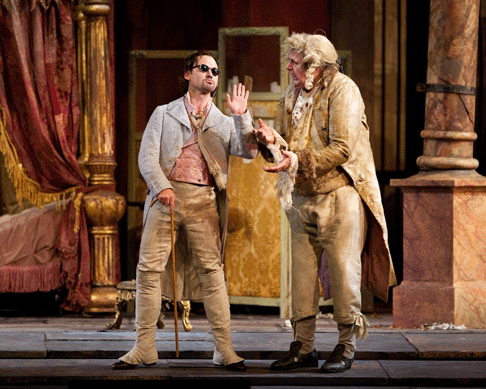
PASQUALE_Kwecien_and_Don_Ca.gifMariusz Kwiecien as Dr. Malatesta and John Del Carlo in the title role

But all these objections seemed to occur to few others in the audience last Friday, who all seemed to be tickled that they were having such fun, enjoying such a sparkling score in such an animated, Broadway-worthy performance, without having to drop a tear or think a thought at all. And isn’t that the sort of pleasure farce is supposed to provide?

John Yohalem

Send to a friend

Send a link to this article to a friend with an optional message.

Friend's Email Address: (required)

Your Email Address: (required)

Message (optional):