At last the ENO experiment of using directors from fields other than opera has been vindicated. Mike Figgis is not an opera director so the opera, which proceeds with minimal intervention. But Figgis is an innovative film-maker, so he knows what makes good drama. This production at the Coliseum, London operates on two parallel levels: film and opera, which done together expand the experience.
Few stories could have more dramatic potential than the legend of Lucrezia Borgia. Incest, violence, political intrigue, orgies. Even Anna Nicole Smith, subject of Mark-Anthony Turnage’s new opera, doesn’t come close. Yet Donizetti seems less interested in Lucrezia than in her supposed son, Gennaro. Cesare Borgia and Pope Alexander VI don’t even appear in the opera. Yet the plot predicates on the fact that the Borgia clan cause extreme fear and hatred. Surely Lucrezia alone can’t have been solely responsible for their terrible reputation? There are other loose ends in the drama. Gennaro fixates on his mother but doesn’t wonder who his father might be. His friends are out for bloodthirsty vengeance. Yet they’re easily distracted when invited to a party. Even when Gennaro is fleeing for his life after escaping from the Duke of Ferrara, he stops to join his friends carousing. So much for dramatic logic! Donizetti’s aim was to write lovely arias fto showcase his singer’s abilities, and in that sense he succeeds. But apart from the bel canto displays, it’s psychologically and dramatically inert.
Significantly, Figgis is under no delusions that anyone can become an opera director overnight. That’s refreshingly honest, since good opera direction requires some musical nous. (In fact, Figgis is a musician). But because he understands drama, he adds to the production in the way he does best, by making films that encase the opera, adding commentary and background without impinging on the stage action itself.
The films are sumptuously lavish, shot on location in Italy. The extravagant Renaissance settings dazzle, but Figgis knows that the reality behind this glamour was brutal. The Borgias operated in an era of depravity and corruption. Figgis’s films start quietly, with the actresses discussing the period while getting into costume. They speak of horrific things, like prostitutes being brutalized and Jews being castrated. You flinch, but you should, for the world Lucrezia lived in wasn’t pretty. Then the actresses transform into role, like savage animals. A metaphor for the times.
Donizetti presents Lucrezia without much explanation, so her evil deeds seem to spring from nowhere. Thus the films act as reminders of Lucrezia’s past. Wealthy and powerful as she is, she’s been abused herself, and grew up surrounded by treachery. In the films, she witnesses how ruthless her father and brother can be when they murder a servant in cold blood, thinking he’s her lover. Lucrezia relives the birth of her son, who is taken from her. This brings Gennaro into the story, for he didn’t exist as historic fact. Before she marries the Duke of Ferrara she’s got to prove she’s a virgin, which everyone (including the Duke) knows is a humiliating farce. The films give psychological depth to Lucrezia’s character. Donizetti, for whatever reason, may have avoided this, but modern audiences are more accustomed to dramatic nuance.
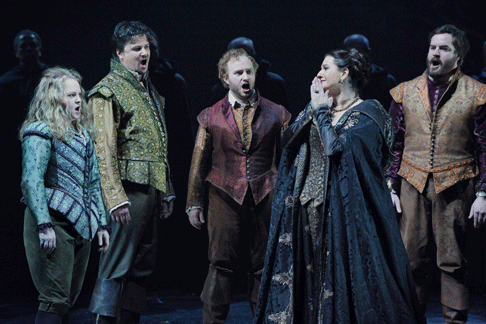 Claire Rutter, Elizabeth DeShong, James Gower, Gerard Collett, Jonathan Stoughton and Tyler Clarke
Frames are a recurring theme throughout. Gennaro (Michael Fabiano) and Orsini (Elizabeth DeShong) converse under a proscenium arch. Later Lucrezia (Claire Rutter) and her husband Alfonso d’Este, Duke of Ferrara (Alastair Miles) appear on an ornate, golden throne. It’s stunning. But look carefully, it’s a giant version of the tabernacle on a Catholic altar, which opens to reveal sacred objects. Lucrezia’s father was the Pope. When Gennaro and his friends celebrate, they’re shown seated in a line around a long table. It’s a direct reference to The Last Supper, In fact, it is their last supper as soon they’ll all die. The audience gasps at the audacity, but it reminds us that the Borgias were far more blasphemous.
Because the films are so luscious, the opera itself appears one dimensional. Movements are static. Apart from the main images on stage, backgrounds are flat, no attempt at realism. Since this looks like opera without direction, those who hate directors ought to love this. Though Figgis is not an opera man, he’s telling us that image and substance are never quite the same. Donizetti’s Lucrezia Borgia is art, not reality.
Innovative as this approach is, it probably wouldn’t work with a less stylized opera. Nor, perhaps, one more expressive orchestrally. Donizetti wrote the opera as vehicles for the singers off his time to display their vocal prowess. The soprano part is a delight, and Claire Rutter sings it with radiant richness. Her part is easily the most rewarding and she makes her presence felt. Michael Fabiano, as Gennaro, also sings more convincingly than his role allows. Elizabeth DeShong, Alastair Miles and supporting singers are good, too, but this isn’t the most demanding of operas, despite moments of beauty.
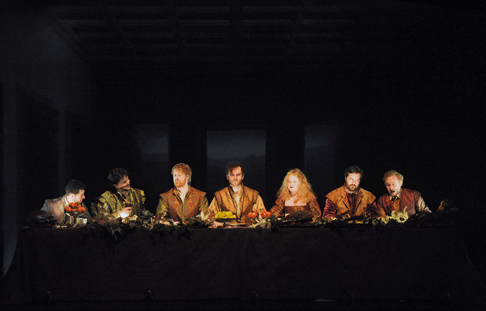 Michael Fabiano, Elizabeth DeShong, Tyler Clarke, Jonathan Stoughton, James Gower and Gerrard Collett
Translation into English doesn’t help, though. At times it felt that the singers were obeying their natural sense of line and intonation, but drawing back to fit the text. That’s a problem with English in general, which isn’t as melodic as Italian. The overall sound of an opera communicates, not just words. There were some horrible rhymes that tried to be funny but weren’t. Orsini’s lines, on the other hand, were so wacky that they worked in an anarchic way. “Let’s respect the protocol, and not indulge in alcohol” and “Chianti! the wine of Dante!”. DeShong’s delivery was so lively that I realized at last what Orsini’s role in this opera might be. The silliness is deliberate, like whistling in a graveyard. Oddly enough, it makes sense of the idea that theatre can be divorced from drama. Donizetti may not have done much to develop Lucrezia Borgia as a personality in her own right, but thanks to Mike Figgis and ENO, we can approach her story in parallel ways. Presumably the films and opera could be experienced separately, but together they enhance each other.
For more details refer to the ENO website.
Anne Ozorio
![Claire Rutter as Lucrezia Borgia [Photo by Stephen Cummisky courtesy of English National Opera]](http://www.operatoday.com/Borgia_ENO_2011_02.gif)