![Philip Cutlip as Joseph De Rocher [Photo by Felix Sanchez courtesy of Houston Grand Opera]](http://www.operatoday.com/DMW_HGO_2011_01.gif)
06 Feb 2011
Heggie’s Dead Man Walking triumphs at HGO
The production of Jake Heggie’s Dead Man Walking currently on stage at the Houston Grand Opera is marvelously celebratory in its success.
English Touring Opera are delighted to announce a season of lyric monodramas to tour nationally from October to December. The season features music for solo singer and piano by Argento, Britten, Tippett and Shostakovich with a bold and inventive approach to making opera during social distancing.
This tenth of ten Live from London concerts was in fact a recorded live performance from California. It was no less enjoyable for that, and it was also uplifting to learn that this wasn’t in fact the ‘last’ LfL event that we will be able to enjoy, courtesy of VOCES8 and their fellow vocal ensembles (more below …).
Ever since Wigmore Hall announced their superb series of autumn concerts, all streamed live and available free of charge, I’d been looking forward to this song recital by Ian Bostridge and Imogen Cooper.
Although Stile Antico’s programme article for their Live from London recital introduced their selection from the many treasures of the English Renaissance in the context of the theological debates and upheavals of the Tudor and Elizabethan years, their performance was more evocative of private chamber music than of public liturgy.
Evidently, face masks don’t stifle appreciative “Bravo!”s. And, reducing audience numbers doesn’t lower the volume of such acclamations. For, the audience at Wigmore Hall gave soprano Elizabeth Llewellyn and pianist Simon Lepper a greatly deserved warm reception and hearty response following this lunchtime recital of late-Romantic song.
For this week’s Live from London vocal recital we moved from the home of VOCES8, St Anne and St Agnes in the City of London, to Kings Place, where The Sixteen - who have been associate artists at the venue for some time - presented a programme of music and words bound together by the theme of ‘reflection’.
'Such is your divine Disposation that both you excellently understand, and royally entertaine the Exercise of Musicke.’
‘And there was war in heaven: Michael and his angels fought against the dragon; and the dragon fought and his angels, And prevailed not; neither was their place found any more in heaven … that old serpent … Satan, which deceiveth the whole world: he was cast out into the earth, and his angels were cast out with him.’
There was never any doubt that the fifth of the twelve Met Stars Live in Concert broadcasts was going to be a palpably intense and vivid event, as well as a musically stunning and theatrically enervating experience.
‘Love’ was the theme for this Live from London performance by Apollo5. Given the complexity and diversity of that human emotion, and Apollo5’s reputation for versatility and diverse repertoire, ranging from Renaissance choral music to jazz, from contemporary classical works to popular song, it was no surprise that their programme spanned 500 years and several musical styles.
The Academy of St Martin in the Fields have titled their autumn series of eight concerts - which are taking place at 5pm and 7.30pm on two Saturdays each month at their home venue in Trafalgar Square, and being filmed for streaming the following Thursday - ‘re:connect’.
The London Symphony Orchestra opened their Autumn 2020 season with a homage to Oliver Knussen, who died at the age of 66 in July 2018. The programme traced a national musical lineage through the twentieth century, from Britten to Knussen, on to Mark-Anthony Turnage, and entwining the LSO and Rattle too.
With the Live from London digital vocal festival entering the second half of the series, the festival’s host, VOCES8, returned to their home at St Annes and St Agnes in the City of London to present a sequence of ‘Choral Dances’ - vocal music inspired by dance, embracing diverse genres from the Renaissance madrigal to swing jazz.
Just a few unison string wriggles from the opening of Mozart’s overture to Le nozze di Figaro are enough to make any opera-lover perch on the edge of their seat, in excited anticipation of the drama in music to come, so there could be no other curtain-raiser for this Gala Concert at the Royal Opera House, the latest instalment from ‘their House’ to ‘our houses’.
"Before the ending of the day, creator of all things, we pray that, with your accustomed mercy, you may watch over us."
The doors at The Metropolitan Opera will not open to live audiences until 2021 at the earliest, and the likelihood of normal operatic life resuming in cities around the world looks but a distant dream at present. But, while we may not be invited from our homes into the opera house for some time yet, with its free daily screenings of past productions and its pay-per-view Met Stars Live in Concert series, the Met continues to bring opera into our homes.
Music-making at this year’s Grange Festival Opera may have fallen silent in June and July, but the country house and extensive grounds of The Grange provided an ideal setting for a weekend of twelve specially conceived ‘promenade’ performances encompassing music and dance.
There’s a “slide of harmony” and “all the bones leave your body at that moment and you collapse to the floor, it’s so extraordinary.”
“Music for a while, shall all your cares beguile.”
The hum of bees rising from myriad scented blooms; gentle strains of birdsong; the cheerful chatter of picnickers beside a still lake; decorous thwacks of leather on willow; song and music floating through the warm evening air.
The production of Jake Heggie’s Dead Man Walking currently on stage at the Houston Grand Opera is marvelously celebratory in its success.
Staged by more than a handful of American companies since its 2000 premiere at San Francisco Opera, Dead Man Walking has been seen in Dresden and Vienna — and in distant Australia. It is the most popular of American operas in decades — perhaps since Porgy and Bess. But that only states the obvious.
More important is the universality the HGO staging brings to the true story of Sister Helen Prejean’s encounter with death-row damned Joe De Rocher. For here the work — and the bare-bones libretto by Terrence McNally — is no longer an argument about capital punishment — if this ever was its central concern. It is now rather an essay — a careful balance of ideas and emotions — on the quest for compassion — and love — in a world poor in compassion, chilled by loneliness and loathe to grant redemption.
HGO music director Patrick Summers conducted the SFO premiere of DMW and has been with it constantly. In Houston he demonstrates how much he has grown in a decade distinguished by further Heggie achievements. Indeed, the Houston staging takes DMW full circle, underscoring a network of friendships that reaches beyond the stage and contrasts warmly with the lonely despair that darkens this story.
In addition to the long collaboration between Heggie and Summers, in the pit for the Dallas premiere of the composer’s Moby Dick last season, this staging gains through the return to the cast of Frederica von Stade who — repeating her SFO role — sings Joe’s mother. Adding to the weight of her still superb singing is the fact that Heggie has long prized the mezzo as his personal Muse, together with that the tug at the heart prompted by the knowledge that the HGO performances mark her last appearance on the opera stage.
John Packard, the first Joe and now an internationally recognized baritone, is now in Houston to sing his father. Older opera buffs are delighted to find in the cast singers of note edged off stage by today’s quest for new talent.
Cheryl Parrish, loved for many performances of Despina and Gilda, and Suzanne Mentzer, only a decade ago a leading Octavian, sing supporting roles. (Both are now voice teachers in Texas.) New to the cast — and the HGO — is Canadian soprano Measha Brueggergosman, who makes Sister Rose an alter ego of Sister Helen.
At the top of this list of notables, of course, is Joyce DiDonato as Sister Helen. An alumna of the HGO studio, DiDonato, now the world’s leading mezzo, has long been Houston’s “own.” Having appeared in a wide variety of roles here, she has just been named the company’s Lynn Wyatt Great Artist for 2011-12. (She will sing the title role in Donizetti’s Maria Stuarda at the end of the next season.) DiDonato, who sang the role at New York City Opera in 2002, is a vulnerably feminine Sister Helen without the grit of Susan Graham who created the role at the SFO. By internalizing the conflict, however, DiDonato brings new intensity to the independent nun. She makes clear that Sister Helen gets more than she bargained for in seeking to counsel Joe. DMW is, after all her opera — her story and her journey. DiDonata makes her a delicately refined woman who underscores how porous the boundary between eros and agape is.
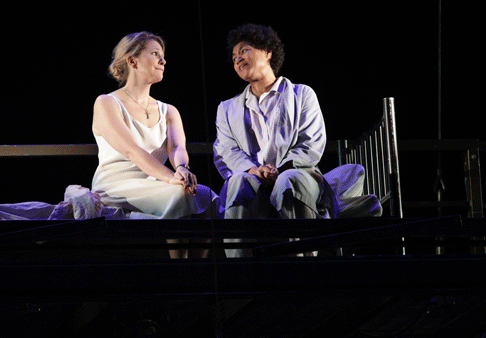 Joyce DiDonato (Sister Helen Prejean) and Measha Brueggergosman (Sister Rose)
Philip Cutlip is an unrelentingly macho Joe — still obsessed by sex — who makes Sister Helen’s mission doubly difficult.
Jake Heggie began his career as a composer of songs, and DMW profits greatly from his understanding of the voice and his ability to set words with transparent clarity. But, as Summers brings home, Heggie is also a master of orchestration. There are interludes in this score that rival Bergs Woyzeck in drama of hurricane force.Sixty years ago DMW would have been taught in courses on Existentialism, for the story is as complex in sins of omission as in their opposite.
And God? Despite Sister Helen’s frequent — and fervent — prayers, Heggie and McNally leave that question to the audience, free to answer it according to the degree of their belief. More significant perhaps is the experience of “King” Elvis Pressley that Joe and Sister Helen share and — recalled by both — leads to the breakthrough in their relationship.
While Dead Man Walking has grown in significance during its decade of enviably popularity, the world — in the eyes of many — has gone downhill. As chaos grows, a society largely with a moral compass and ethical rudder seems doomed to produce more and more souls equal in loss to Joe De Rocher, while the supply of Sister Helens diminishes.
This was brought home by the near-capacity audience in the Brown Theater in Houston’s impressive Wortham Center on January 29. They were totally — and actively — engaged in DMW. Indeed, one might speak of a Jungian mystique of participation, something for which art strives, but all too rarely achieves. (This was the second of five performances of the work that began on January 22.)
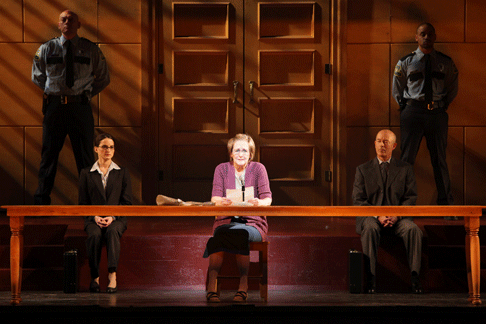 Frederica von Stade as Mrs. Patrick De Rocher
Although Jake Heggie, born in 1961, has done significant things during the past decade, a direct line connects his two big — indeed, grand operas: Dead Man Walking and Moby Dick, premiered by Dallas Opera last April. In his overwhelmingly successful capturing of the epic sweep and scope of one of the world’s major novels, Heggie makes clear that it is time to liberate him from the “post-Sondheim” category and cherish him as the equal of John Adams and Osvaldo Golijov, America’s two major masters of opera. Heggie writes with a voice as original, powerful and emotionally convincing as his slightly older contemporaries. The Houston Grand Opera production of Dead Man Walking leaves no doubt about this. Indeed, the staging of this now-classic work is a well-deserved celebration of Jake Heggie’s stature and significance.
Wes Blomster