Subscribe to
Opera Today

Receive articles and news via RSS feeds or email subscription.


twitter_logo[1].gif


UCP_9780226043425.gif

Recently in Performances

Domingo Conducts Holdridge’s New Opera Dulce Rosa

Dulce Rosa, a brand new opera, had its world premiere Friday night, May 17, 2013 at the Broad Stage in Santa Monica, California. It was produced by Los Angeles Opera, but staged in the smaller theater.

Verdi’s Falstaff at Glyndebourne

Richard Jones’ 2009 production of Verdi’s Falstaff translates the action from the first Elizabethan age to the start of the second.

Gareth John, Wigmore Hall

Baritone Gareth John is rapidly accumulating a war-chest of honours. Winner of the 2013 Kathleen Ferrier Award, he recently won the Royal Academy of Music Patrons’ Award and was presented the Silver Medal by the Worshipful Company of Musicians.

La bohème at ENO

This second revival of Jonathan Miller’s La bohème was the first time I had caught the production.

Rolando Villazón: Verdi (International Opera Stars Series 2013)

It’s Verdi’s bicentenary year and Rolando Villazón has two new CDs to plug — titled somewhat confusingly, ‘Villazón: Verdi’ and ‘Villazón’s Verdi’, the latter a ‘personal selection’ of favourite numbers performed by stars of the past and present.

Brahms Third in San Francisco

Nicola Luisotti and the San Francisco Opera Orchestra climbed out of the War Memorial pit, braved the wind whipped bay and held spellbound an audience at Cal Performances’ Zellerbach Auditorium at UC Berkeley.

Glyndebourne: Ariadne auf Naxos

Utterly mad but absolutely right — Richard Strauss’s Ariadne auf Naxos started the Glyndebourne 2013 season with an explosion. Strauss could hardly have made his intentions more clear. Ariadne auf Naxos is not “about” Greek myth so much as a satire on art and the way art is made.

Wozzeck at ENO

“Man is an abyss. It makes one dizzy to look into it.” So utters Georg Büchner’s Woyzeck, repeating what was also a recurring motif in the playwright’s own letters.

Mulhouse: Rare Britten Well Done

National Opera Company of the Rhine has marked this year’s Benjamin Britten celebration with a remarkably compelling, often gripping new production of the seldom-seen Owen Wingrave.

Frankfurt's Intriguing Idomeneo

Once upon a time, Frankfurt Opera had the baddest ass reputation in Germany as “the” cutting edge producer of must-see opera.

Rigoletto at Lyric Opera of Chicago

Productions of Giuseppe Verdi’s Rigoletto can serve as a vehicle for individual singers to make a strong impression and become afterward associated with specific roles in the opera.

Britten Sinfonia with Ian Bostridge

Just in case we were not aware that the evening’s programme was ‘themed’, the Britten Sinfonia designed a visual accompaniment to their musical exploration of night, sleep and dreams.

Aida, Manitoba Opera

Poor Aida! She never seems to have anything go her way.

Superlative singing: Don Carlo, Royal Opera House

Is it possible to upstage Jonas Kaufmann? Kaufmann was brilliant in this Verdi Don Carlo at the Royal Opera House, London, but the rest of the cast was so good that he was but first among equals. Don Carlo is a vehicle for stars, but this time the stars were everyone on stage and in the pit. Even the solo arias, glorious as they are, grow organically out of perfect ensemble. This was a performance that brought out the true beauty of Verdi's music.

Sarah Connolly: French Song at Wigmore Hall

The big names were absent: Duparc, D’Indy, Debussy, Ravel … and while Fauré, Chausson, Roussel and several members of Les Six put in an appearance, in less than familiar guises, this survey of French song of the early 20th century and interwar years deliberately took us on a journey through infrequently travelled terrain.

Rare restoration: Handel’s Esther 1720

Composed between 1718 and 1720, Handel’s Esther is sometimes described as the ‘first English Oratorio’, but is in fact a hybrid form, mixing elements of oratorio, masque, pastoral and opera.

The Damnation of Faust, London

Hector Berlioz's légende dramatique, La Damnation de Faust, exists somewhere between cantata and opera. Berlioz's flexible attitude to dramatic form made the piece unworkable on the stages of early 19th century Paris and his music is so vivid that you wonder whether the piece needs staging at all.

Elizabeth Connell Memorial Concert, St John's Smith Square

St. John’s Smith Square was the site of Elizabeth Connell’s final London concert, intended as a farewell to London on her moving to Australia. It was rendered ultimately final by her unexpected death.

Aida with all the Trimmings, Even a Blue Silk Elephant!

With the building of the Suez Canal, Egypt became more interesting to Western Europeans. Khedive Ismail Pasha wanted a hymn by Verdi for the opening of a new opera house in Cairo, but the composer said he did not write occasional pieces.

Die Zauberflöte, Royal Opera

Back for its fourth revival, David McVicar’s 2003 production of Mozart’s Die Zauberflöte has much charm, beauty and artistry.

OPERA TODAY ARCHIVES »

Performances

Plácido Domingo as Oreste [Photo by Ken Howard courtesy of the Metropolitan Opera]
27 Feb 2011

Iphigénie en Tauride, New York

Gluck’s operas are part of a continuum, a tradition of French vocal declamation (as opposed to the Italian school of flights of elegant, open-throated vocal fantasy) that can be traced to him from Lully and Rameau, and then from Gluck through certain works of Mozart and Gluck’s pupil, Salieri to the operas of Spontini, Berlioz and Wagner.

Christoph Willibald Gluck: Iphigénie en Tauride

Iphigénie: Elizabeth Bishop; Oreste: Plácido Domingo; Pylade: Paul Groves; Thoas: Gordon Hawkins; Diane: Julie Boulianne; Priestesses: Lei Xu, Cecelia Hall. Metropolitan Opera Chorus and Orchestra, conducted by Patrick Summers. Performance of February 16.

Above: Plácido Domingo as Oreste

Except as otherwise indicated, all photos by Ken Howard courtesy of the Metropolitan Opera


It is not a greater or lesser tradition than the Italian style, but it achieves different dramatic effects, or the same effects by different means, and individual singers are often more proficient in one than in the other. Specialists in Gluck being rare (though he is, happily, going through one of his periodic revivals just now), one must seek great Gluck singers in other branches of the repertory. Those trained for Wagner, not too surprisingly, often fit well in the Gluckian glove. Thus, back in the 1950s, Flagstad and Farrell were both superb as Gluck’s Alceste and would probably have been exciting as his Iphigénie.
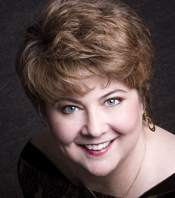
Elizabeth_Bishop_02.gifElizabeth Bishop [Photo by Sasha Vasiljev courtesy of Barrett Vantage Artists]

With this in mind, I was intrigued to learn that Susan Graham was indisposed on the night I attended Iphigénie en Tauride at the Met and would be replaced by Elizabeth Bishop. I had last heard Bishop as Venus in Tannhäuser (also a last-minute replacement) and have fond memories of that performance: a young singer of great authority and potential in dramatic roles. But Iphigénie is a less one-note conception than Venus; too, she is the epitome of restraint where Venus is just the opposite.

Gluck’s Iphigénie, taken from Euripides, is a dignified priestess, torn between her personal, humane, Greek sense of ethics and the demands of the barbaric society in which she finds herself trapped, demands that include performing human sacrifices. The screw turns its final gyre when two proposed victims are her long-lost brother, Oreste, and his friend Pylade. Tension is provided by the fact that, after fifteen years apart, the siblings do not recognize each other and somehow never ask each other’s name. Wouldn’t you tell a priestess your name before she cut your throat?

The situation is resolved in antique high style by the appearance of the deity, Diane, who rescues the Greeks and abolishes human sacrifice—but she takes her time to show up (at the end of Act IV), allowing us to comprehend the noble natures of our legendary characters as they face their predicament. In Gluck’s stately score dignity is the watchword, though at the Met, in Stephen Wadsworth’s excessively busy production, Iphigénie is inclined to hysterical fits and hallucinations. So, for that matter, is Oreste, but he has an excuse—the Furies drove him mad for his brief fit of matricide back in Aeschylus’ Oresteia.
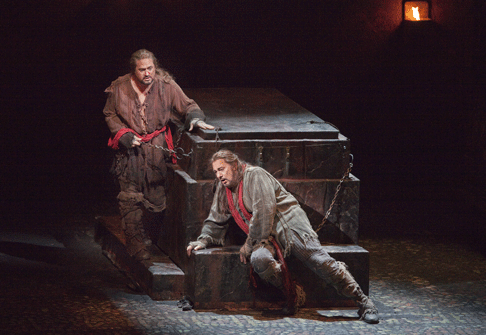
IPHIGENIE_Groves_and_Doming.gifPaul Groves as Pylade and Plácido Domingo as Oreste

Bishop sang the priestess-princess with the right stately propriety and a large, burnished mezzo, but with occasional lapses of evenness, of control, that suggested she had not fully gauged the demands of this long role. It was not a fully crafted performance, though a promising one; if Ms. Graham remains under the weather (Bishop has sung at least one other evening since the one I attended), another excursion or two should pull it all together. Plácido Domingo, too, had a cold (and had the Met say so) but, canny codger that he is, concealed his discomfort behind the craziness Oreste calls for. Not until Bishop had him on his back on the altar, knife poised above, did the familiar Domingo sound pour miraculously forth. Paul Groves, as Pylade, had much the best night of the three leading singers, with an ardent, gleaming sound and acting that made this two-dimensional sidekick role seem genuinely heroic. Mr. Groves has usually been regarded as a lightweight, Mozartean tenor, but his singing here implied that he could take on weightier assignments rewardingly: Florestan or Samson or (in Domingo’s footsteps) light Wagner. Gordon Hawkins sang Thoas unimpressively, Julie Boulianne was acceptable as Diane, and I must say a word about Lei Xu and Cecelia Hall, who made a genuine and joyous impression in the small roles of Iphigénie’s assisting priestesses. Gluck obscures no one; his score allows everyone to shine if she or he is able to. The Met chorus did a tidy a job and Patrick Summers brought out the many felicities of this gracious, unusual score that sums up so much of where drama and opera had led by 1779 and predicts so much of what was to come.
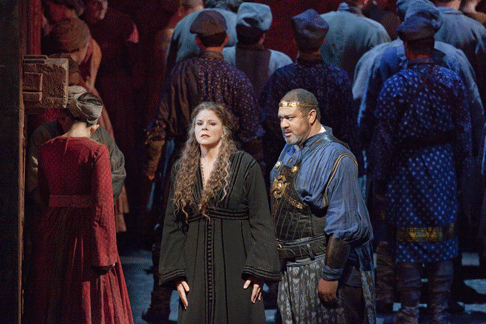
IPHIGENIE_Graham_and_Hawkin.gifSusan Graham as Iphigénie and Gordon Hawkins as Thoas

The Wadsworth production accompanies the “Janissary” percussion Gluck composed so that we’d know we were in a land of barbarians with inane and frantic dancing here and there in nooks and landings and crannies of the set to make us think wild orgies were going on next door. There are also pointless and tiresome intrusions of the ghosts of persons sung about who have no business being on stage, where they confuse the casual viewer and annoy the knowing one. All these things, and Iphigénie’s hysteria could be altered with a simple restaging. Less easy to comprehend and impossible to forgive is the positioning of the statue of the goddess in her temple: In all the long millennia of religious faith, this is surely the only occasion anyone has ever offered prayers, sacrifices and hymns to the backside of a deity. Couldn’t they turn her at least ninety degrees and have them offer sacrifice beside her?

All that aside, it’s a good show.

John Yohalem

Send to a friend

Send a link to this article to a friend with an optional message.

Friend's Email Address: (required)

Your Email Address: (required)

Message (optional):