![Deborah Voigt as the Girl [Photo by Dan Rest courtesy of Lyric Opera of Chicago]](http://www.operatoday.com/Fanciulla_Chicago_01.gif)
02 Feb 2011
La Fanciulla in its Anniversary at Lyric Opera of Chicago
In its current production of Giacomo Puccini’s La fanciulla del West Lyric Opera of Chicago celebrates the centenary of the first performances of the opera.
English Touring Opera are delighted to announce a season of lyric monodramas to tour nationally from October to December. The season features music for solo singer and piano by Argento, Britten, Tippett and Shostakovich with a bold and inventive approach to making opera during social distancing.
This tenth of ten Live from London concerts was in fact a recorded live performance from California. It was no less enjoyable for that, and it was also uplifting to learn that this wasn’t in fact the ‘last’ LfL event that we will be able to enjoy, courtesy of VOCES8 and their fellow vocal ensembles (more below …).
Ever since Wigmore Hall announced their superb series of autumn concerts, all streamed live and available free of charge, I’d been looking forward to this song recital by Ian Bostridge and Imogen Cooper.
Although Stile Antico’s programme article for their Live from London recital introduced their selection from the many treasures of the English Renaissance in the context of the theological debates and upheavals of the Tudor and Elizabethan years, their performance was more evocative of private chamber music than of public liturgy.
Evidently, face masks don’t stifle appreciative “Bravo!”s. And, reducing audience numbers doesn’t lower the volume of such acclamations. For, the audience at Wigmore Hall gave soprano Elizabeth Llewellyn and pianist Simon Lepper a greatly deserved warm reception and hearty response following this lunchtime recital of late-Romantic song.
For this week’s Live from London vocal recital we moved from the home of VOCES8, St Anne and St Agnes in the City of London, to Kings Place, where The Sixteen - who have been associate artists at the venue for some time - presented a programme of music and words bound together by the theme of ‘reflection’.
'Such is your divine Disposation that both you excellently understand, and royally entertaine the Exercise of Musicke.’
‘And there was war in heaven: Michael and his angels fought against the dragon; and the dragon fought and his angels, And prevailed not; neither was their place found any more in heaven … that old serpent … Satan, which deceiveth the whole world: he was cast out into the earth, and his angels were cast out with him.’
There was never any doubt that the fifth of the twelve Met Stars Live in Concert broadcasts was going to be a palpably intense and vivid event, as well as a musically stunning and theatrically enervating experience.
‘Love’ was the theme for this Live from London performance by Apollo5. Given the complexity and diversity of that human emotion, and Apollo5’s reputation for versatility and diverse repertoire, ranging from Renaissance choral music to jazz, from contemporary classical works to popular song, it was no surprise that their programme spanned 500 years and several musical styles.
The Academy of St Martin in the Fields have titled their autumn series of eight concerts - which are taking place at 5pm and 7.30pm on two Saturdays each month at their home venue in Trafalgar Square, and being filmed for streaming the following Thursday - ‘re:connect’.
The London Symphony Orchestra opened their Autumn 2020 season with a homage to Oliver Knussen, who died at the age of 66 in July 2018. The programme traced a national musical lineage through the twentieth century, from Britten to Knussen, on to Mark-Anthony Turnage, and entwining the LSO and Rattle too.
With the Live from London digital vocal festival entering the second half of the series, the festival’s host, VOCES8, returned to their home at St Annes and St Agnes in the City of London to present a sequence of ‘Choral Dances’ - vocal music inspired by dance, embracing diverse genres from the Renaissance madrigal to swing jazz.
Just a few unison string wriggles from the opening of Mozart’s overture to Le nozze di Figaro are enough to make any opera-lover perch on the edge of their seat, in excited anticipation of the drama in music to come, so there could be no other curtain-raiser for this Gala Concert at the Royal Opera House, the latest instalment from ‘their House’ to ‘our houses’.
"Before the ending of the day, creator of all things, we pray that, with your accustomed mercy, you may watch over us."
The doors at The Metropolitan Opera will not open to live audiences until 2021 at the earliest, and the likelihood of normal operatic life resuming in cities around the world looks but a distant dream at present. But, while we may not be invited from our homes into the opera house for some time yet, with its free daily screenings of past productions and its pay-per-view Met Stars Live in Concert series, the Met continues to bring opera into our homes.
Music-making at this year’s Grange Festival Opera may have fallen silent in June and July, but the country house and extensive grounds of The Grange provided an ideal setting for a weekend of twelve specially conceived ‘promenade’ performances encompassing music and dance.
There’s a “slide of harmony” and “all the bones leave your body at that moment and you collapse to the floor, it’s so extraordinary.”
“Music for a while, shall all your cares beguile.”
The hum of bees rising from myriad scented blooms; gentle strains of birdsong; the cheerful chatter of picnickers beside a still lake; decorous thwacks of leather on willow; song and music floating through the warm evening air.
In its current production of Giacomo Puccini’s La fanciulla del West Lyric Opera of Chicago celebrates the centenary of the first performances of the opera.
As elsewhere during the past year Deborah Voigt sings the role of Minnie, who manages the Polka tavern in a California mining camp. The man who wins her heart, and is identified alternately as Dick Johnson or Ramerrez, is sung by Marcello Giordani. The baritone Marco Vratogna, in his debut at Lyric Opera, takes on the role of Jack Rance, the Sheriff who also develops an emotional attachment to Minnie. Sir Andrew Davis conducts with enthusiastic vigor the Lyric Opera Orchestra.
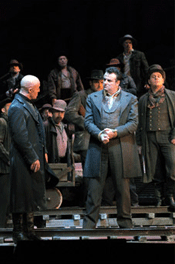 Marco Vratogna as Jack Rance and Marcello Giordani as Dick Johnson (Ramerrez)
In the brief orchestral prelude to Act I Davis emphasizes sweeping gestures
with hints of the West looking toward the action of the opera. Credit must be
given to the ensemble of performers making up the cast of miners in the opening
scene. Under the direction of chorus master Donald Nally members of the Ryan
Opera Center executed both solo and group parts convincingly in their dramatic
and vocal involvement. The tavern is first depicted as a relatively dark set
with painted flats or backdrops signifying the California mountains of the 1849
Gold Rush. Once the miners are gathered inside the Polka, the set brightens and
the stage is devoted to an appropriately busy series of exchanges. The
manipulative bartender Nick, here portrayed and sung with just the right amount
of dash by David Cangelosi, proclaims, “Whisky per tutti;” all then
settle to hear a nostalgic ballad sung by the character Jake Wallace, movingly
performed by Paul Corona. When an argument erupts over a game of cards, only
the intercession of Sheriff Rance halts the possibility of further violence.
Mr. Vratogna cuts an imposing figure as Jack Rance, his snarling demeanor
commanding respect as he tosses off lines with angry menace. Vratogna’s
declamatory force is more effective than his lines in the middle register of
his vocal range, where he seems to depend on a recurring tremulous approach.
Yet even Rance is not immune to a good fight, as one breaks out against a miner
who vies — like the Sheriff — for the love of Minnie. In her first
dramatic entrance, accompanied by pistol shots, she indeed stops the fight and
settles any confusion brewing in her saloon. Ms. Voigt proves herself
comfortable in the role of Minnie. She is able to combine swagger, as she
tosses back a drink, with the mothering care she feels for the miners. Further,
Voigt invests her character with a tender emotionalism , as she explains to
Rance what she hopes to find in love with an ideal partner. In the only solo
part of this act which could be deemed an aria for Minnie, Voigt states her
case movingly if at times with some insecurity in notes that are taken
forte. Soon after her statement the figure identifying himself as Dick
Johnson enters the tavern, and their emotional bond develops in an extended
scene of dialogue and shared lyricism. Mr. Giordani fulfills the vocal demands
of the role admirably in his abilities to sing at varying expressive levels
while shading his voice to emphasize his character’s personality. In the
identity of Ramerrez he is, of course, the leader of a criminal gang who
collectively plan to rob Minnie’s tavern. The love which springs up in
their scene together causes Dick/Ramerrez to abandon this plan as Minnie
declares at the close of the act that she guards the gold belonging to the
miners. Whoever wants it will first have to kill her.
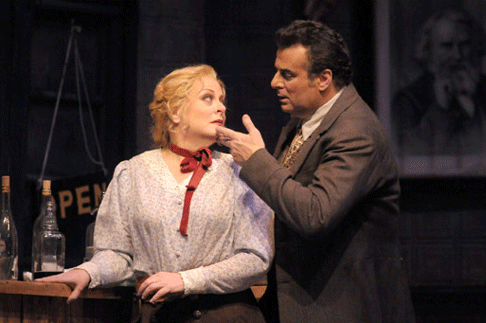 Marcello Giordani as Dick Johnson (Ramerrez) and Deborah Voigt as the Girl
In Act II Dick has responded to an invitation to visit Minnie at her cabin. At the opening Minnie’s Indian maidservant agrees that she will follow the moral suggestion of her mistress and marry the father of her young child. She helps Minnie to change into more domestic attire and withdraws to her teepee following the introduction of Dick’s visit. At first Minnie resists Dick’s advances, then she surrenders yielding to him her first kiss. Because of the falling snow Dick is allowed to stay the night and is given space at a respectable distance. When the Sheriff and his guard awaken the pair, Dick hides during a confrontational scene in which Minnie must accept the news of her lover’s criminal association. Once they are again alone, Minnie releases her bitter resentment in a series of outbursts that show Voigt in her best form of the performance. Her top notes are convincingly delivered with the stirring communication of a deceived soul. Despite Dick’s touching self-defense Minnie forces him out of the cabin, where his is wounded by the law. When Jack Rance returns and discovers his bleeding prey returned to Minnie’s protection, a card-game determines the hero’s fate. In her well-acted stint at poker Voigt proves Minnie’s devotion to Dick by cheating and, when left alone, casting her bogus cards into the air to celebrate her win.
The short Act III of Puccini’s opera provides resolution of both emotions and individual characters as portrayed. When Dick is caught by a posse and threatened with punishment by hanging, he begs that Minnie not be informed of his shameful death. Giordani’s aria as the tenor’s highlight of this performance is an impressive appeal to spare the feelings of his beloved. Minnie’s entrance while riding and plying a mining cart is as show-stopping as her pistol shots in the first act. At the same time, her sincere reminders now that Dick has been blessed by God, who has changed him, recalls her readings from the Bible in that opening scene. She succeeds through dint of her persuasive tone in freeing the reformed Dick. As they look forward to a life elsewhere, Voigt and Giordani sing a stirringly united “Addio” to California and the Sierras.
Salvatore Calomino