![Robert Orth as Richard Nixon and Maria Kanyova as Pat Nixon [Photo by Michael Cooper courtesy of Canadian Opera Company]](http://www.operatoday.com/Nixon06.gif)
15 Feb 2011
The Chill of Grace: A Winter Weekend at COC
At the moment, it seems inevitable that John Adams’ 1987 opera Nixon in China will become a fixture in the repertoire.
English Touring Opera are delighted to announce a season of lyric monodramas to tour nationally from October to December. The season features music for solo singer and piano by Argento, Britten, Tippett and Shostakovich with a bold and inventive approach to making opera during social distancing.
This tenth of ten Live from London concerts was in fact a recorded live performance from California. It was no less enjoyable for that, and it was also uplifting to learn that this wasn’t in fact the ‘last’ LfL event that we will be able to enjoy, courtesy of VOCES8 and their fellow vocal ensembles (more below …).
Ever since Wigmore Hall announced their superb series of autumn concerts, all streamed live and available free of charge, I’d been looking forward to this song recital by Ian Bostridge and Imogen Cooper.
Although Stile Antico’s programme article for their Live from London recital introduced their selection from the many treasures of the English Renaissance in the context of the theological debates and upheavals of the Tudor and Elizabethan years, their performance was more evocative of private chamber music than of public liturgy.
Evidently, face masks don’t stifle appreciative “Bravo!”s. And, reducing audience numbers doesn’t lower the volume of such acclamations. For, the audience at Wigmore Hall gave soprano Elizabeth Llewellyn and pianist Simon Lepper a greatly deserved warm reception and hearty response following this lunchtime recital of late-Romantic song.
For this week’s Live from London vocal recital we moved from the home of VOCES8, St Anne and St Agnes in the City of London, to Kings Place, where The Sixteen - who have been associate artists at the venue for some time - presented a programme of music and words bound together by the theme of ‘reflection’.
'Such is your divine Disposation that both you excellently understand, and royally entertaine the Exercise of Musicke.’
‘And there was war in heaven: Michael and his angels fought against the dragon; and the dragon fought and his angels, And prevailed not; neither was their place found any more in heaven … that old serpent … Satan, which deceiveth the whole world: he was cast out into the earth, and his angels were cast out with him.’
There was never any doubt that the fifth of the twelve Met Stars Live in Concert broadcasts was going to be a palpably intense and vivid event, as well as a musically stunning and theatrically enervating experience.
‘Love’ was the theme for this Live from London performance by Apollo5. Given the complexity and diversity of that human emotion, and Apollo5’s reputation for versatility and diverse repertoire, ranging from Renaissance choral music to jazz, from contemporary classical works to popular song, it was no surprise that their programme spanned 500 years and several musical styles.
The Academy of St Martin in the Fields have titled their autumn series of eight concerts - which are taking place at 5pm and 7.30pm on two Saturdays each month at their home venue in Trafalgar Square, and being filmed for streaming the following Thursday - ‘re:connect’.
The London Symphony Orchestra opened their Autumn 2020 season with a homage to Oliver Knussen, who died at the age of 66 in July 2018. The programme traced a national musical lineage through the twentieth century, from Britten to Knussen, on to Mark-Anthony Turnage, and entwining the LSO and Rattle too.
With the Live from London digital vocal festival entering the second half of the series, the festival’s host, VOCES8, returned to their home at St Annes and St Agnes in the City of London to present a sequence of ‘Choral Dances’ - vocal music inspired by dance, embracing diverse genres from the Renaissance madrigal to swing jazz.
Just a few unison string wriggles from the opening of Mozart’s overture to Le nozze di Figaro are enough to make any opera-lover perch on the edge of their seat, in excited anticipation of the drama in music to come, so there could be no other curtain-raiser for this Gala Concert at the Royal Opera House, the latest instalment from ‘their House’ to ‘our houses’.
"Before the ending of the day, creator of all things, we pray that, with your accustomed mercy, you may watch over us."
The doors at The Metropolitan Opera will not open to live audiences until 2021 at the earliest, and the likelihood of normal operatic life resuming in cities around the world looks but a distant dream at present. But, while we may not be invited from our homes into the opera house for some time yet, with its free daily screenings of past productions and its pay-per-view Met Stars Live in Concert series, the Met continues to bring opera into our homes.
Music-making at this year’s Grange Festival Opera may have fallen silent in June and July, but the country house and extensive grounds of The Grange provided an ideal setting for a weekend of twelve specially conceived ‘promenade’ performances encompassing music and dance.
There’s a “slide of harmony” and “all the bones leave your body at that moment and you collapse to the floor, it’s so extraordinary.”
“Music for a while, shall all your cares beguile.”
The hum of bees rising from myriad scented blooms; gentle strains of birdsong; the cheerful chatter of picnickers beside a still lake; decorous thwacks of leather on willow; song and music floating through the warm evening air.
At the moment, it seems inevitable that John Adams’ 1987 opera Nixon in China will become a fixture in the repertoire.
James Robinson’s stylish and imaginative production from 2004, revived this season by the Canadian Opera Company, illustrates that this opera indeed has a life beyond that imagined by its creators. In fact, viewing Robinson’s Nixon in quick succession with creator Peter Sellars’ recent restaging at the Metropolitan Opera confirms the impression from 2004 that this opera will provide inspiration for creative teams for generations to come. In the instance of Robinson’s production (originally designed for Opera Theatre of Saint Louis), the integrative video design revolutionizes the use of projections within opera by timing visual sequences so intimately with the music that the result is practically a new visual libretto. The chosen images are astute as well as visually stunning, as in the top of Act II when static on the television screens created a snowy landscape. The televisions themselves were used as modular architecture throughout the opera; descending from the sky en mass, acting as a dais for speeches, and evoking individual spaces (perhaps even headboards) for each of the characters during Act III.
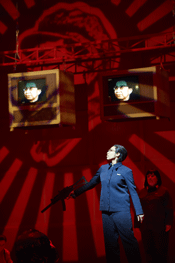 Marisol Montalvo as Chiang Ch’ing (Madam Mao) (front) and Megan Latham as Third Secretary to Mao (behind)
Robinson, his design team, and the cast have struck a fine balance that
divides the story-telling between the live action onstage and the use of video
while simultaneously blurring the distinctions between the two elements. At
times, the characters strike poses as if captured within a snapshot and these
moments of heightened realism integrate beautiful with the meta-commentary both
on the screens and built into Adams’ score. Furthermore, despite the
inherent challenge of portraying historical figures, the majority of the cast
does an excellent job of breathing inner life into what could become
caricatures. Robert Orth could scarcely act the role of Nixon better, but he
could have afforded to sing with more beauty of tone at least some of the time.
In particular, the moment when Nixon speaks of fathers and sons joining hands
in peace would have been even more effective had Orth sung more like a baritone
and less like a president. As the Chinese Prime Minister Chou En-lai, Chen-Ye
Yuan was quietly compelling from the very beginning through the opera’s
haunting last line.
Like the real Henry Kissinger, Thomas Hammons was a strange mixture of enigmatic power and allure. He also seemed to embrace his role as Lao Szu within the ballet with real gusto. Maria Kanyova found both the lyrical and coquettish moments as Pat Nixon and her diction was impressive throughout. Her middle voice could be more attractive, but her floated top notes were so easily suspended that it seemed a shame for conductor Pablo Heras-Casado to rush through them. As Mao Tse-tung and his wife Chiang Ch’ing, Adrian Thompson and Marisol Montalvo were both committed dramatically but lacked the vocal goods to back up what could have been splendid performances.
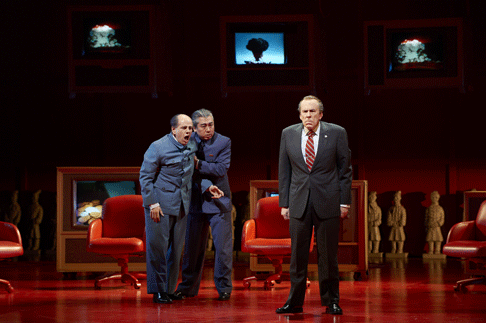 Adrian Thompson as Mao Tse-tung, Chen Ye-Yuan as Chou En-lai and Robert Orth as Richard Nixon
Even though most of the action onstage was well synchronized with Adam’s music, there were several moments of dynamic imbalance between the orchestra and the singers that cannot be attributed to the use of amplification in Adam’s score. Rather, the orchestra was plagued by imprecise playing and pacing throughout, which became distracting and detracted from Adam’s astute choices of orchestration. That said, the chorus was impeccably rehearsed by Sandra Horst and it seems very likely that some of the musical missteps will be corrected during the course of the run.
The lighting by Paul Palazzo was some of the most effective work I have ever seen in any theatre — ranging from the eerie glow of an unseen television flickering on the faces of the typical American family to use of Chinese lanterns on the television screens as a light source. Allen Moyer’s set design provided several layers of visual and semiotic interest, especially for Pat Nixon’s tour of sites during Act II, and James Schuette’s costumes were rhetorically effective while maintaining a strong sense of the opera’s place and time.
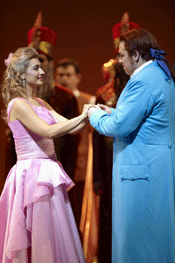 Isabel Bayrakdarian as Pamina and Michael Schade as Tamino
Ultimately, the success of Saturday evening’s performance was largely due to
Robinson’s creative staging which faced the challenges of the libretto
while allowing the quality of the music to speak for itself. In this respect,
Diane Paulus’ new production of Mozart’s Die Zauberflöte was an
entirely fitting companion piece for Nixon in China. Paulus reimagined
the opera’s action taking place on the grounds of a beautiful 18th
century estate as an entertainment on the occasion of the name day of Pamina.
The resulting play-within-a-play scenario worked incredibly well for the first
half of the opera. The staging of the overture introduced the new framework of
Mozart’s familiar characters with uncanny clarity. Papageno took charge
of last-minute rehearsals with some of the estate’s ruder mechanicals
while Sarastro, as lord of the manor, oversaw the entire operation.
From the moment the curtain went up, the cast embraced their dual roles as characters within the festivities and their “real life” counterparts. Betty Waynne Allison, Wallis Giunta, and Lauren Segal were as strong individually as they were as a trio. Rather than portraying Tamino as a bland hero, tenor Michael Schade embraced the ambiguity of his role. He sang and acted like a lover and prince (even to the point of being overly precious vocally) but occasionally revealed a more human impatience or even harshness. Rodion Pogossov and Lisa DiMaria were ideally matched as Papageno and Papagena. They were both as generous with their vocalism and musicality as they were with their spirited comedic performances. Isabel Bayrakdarian may not have been ideally cast as Pamina, but her acting had the strength of purpose and conviction necessary to turn the role into the opera’s true heroine. As her mother, Aline Kutan delivered a one-two punch with the Queen of the Night’s arias that won’t soon be forgotten.
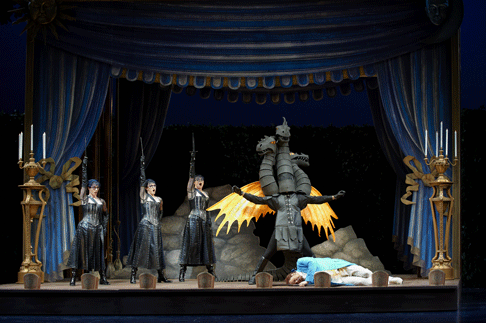 Lauren Segal as the Third Lady, Wallis Giunta as the Second Lady, Betty Waynne Allison as the First Lady and Michael Schade as Tamino (lying down)
House Music Director Johannes Debus led the orchestra in a brisk and lively performance. With the exception of a slightly scrappy final chorus, the choristers were as excellent as they had been the night before. Furthermore, Paulus’ new context for the opera finally allowed for a female chorus contingent that didn’t seem totally superfluous to the action. The production’s concept was not as fully realized in the second half, but the significant strengths of Act I and the pure charm throughout (enhanced at every turn by set and costume designer Myung Hee Cho) made the production a joy to behold.
As for the Canadian Opera Company itself, to paraphrase Alice Goodman’s excellent, beguiling libretto for Nixon in China, how much of what they did last weekend was good? Most of it was good, and some of it was even great.
Alison Moritz