![La Traviata [Photo courtesy of Howard Paley Photography]](http://www.operatoday.com/HHP_PMO_Traviata_DSC_4949.gif)
10 Mar 2011
La Traviata, Phoenix
Francesco Maria Piave’s Italian libretto for Giuseppe Verdi’s opera La Traviata is based on the French play La Dame aux Camélias.
English Touring Opera are delighted to announce a season of lyric monodramas to tour nationally from October to December. The season features music for solo singer and piano by Argento, Britten, Tippett and Shostakovich with a bold and inventive approach to making opera during social distancing.
This tenth of ten Live from London concerts was in fact a recorded live performance from California. It was no less enjoyable for that, and it was also uplifting to learn that this wasn’t in fact the ‘last’ LfL event that we will be able to enjoy, courtesy of VOCES8 and their fellow vocal ensembles (more below …).
Ever since Wigmore Hall announced their superb series of autumn concerts, all streamed live and available free of charge, I’d been looking forward to this song recital by Ian Bostridge and Imogen Cooper.
Although Stile Antico’s programme article for their Live from London recital introduced their selection from the many treasures of the English Renaissance in the context of the theological debates and upheavals of the Tudor and Elizabethan years, their performance was more evocative of private chamber music than of public liturgy.
Evidently, face masks don’t stifle appreciative “Bravo!”s. And, reducing audience numbers doesn’t lower the volume of such acclamations. For, the audience at Wigmore Hall gave soprano Elizabeth Llewellyn and pianist Simon Lepper a greatly deserved warm reception and hearty response following this lunchtime recital of late-Romantic song.
For this week’s Live from London vocal recital we moved from the home of VOCES8, St Anne and St Agnes in the City of London, to Kings Place, where The Sixteen - who have been associate artists at the venue for some time - presented a programme of music and words bound together by the theme of ‘reflection’.
'Such is your divine Disposation that both you excellently understand, and royally entertaine the Exercise of Musicke.’
‘And there was war in heaven: Michael and his angels fought against the dragon; and the dragon fought and his angels, And prevailed not; neither was their place found any more in heaven … that old serpent … Satan, which deceiveth the whole world: he was cast out into the earth, and his angels were cast out with him.’
There was never any doubt that the fifth of the twelve Met Stars Live in Concert broadcasts was going to be a palpably intense and vivid event, as well as a musically stunning and theatrically enervating experience.
‘Love’ was the theme for this Live from London performance by Apollo5. Given the complexity and diversity of that human emotion, and Apollo5’s reputation for versatility and diverse repertoire, ranging from Renaissance choral music to jazz, from contemporary classical works to popular song, it was no surprise that their programme spanned 500 years and several musical styles.
The Academy of St Martin in the Fields have titled their autumn series of eight concerts - which are taking place at 5pm and 7.30pm on two Saturdays each month at their home venue in Trafalgar Square, and being filmed for streaming the following Thursday - ‘re:connect’.
The London Symphony Orchestra opened their Autumn 2020 season with a homage to Oliver Knussen, who died at the age of 66 in July 2018. The programme traced a national musical lineage through the twentieth century, from Britten to Knussen, on to Mark-Anthony Turnage, and entwining the LSO and Rattle too.
With the Live from London digital vocal festival entering the second half of the series, the festival’s host, VOCES8, returned to their home at St Annes and St Agnes in the City of London to present a sequence of ‘Choral Dances’ - vocal music inspired by dance, embracing diverse genres from the Renaissance madrigal to swing jazz.
Just a few unison string wriggles from the opening of Mozart’s overture to Le nozze di Figaro are enough to make any opera-lover perch on the edge of their seat, in excited anticipation of the drama in music to come, so there could be no other curtain-raiser for this Gala Concert at the Royal Opera House, the latest instalment from ‘their House’ to ‘our houses’.
"Before the ending of the day, creator of all things, we pray that, with your accustomed mercy, you may watch over us."
The doors at The Metropolitan Opera will not open to live audiences until 2021 at the earliest, and the likelihood of normal operatic life resuming in cities around the world looks but a distant dream at present. But, while we may not be invited from our homes into the opera house for some time yet, with its free daily screenings of past productions and its pay-per-view Met Stars Live in Concert series, the Met continues to bring opera into our homes.
Music-making at this year’s Grange Festival Opera may have fallen silent in June and July, but the country house and extensive grounds of The Grange provided an ideal setting for a weekend of twelve specially conceived ‘promenade’ performances encompassing music and dance.
There’s a “slide of harmony” and “all the bones leave your body at that moment and you collapse to the floor, it’s so extraordinary.”
“Music for a while, shall all your cares beguile.”
The hum of bees rising from myriad scented blooms; gentle strains of birdsong; the cheerful chatter of picnickers beside a still lake; decorous thwacks of leather on willow; song and music floating through the warm evening air.
Francesco Maria Piave’s Italian libretto for Giuseppe Verdi’s opera La Traviata is based on the French play La Dame aux Camélias.
The play was adapted from a novel by Alexandre Dumas fils, who actually knew the real life heroine, Marie Duplessis.
When Alphonsine Rose Plessis was born on the 15th of January, 1824, in the tiny village of Nonnant in Normandy, no one could have imagined that within twenty years she would become the famous courtesan, Marie Duplessis. Her father put her to work at an early age, first as a beggar and later as a prostitute. When he was investigated for child abuse, he sent the girl to live with relatives in Paris. There, at age 15, she began to frequent dances where she hoped to meet men who would pay her living expenses.
 Director of the Paris Opéra Nestor Roqueplan wrote that he once saw her on
the Pont Neuf eating a green apple, but gazing hungrily at the fried potatoes
being sold nearby. He bought her a large portion and watched as she wolfed them
down and even licked the paper in which they had been wrapped. Roqueplan would
recall this incident in 1851 when he spoke with Giuseppe Verdi about bringing
La Traviata to the Opéra.
Director of the Paris Opéra Nestor Roqueplan wrote that he once saw her on
the Pont Neuf eating a green apple, but gazing hungrily at the fried potatoes
being sold nearby. He bought her a large portion and watched as she wolfed them
down and even licked the paper in which they had been wrapped. Roqueplan would
recall this incident in 1851 when he spoke with Giuseppe Verdi about bringing
La Traviata to the Opéra.
Marie worked hard at bettering herself. She not only learned to read and write, but she also attained an appreciation of the arts. When Roqueplan next saw her, he was astonished to note that the little waif from the Pont Neuf had become the fashionable lady on the arm of the Duc de Guiche.
One evening, when Marie was attending a party with Alexandre Dumas, son of the famous writer, she had a dreadful coughing spell. She explained that since there was no cure for her illness she chose to be among interesting people who would distract her from her pain. Dumas continued his affair with her for about a year, but he had to evade detection by her actual protector because he did not have anywhere near enough money to maintain her household. Another of her admirers, Franz Liszt, wrote: “She had a great deal of heart, a great liveliness of spirit and I consider her unique of her kind.She was the most complete incarnation of womankind that has ever existed.” This is the femme fatale we see on the stage as “Violetta” in La Traviata.
On March 4, 2011, Phoenix opera presented Carroll Freeman’s traditional staging of La Traviata at the historic Orpheum Theater. Peter Dean Beck’s set, originally designed for Florida Grand Opera, was easily transformed into the opera’s various scenes. John Lehmeyer’s detailed costumes set the period securely and added considerably to the opera’s visual appeal.
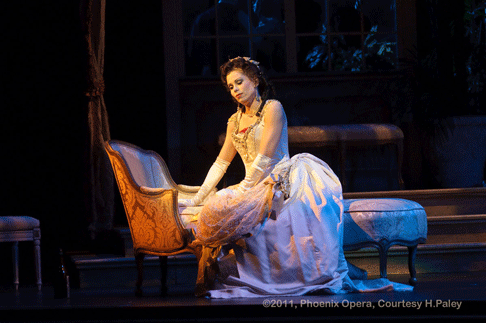
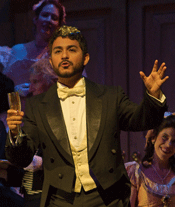
Viennese soprano Julia Koci was a radiantly beautiful Violetta who sang with taste and musicality. She is one of the few interpreters of this role who can truly handle both the coloratura of the first act and the dramatic singing required by the following scenes. Operalia winner Jesus Garcia was a passionate young lover who sang with robust, ringing tones. Together they were an ideal couple in Act I, and a pair of troubled but intriguing lovers thereafter. One could not help reaching for a handkerchief in the last act when Germont, not the soprano, read the letter which comes too late. That was an interesting choice by the director and it worked well.
Germont was sung with panache by veteran French Canadian baritone Gaétan Laperrière. He made you angry as he gave Violetta a piece of his narrow mind in Act II, but he tore at your heart strings at the end with his expressions of remorse. An attractive Flora, Erin Tompkins sang with a solid sound while Francisco Renteria was an unwavering Gastone. Alexis Davis Hazell was a poignant Annina and her husband, Earl Hazell, sang the Commissioner with a stentorian voice. Baritones Christopher Holmes and Christopher Herrera portrayed Baron Douphol and Doctor Grenvil with authority, while bass baritone Andrew Gray proved to be a commanding Marchese.
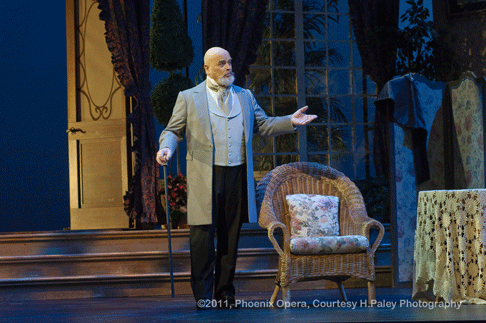
Company Founder and Artistic Director John Massaro led the rather small orchestra in a smooth, lyrical rendition of the work. The audience response at the end of the opera was tumultuous and it was fitting praise for the excellent performers who brought Verdi’s wonderful opera to life.
Maria Nockin