Hollywood’s historical style, especially the epics with spiritual
content, took its cue from Scribe, and the idea of accompanying the pageant
with a thrilling but shallow score may also derive from these operas. In any
case, the Scribe-Meyerbeer firm achieved this very well; their operas,
expensive as they were to produce properly, were much loved for a hundred
years. Changes in the style of singing, the onset of highfalutin Wagnerian
music-drama, which outclassed grand opera, and the sheer cost of putting this
grandeur on stage (six or seven leading singers were not the least of
it—but ballets of ice skaters or ghostly nuns, sixteenth-century bathing
beauties with pool, a full-rigged galleon overwhelmed by a
typhoon—don’t none of it come cheap) fell victim to the Crash of
1929.
Revivals of their four grandest collaborations, not to mention the lesser
ones, have been so rare since World War II that it is easy to keep track (and
own pirates) of most of the grandest (the Sutherland-Corelli-Simionato Gli
Ugonotti in Milan, the Ramey-Anderson Robert le Diable in Paris,
the Leech-Lorengar Des Hugenotten in Berlin, the Horne-McCracken
Prophète at the Met, the Verrett-Domingo L’Africaine in
San Francisco). L’Africaine, the final (and posthumous)
Scribe-Meyerbeer creation (premiere 1865), was last staged in New York in 1934
with Rethberg, Martinelli and Pinza. It was last heard here in concert in 1972,
when the brand new Opera Orchestra of New York gave it for Richard Tucker to
show off his stalwart ut de poitrine as Vasco da Gama. Eve Queler, who is
standing down as maestra for the company she has steered through so many shoals
past so many Capes of Good Hope, presented it again last week as her farewell
to the podium.
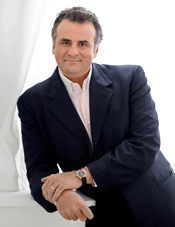 Marcello Giordani [Photo by Dario Acosta]
L’Africaine has everything—except Africa or Africans.
(The plot changed over years of rewriting but they forgot to change the title,
and both men had died before the premiere.) L’Africaine
certainly had everything Meyerbeer’s audiences expected: big arias and
loud duets for singers with range and staying power, orchestral variety, insane
stage effects, local color run riot, chorale, ballet. There are so many
characters in Act I that we are relieved when a catastrophe in Act III reduces
the story to manageable size, their stage-filling Portuguese galleon having hit
a reef (thanks to an invocation of a god of the winds) where bloodthirsty
savages overwhelm the crew. This still leaves two acts of romantic mayhem,
oriental religious rituals and the opera’s most famous aria, “O
Paradis” before a bittersweet conclusion: The savage but noble queen
sends her adored Vasco and his Portuguese sweetheart home, then eats poisoned
crimson flowers on a cliff overlooking the sea. (Yes, this situation was
borrowed for Aida and Gioconda.) Unfortunately for the peoples of the
Orient, the lovesick queen also gives Vasco navigational secrets with which to
found a colonial empire, but in 1865 that was just what all the opera-loving
countries wanted to do. “O Paradiso” (as it was sung in Italian, by
Caruso, Gigli, Martinelli et al.) became, in a way, the theme song of the
age.
L’Africaine’s rare full revivals (most recently, in
this country, in San Francisco in 1988, with Shirley Verrett, Plácido Domingo,
Ruth Ann Swenson and Justino Diaz, a production available on video) never fail
to delight those audiences who like their opera grand, with big tunes, big
voices, long nights and manic spectacle. Its repute (both good and bad) pretty
much guarantees an audience of the curious, and Avery Fisher Hall was packed to
the rafters on the present occasion, despite the lack of well-known singers
other than Marcello Giordani. Just, you know, to hear the thing. Most
of us were still hanging on three and a half hours after Maestra Queler raised
her baton (and there was only one intermission). And as soon as we heard a
massed basso chorus threatening violence in the name of intolerant religion (a
familiar Scribe trope), accompanied by a piccolo, we knew we were in Meyerbeer
country. (Scribe gets it twice in L’Africaine—the raging
basses are Catholics in Act I, when they wish to kill Vasco for attempting to
circumnavigate Africa, and they’re bloodthirsty Brahmins in Act IV, when
they want to kill him lest he go home and reveal the secret route.)
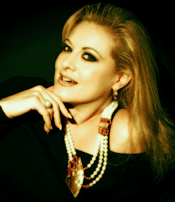 Chiara Taigi
Eve Queler has been running this show for forty years and her conducting
style isn’t going to change. How dancers would follow her languid beat
through Meyerbeer’s exotic ballets is hard to imagine, but happily this
is not a requirement in concert performances; the singers had merely to stand
out and declaim. The pace of the evening did not flag, the climaxes and
confrontations were a thrill. For example, the xenophobic Brahmins inserting
cries of “No!” into Vasco’s pleas for mercy were a nice
Meyerbeerian touch, though of course stolen from Gluck’s Orfeo,
which the Opéra had recently revived for Pauline Viardot. The tenor-bass duet
in Act III, as Vasco and slimy Don Pedro nearly come to blows over the lovely
Inèz, is even more exciting because we know the typhoon is blowing up. The
soprano-mezzo battle over the tenor (again: Verdi and Ponchielli were paying
heed) enlivens Act V while the conclusion is still in doubt. It was an evening
of crowd-pleasers.
Besides showing off scores we are unlikely to encounter staged, Opera
Orchestra’s other great function has been to introduce New York to
singers we may not otherwise encounter. OONY’s alumni are quite a roster.
That last L’Africaine, for example, paired Tucker with
Antonietta Stella. OONY’s Les Huguenots, a triumphant occasion
and a rare performance of nearly the entire score, gave us not only the New
York debut of Krassimira Stoyanova as Valentine but the superb Raoul of
Marcello Giordani. Giordani, for whatever reason, never sounds so good, so
heroic, at the Met (where he sometimes sings the same roles) as he does when
performing with OONY, and L’Africaine showcased his Vasco da
Gama, some of the noblest, most robust singing he has given New York in many
years, though not without an occasional bobble.
Giordani was joined by a curious roster of strangers and familiar faces in
unusual roles. Among the strangers was Chiara Taigi, an Italian soprano of
striking looks and high melodrama in the acting department, showing off three
different costumes to suit Sélika’s three roles of lovelorn slave girl,
restored queen and suicidal abandoned lover. The role is as juicy as, well, a
Meyerbeer heroine, but sits awkwardly for the voice, mostly high mezzo with
some soprano extension. Rosa Ponselle, whose voice ran precisely there, had a
tremendous success with it, but no one living has the technique, much less the
gift, of a Ponselle. Taigi’s top notes were rough and the joints
sometimes showed, but it is a prima donna-sized instrument with some very
beautiful material in it. I’d be curious to see her in more basic
repertory, but I’m not sure which—the list of roles in her bio is
all over the map, and her emoting may not suit the modern
“realistic” school. In an OONY evening, she was just what we
wanted.
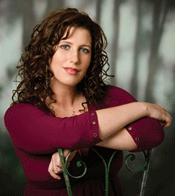 Ellie Dehn [Photo by Dario Acosta]
Ellie Dehn, who sings an odd assortment of parts at the Met (I loved her in
Satyagraha), sang the role of Vasco’s girlfriend, Inèz, with
some brilliant color but imperfect coloratura. A South African baritone named
Fikile Mvinjelwa—short, barrel-chested, dark-skinned, a voice to reckon
with and an actor to his fingertips—took advantage of all the quirks of
Nélusko’s sinister-heroic personality without reticence and brought down
the house with his “Adamastor, roi des vagues.” (He’s been
covering roles like Rigoletto at the Met; I say: Turn him loose to sing them.)
Daniel Mobbs, ever reliable and elegant, sang selfish Don Pedro suavely. Ezio
Pinza was wont to sing both the Grand Inquisitor and the High Priest in the old
days—more Scribean commentary on the universality of religious
intolerance—but Queler gave them to sturdy rival basses.
It was a performance to make us all hope to be around the next time
L’Africaine comes back—and more eager still to hear a
Robert le Diable or Dinorah or Crociato in
Egitto.
John Yohalem