![Natalie Dessay as Lucia [Photo by Ken Howard courtesy of The Metropolitan Opera]](http://www.operatoday.com/LUCIA_Dessay_as_Lucia.gif)
15 Mar 2011
Lucia, New York
It costs a lot to look cheap. And it takes a village to raise a child. In the case of the Metropolitan Opera’s current revival of Donizetti’s Lucia di Lammermoor, it takes a lot of talent to produce underwhelming opera.
English Touring Opera are delighted to announce a season of lyric monodramas to tour nationally from October to December. The season features music for solo singer and piano by Argento, Britten, Tippett and Shostakovich with a bold and inventive approach to making opera during social distancing.
This tenth of ten Live from London concerts was in fact a recorded live performance from California. It was no less enjoyable for that, and it was also uplifting to learn that this wasn’t in fact the ‘last’ LfL event that we will be able to enjoy, courtesy of VOCES8 and their fellow vocal ensembles (more below …).
Ever since Wigmore Hall announced their superb series of autumn concerts, all streamed live and available free of charge, I’d been looking forward to this song recital by Ian Bostridge and Imogen Cooper.
Although Stile Antico’s programme article for their Live from London recital introduced their selection from the many treasures of the English Renaissance in the context of the theological debates and upheavals of the Tudor and Elizabethan years, their performance was more evocative of private chamber music than of public liturgy.
Evidently, face masks don’t stifle appreciative “Bravo!”s. And, reducing audience numbers doesn’t lower the volume of such acclamations. For, the audience at Wigmore Hall gave soprano Elizabeth Llewellyn and pianist Simon Lepper a greatly deserved warm reception and hearty response following this lunchtime recital of late-Romantic song.
For this week’s Live from London vocal recital we moved from the home of VOCES8, St Anne and St Agnes in the City of London, to Kings Place, where The Sixteen - who have been associate artists at the venue for some time - presented a programme of music and words bound together by the theme of ‘reflection’.
'Such is your divine Disposation that both you excellently understand, and royally entertaine the Exercise of Musicke.’
‘And there was war in heaven: Michael and his angels fought against the dragon; and the dragon fought and his angels, And prevailed not; neither was their place found any more in heaven … that old serpent … Satan, which deceiveth the whole world: he was cast out into the earth, and his angels were cast out with him.’
There was never any doubt that the fifth of the twelve Met Stars Live in Concert broadcasts was going to be a palpably intense and vivid event, as well as a musically stunning and theatrically enervating experience.
‘Love’ was the theme for this Live from London performance by Apollo5. Given the complexity and diversity of that human emotion, and Apollo5’s reputation for versatility and diverse repertoire, ranging from Renaissance choral music to jazz, from contemporary classical works to popular song, it was no surprise that their programme spanned 500 years and several musical styles.
The Academy of St Martin in the Fields have titled their autumn series of eight concerts - which are taking place at 5pm and 7.30pm on two Saturdays each month at their home venue in Trafalgar Square, and being filmed for streaming the following Thursday - ‘re:connect’.
The London Symphony Orchestra opened their Autumn 2020 season with a homage to Oliver Knussen, who died at the age of 66 in July 2018. The programme traced a national musical lineage through the twentieth century, from Britten to Knussen, on to Mark-Anthony Turnage, and entwining the LSO and Rattle too.
With the Live from London digital vocal festival entering the second half of the series, the festival’s host, VOCES8, returned to their home at St Annes and St Agnes in the City of London to present a sequence of ‘Choral Dances’ - vocal music inspired by dance, embracing diverse genres from the Renaissance madrigal to swing jazz.
Just a few unison string wriggles from the opening of Mozart’s overture to Le nozze di Figaro are enough to make any opera-lover perch on the edge of their seat, in excited anticipation of the drama in music to come, so there could be no other curtain-raiser for this Gala Concert at the Royal Opera House, the latest instalment from ‘their House’ to ‘our houses’.
"Before the ending of the day, creator of all things, we pray that, with your accustomed mercy, you may watch over us."
The doors at The Metropolitan Opera will not open to live audiences until 2021 at the earliest, and the likelihood of normal operatic life resuming in cities around the world looks but a distant dream at present. But, while we may not be invited from our homes into the opera house for some time yet, with its free daily screenings of past productions and its pay-per-view Met Stars Live in Concert series, the Met continues to bring opera into our homes.
Music-making at this year’s Grange Festival Opera may have fallen silent in June and July, but the country house and extensive grounds of The Grange provided an ideal setting for a weekend of twelve specially conceived ‘promenade’ performances encompassing music and dance.
There’s a “slide of harmony” and “all the bones leave your body at that moment and you collapse to the floor, it’s so extraordinary.”
“Music for a while, shall all your cares beguile.”
The hum of bees rising from myriad scented blooms; gentle strains of birdsong; the cheerful chatter of picnickers beside a still lake; decorous thwacks of leather on willow; song and music floating through the warm evening air.
It costs a lot to look cheap. And it takes a village to raise a child. In the case of the Metropolitan Opera’s current revival of Donizetti’s Lucia di Lammermoor, it takes a lot of talent to produce underwhelming opera.
Despite what anyone says regarding soprano Natalie Dessay’s vocal technique or her attendance record at the Met, she is undoubtedly an exciting performer to watch. Joseph Calleja and Ludovic Tézier both bring ample good looks and stage worthiness to the table in addition to fine musicianship and distinctive voices. Director Mary Zimmerman, a 1998 recipient of a MacArthur “Genius” grant, took the theatre world by storm with her 2002 adaptation of Ovid’s Metamorphoses. So, why is this Lucia so bland?
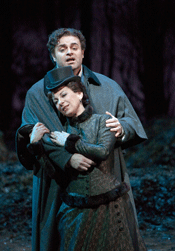 Joseph Calleja as Edgardo and Natalie Dessay as Lucia
From the moment the curtain raises, it appears that the devil is in the details. The overture is a semi-staged affair with depressingly literal lighting effects and, when the action begins, the extremely tight false proscenium looks more like a diorama from the Museum of Natural History than a set from one of the world’s leading opera houses. During the interlude after the first scene, snow falls for no apparent reason other than to justify the large muff that Lucia wields later.
But these are relatively small concerns compared to the generic performances that Zimmerman elicits from her starry cast. Dessay, a stage animal par excellence, even seemed tentative in the first and second acts. Perhaps this was partially due to the limitations placed upon Lucia’s psychological development by making the ghost literally appear during “Regnava nel silenzio.” If Lucia is not unhinged by grief at the beginning, her affection for Edgardo falls short of passion, and the situation with her brother is only vaguely threatening in the second act, then there is little justification for her later actions.
Furthermore, in this production, Lucia appears with her bridegroom at the beginning of Act III, Scene ii and they exit the stage only moments before Raimondo enters and tells the wedding guests what has transpired in the bridal chamber. This robs the audience of seeing Lucia’s shocking transformation from obedient bride and sister into a madwoman. Even worse, the timing is completely off — the horror of the moment stems as much from the realization that the party has gone on for hours as Arturo’s body grew cold as in Lucia’s act itself. There were several such lapses in the storytelling and Zimmerman seems to have stayed too close to the original novel and done the opera a disservice by not treating it as the ripping tale it is.
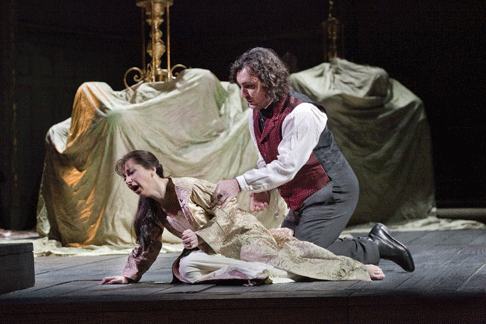 Ludovic Tézier as Enrico and Natalie Dessay as Lucia
Within the murky and misguided production, the singers did their level best. Dessay rallied for her mad scene which transfixed the audience. Ludovic Tézier looked and sounded the part of Lucia’s brother Enrico, burdened as he was with a costume that made him Severus Snape’s doppelgänger. And while tenor Joseph Calleja was impassioned as Edgardo, unfortunately the tension between the two characters during the Wolf’s Crag scene was nonexistent due to some serious park and bark staging in front of a silly-looking scrim with a mouse hole. Kwangchul Youn was absolute luxury casting in the role of Raimondo and Matthew Plenk handled his duties as Arturo so well that it seemed a real pity to see him go so quickly.
The chorus was well-rehearsed musically but did little to convey the social turmoil that provides the impetus for the action and ultimately serves as a Greek chorus during the opera’s greatest moments of catharsis. Conductor Patrick Summers lead the reliably excellent orchestra with suavity and confidence.
With all the elements in place behind this production — including great source material, a fantastic cast, and the technical and artistic resources of the Metropolitan Opera — the results felt like a waste, much like the blighted life of the opera’s heroine.
Alison Moritz