English Touring Opera are delighted to announce a season of lyric monodramas to tour nationally from October to December. The season features music for solo singer and piano by Argento, Britten, Tippett and Shostakovich with a bold and inventive approach to making opera during social distancing.
This tenth of ten Live from London concerts was in fact a recorded live performance from California. It was no less enjoyable for that, and it was also uplifting to learn that this wasn’t in fact the ‘last’ LfL event that we will be able to enjoy, courtesy of VOCES8 and their fellow vocal ensembles (more below …).
Ever since Wigmore Hall announced their superb series of autumn concerts, all streamed live and available free of charge, I’d been looking forward to this song recital by Ian Bostridge and Imogen Cooper.
Although Stile Antico’s programme article for their Live from London recital introduced their selection from the many treasures of the English Renaissance in the context of the theological debates and upheavals of the Tudor and Elizabethan years, their performance was more evocative of private chamber music than of public liturgy.
Evidently, face masks don’t stifle appreciative “Bravo!”s. And, reducing audience numbers doesn’t lower the volume of such acclamations. For, the audience at Wigmore Hall gave soprano Elizabeth Llewellyn and pianist Simon Lepper a greatly deserved warm reception and hearty response following this lunchtime recital of late-Romantic song.
For this week’s Live from London vocal recital we moved from the home of VOCES8, St Anne and St Agnes in the City of London, to Kings Place, where The Sixteen - who have been associate artists at the venue for some time - presented a programme of music and words bound together by the theme of ‘reflection’.
‘And there was war in heaven: Michael and his angels fought against the dragon; and the dragon fought and his angels, And prevailed not; neither was their place found any more in heaven … that old serpent … Satan, which deceiveth the whole world: he was cast out into the earth, and his angels were cast out with him.’
There was never any doubt that the fifth of the twelve Met Stars Live in Concert broadcasts was going to be a palpably intense and vivid event, as well as a musically stunning and theatrically enervating experience.
‘Love’ was the theme for this Live from London performance by Apollo5. Given the complexity and diversity of that human emotion, and Apollo5’s reputation for versatility and diverse repertoire, ranging from Renaissance choral music to jazz, from contemporary classical works to popular song, it was no surprise that their programme spanned 500 years and several musical styles.
The Academy of St Martin in the Fields have titled their autumn series of eight concerts - which are taking place at 5pm and 7.30pm on two Saturdays each month at their home venue in Trafalgar Square, and being filmed for streaming the following Thursday - ‘re:connect’.
The London Symphony Orchestra opened their Autumn 2020 season with a homage to Oliver Knussen, who died at the age of 66 in July 2018. The programme traced a national musical lineage through the twentieth century, from Britten to Knussen, on to Mark-Anthony Turnage, and entwining the LSO and Rattle too.
With the Live from London digital vocal festival entering the second half of the series, the festival’s host, VOCES8, returned to their home at St Annes and St Agnes in the City of London to present a sequence of ‘Choral Dances’ - vocal music inspired by dance, embracing diverse genres from the Renaissance madrigal to swing jazz.
Just a few unison string wriggles from the opening of Mozart’s overture to Le nozze di Figaro are enough to make any opera-lover perch on the edge of their seat, in excited anticipation of the drama in music to come, so there could be no other curtain-raiser for this Gala Concert at the Royal Opera House, the latest instalment from ‘their House’ to ‘our houses’.
The doors at The Metropolitan Opera will not open to live audiences until 2021 at the earliest, and the likelihood of normal operatic life resuming in cities around the world looks but a distant dream at present. But, while we may not be invited from our homes into the opera house for some time yet, with its free daily screenings of past productions and its pay-per-view Met Stars Live in Concert series, the Met continues to bring opera into our homes.
Music-making at this year’s Grange Festival Opera may have fallen silent in June and July, but the country house and extensive grounds of The Grange provided an ideal setting for a weekend of twelve specially conceived ‘promenade’ performances encompassing music and dance.
The hum of bees rising from myriad scented blooms; gentle strains of birdsong; the cheerful chatter of picnickers beside a still lake; decorous thwacks of leather on willow; song and music floating through the warm evening air.
This is an opera written with a cannon and a feather. There is sensory
overload—an overload of sensory overload: lights that shine into your face in
the manner of an ophthalmologist scanning your retina; eerie, too-loud sounds
that invade you from every direction; dancing patterns of light that may
resolve into huge words or huge faces; a great chandelier-harp that sometimes
descends to be played, a strumming like the sounds of the sirens in Plato’s
parable of the concentric crystalline spheres.
Tod Machover: Death and the Powers
Simon Powers: James Maddalena; Evvy: Emily Albrink, Patricia Risley (Monaco Premiere); Miranda: Sara Heaton, Joélle Harvey (Monaco Premiere); Nicholas: Hal Cazalet. The United Way: Doug Dodson, Frank Kelley (Monaco Premiere); The United Nations: David Kravitz; The Administration: Tom McNichols, Daniel Cole (September 2009 Workshop). Boston Modern Orchestra Project. Conductor: Gil Rose. Principal Keyboard: John McDonald. Second Keyboard: Linda Osborn-Blaschke, Simone Ovsey (September 2009 Workshop). Director: Diane Paulus. Production Designer: Alex Mcdowell. Choreographer: Karole Armitage. MIT Media Lab.
But there are also moments of
fragile lyricism, pretty melodies that sing of the old values of love and
touch. The opera vacillates between the loud future of silicon and solenoid,
and the quietly humane past.
Tod Machover
Like certain other short operas, such as Rachmaninov’s Francesca da
Rimini, this is an opera in the past tense: the prologue shows us robots
in a post-organic world, trying to puzzle out the meaning of the nonsensical
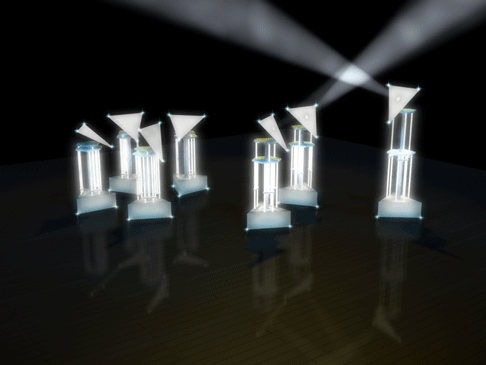
word death. (There is something too cute about these robots, who look like the
sly agile desk lamps in the old Pixar animation, and who sound like the
apotheosis of R2D2.) The robots put on a skit—the opera itself—about the
transformation of the human into the post-human: a billionaire named Simon
Powers decides to abandon his dying body and place his consciousness, his
identity, into The System, a motile all-encompassing electrical structure that
is slowly replacing a dematerializing world. In this quest he is aided by
Nicholas, a young assistant with a prosthetic arm, and resisted, at least
partly, by his third wife Evvie and his daughter Miranda.
The name Miranda of course brings to mind Shakespeare’s The
Tempest, and makes us wonder whether Powers is just another name for
Prospero. In Dryden’s adaptation of The Tempest, Prospero never
forswears magic and retains his mastery over the elements; and Simon Powers is
a magician who keeps his power, although he may be a wizard lost in his own
labyrinth. Nicholas, who dances and prances around the stage, and climbs up the
grid of lights, is his affable Ariel.
Robert Pinsky’s text is more clumsy that one would expect from a
distinguished poet, full of lame puns and overextended parallels: he keeps
hitting you over the head with quotations from Yeats’s “Sailing to
Byzantium” (a poem about an old man who muses on his possible transfiguration
into a mechanical bird) and with plugs for poetry itself as something Important
to the Human Soul. But the text does have the virtue of a certain moral
ambiguity: it would have been easy to deplore the robots and to uphold the
grand old human world of tears and joy; but Pinsky refuses this easy simple
conflict, and makes The System a seductive place with at least partially real
delights, and makes the human world a place of evil as well as good. At one
point the delegates from the United Way, the United Nations, and the United
States (the last a superb bass, Tom McNichols, maybe the best singer in the
cast) visit the virtualized Simon to plead with him not to ruin the global
economy. But these are not figures of pathos, but officious fools, somewhat
like the Jews in Strauss’s Salome. And when the starving multitudes
thrust themselves onto the stage toward the end of the opera, they seem like a
bloodthirsty mob about to tear Miranda limb from limb. Only Miranda and Evvie
place the warm world of sorrow and devotion in a favorable light; and Evvie, at
least, herself decides to enter The System. In his interesting program note,
Pinsky implicitly compares his text to “a robot that performs the work of
meaning and emotion…the robots [in the opera] are in a sense returning the
favor of creation”; and intelligence and sensitivity of robots constitute an
important theme here.
Rendering of Operabots interacting with each other
It is an odd opera in that there is little romantic love, and little
conflict beyond the cerebral pondering of robot vs. human cerebration. In this
way it resembles Das Rheingold, another opera with little romantic
love, and a good deal of thinking about the values of the wet old healthy
elemental world vs. the values of a futuristic society built by robots (or, as
Wagner called them, giants). In the scene where Simon gloats over his
successful assimilation into The System, Machover bases the music on a
triumphalist Naturthema not out of place in Wagner; and the sustained roar of
certain episodes near the end might call to mind another great moment of
sensory overload, the final bars of Das Rheingold.
The singing was satisfactory and evidently accurate, but unremarkable. James
Maddalena, the Simon, was not in excellent voice, but his forceful baritone
made for a potent stage presence—Alberich the billionaire, invisible in his
Tarnhelm but dominating the world.
![Sara Heaton as Miranda [Photo: http://opera.media.mit.edu/projects/deathandthepowers/gallery.php]](http://www.operatoday.com/Machover_miranda_sara.gif)