![Kevin Moreno [Photo by David Moreno courtesy of Virginia Arts Festival]](http://www.operatoday.com/Rappahannock-County---Kevin.gif)
19 Apr 2011
Americans define new territory for songs
They all wrote songs — lots of them: Ives, Bernstein, Rorem. In recital, however, the American product has never found a place on the perch claimed by Schubert and Schumann.
English Touring Opera are delighted to announce a season of lyric monodramas to tour nationally from October to December. The season features music for solo singer and piano by Argento, Britten, Tippett and Shostakovich with a bold and inventive approach to making opera during social distancing.
This tenth of ten Live from London concerts was in fact a recorded live performance from California. It was no less enjoyable for that, and it was also uplifting to learn that this wasn’t in fact the ‘last’ LfL event that we will be able to enjoy, courtesy of VOCES8 and their fellow vocal ensembles (more below …).
Ever since Wigmore Hall announced their superb series of autumn concerts, all streamed live and available free of charge, I’d been looking forward to this song recital by Ian Bostridge and Imogen Cooper.
Although Stile Antico’s programme article for their Live from London recital introduced their selection from the many treasures of the English Renaissance in the context of the theological debates and upheavals of the Tudor and Elizabethan years, their performance was more evocative of private chamber music than of public liturgy.
Evidently, face masks don’t stifle appreciative “Bravo!”s. And, reducing audience numbers doesn’t lower the volume of such acclamations. For, the audience at Wigmore Hall gave soprano Elizabeth Llewellyn and pianist Simon Lepper a greatly deserved warm reception and hearty response following this lunchtime recital of late-Romantic song.
For this week’s Live from London vocal recital we moved from the home of VOCES8, St Anne and St Agnes in the City of London, to Kings Place, where The Sixteen - who have been associate artists at the venue for some time - presented a programme of music and words bound together by the theme of ‘reflection’.
'Such is your divine Disposation that both you excellently understand, and royally entertaine the Exercise of Musicke.’
‘And there was war in heaven: Michael and his angels fought against the dragon; and the dragon fought and his angels, And prevailed not; neither was their place found any more in heaven … that old serpent … Satan, which deceiveth the whole world: he was cast out into the earth, and his angels were cast out with him.’
There was never any doubt that the fifth of the twelve Met Stars Live in Concert broadcasts was going to be a palpably intense and vivid event, as well as a musically stunning and theatrically enervating experience.
‘Love’ was the theme for this Live from London performance by Apollo5. Given the complexity and diversity of that human emotion, and Apollo5’s reputation for versatility and diverse repertoire, ranging from Renaissance choral music to jazz, from contemporary classical works to popular song, it was no surprise that their programme spanned 500 years and several musical styles.
The Academy of St Martin in the Fields have titled their autumn series of eight concerts - which are taking place at 5pm and 7.30pm on two Saturdays each month at their home venue in Trafalgar Square, and being filmed for streaming the following Thursday - ‘re:connect’.
The London Symphony Orchestra opened their Autumn 2020 season with a homage to Oliver Knussen, who died at the age of 66 in July 2018. The programme traced a national musical lineage through the twentieth century, from Britten to Knussen, on to Mark-Anthony Turnage, and entwining the LSO and Rattle too.
With the Live from London digital vocal festival entering the second half of the series, the festival’s host, VOCES8, returned to their home at St Annes and St Agnes in the City of London to present a sequence of ‘Choral Dances’ - vocal music inspired by dance, embracing diverse genres from the Renaissance madrigal to swing jazz.
Just a few unison string wriggles from the opening of Mozart’s overture to Le nozze di Figaro are enough to make any opera-lover perch on the edge of their seat, in excited anticipation of the drama in music to come, so there could be no other curtain-raiser for this Gala Concert at the Royal Opera House, the latest instalment from ‘their House’ to ‘our houses’.
"Before the ending of the day, creator of all things, we pray that, with your accustomed mercy, you may watch over us."
The doors at The Metropolitan Opera will not open to live audiences until 2021 at the earliest, and the likelihood of normal operatic life resuming in cities around the world looks but a distant dream at present. But, while we may not be invited from our homes into the opera house for some time yet, with its free daily screenings of past productions and its pay-per-view Met Stars Live in Concert series, the Met continues to bring opera into our homes.
Music-making at this year’s Grange Festival Opera may have fallen silent in June and July, but the country house and extensive grounds of The Grange provided an ideal setting for a weekend of twelve specially conceived ‘promenade’ performances encompassing music and dance.
There’s a “slide of harmony” and “all the bones leave your body at that moment and you collapse to the floor, it’s so extraordinary.”
“Music for a while, shall all your cares beguile.”
The hum of bees rising from myriad scented blooms; gentle strains of birdsong; the cheerful chatter of picnickers beside a still lake; decorous thwacks of leather on willow; song and music floating through the warm evening air.
They all wrote songs — lots of them: Ives, Bernstein, Rorem. In recital, however, the American product has never found a place on the perch claimed by Schubert and Schumann.
(When did you, for example, last hear Elie Siegmeister’s Strange Funeral in Braddock, the 1936 documentation of a day when Marxism was not yet a curse in America?) Happily, things are changing — largely due to the commitment to song on the part of two Americans now moving toward middle age: Jake Heggie and Ricky Ian Gordon.
True, both men made their strongest mark in opera. Heggie’s Dead Man Walking, premiered in San Francisco in 2000, has become the most-performed opera of the 20th century, although in all probability it will soon by outranked by his Moby Dick, first staged by Dallas Opera a year ago. And Minnesota Opera offered Gordon’s touching treatment of Grapes of Wrath in 2007. Although both men are somewhat too easily pegged as “post-Broadway” and “post-Sondheim,” their achievement of the past month indicates it is time to take them with greater seriousness and see them as original and unique voices that elevate the status of American music. Their newest achievements in songs define new parameters for the genre.
*******
Heggie returned to Dallas’ Winspear Opera House on April 8, 2011,for the premiere of a new song cycle, A Question of Light. The six songs, again a colaboration with Gene Scheer, whose poems respond to works in the Dallas Art Museum, celebrate the philanthropy of Margaret McDermott, for whom the Winspear’s auditorium is named. “They are works either given to the Museum by Margaret or by friends in tribute to her,” explained Scheer, whose partnership with Heggie finds the two widely referred to as the “Strauss/Hofmannstal of the 21st century.”
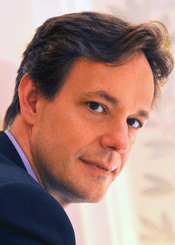 Jake Heggie [Photo © Ellen Appel]
“We had turned earlier to works of art for inspiration,” Scheer added “And in Dallas we had gotten to know Margaret, an incredible philanthropist and a great friend.” Scheer and Heggie toured the Dallas Museum to study 40 works that fit the definition of the project. “There were six that immediately triggered my imagination,” Scheer said. “I found words right away for Magritte, but came up with nothing for Mondrian — and then one day it was there.”
The works are: The Light of Coincidences by Rene’ Magritte, a Mayan flint depicting a crocodile canoe from between 600 and 900A.D., Gustave Caillebotte’s Yellow Roses in a Vase, Piet Mondrian’s Place de la Concorde, El Hombre by Rufino Tamayo and Gerald Murphy’s Watch. “Jake had his heart set on the Tamayo,” Scheer said. “And I loved it as well.”
Although Scheer’s poems stand stably on their own (the audience would have gained from projection of the texts), they are enhanced by the changing moods of Heggie’s candidly romantic settings. Heggie sets the cycle in motion with bell-like Impressionist sounds for Magritte, grows dreamy in Caillebotte and gains Latin force in flavor in Tamayo. Heggie, long the master accompanist of his work, partnered baritone Nathan Gunn in the premiere. While Gunn sings Mozart’s Papageno at the cavernous Met, the 2,200 Winspear seemed a trifle large for his cultivated delivery.
On the second half of the program, a gala fundraiser for Dallas Opera, Gunn turned to music reaching from Home on the Range to a “hit” from Camelot. Here he was almost upstaged by his keyboard partner — and also his wife — Julie Jordan Gunn, a professor of music at the University of Illinois at Urbana-Champaign. “Moby Dick took me to a new level in my composition,” Heggie said. “And these songs are a direct extension of that musical language and world. “Each part of the cycle asks who we are and how we fit into the landscape — what a work of art says to us, and what we bring to it as we look at it as well.”
*******
It was hardly a coincidence that the Virginia Arts Festival scheduled the world premiere of Rappahannock County for April 12, 2011. For it was on April 12, 1861 that the attack on Fort Sumter in Charleston Harbor launched the Civil War. Rappahannock County, a music theater piece composed by Ricky Ian Gordon with texts by Mark Campbell not only recalls that event, it traces the fate of the divided nation through the five years of war that followed. To add to the significance of this cycle of 22 songs that follow the feelings of those affected by the war the Festival made the premiere the opening event of its 15th anniversary season.
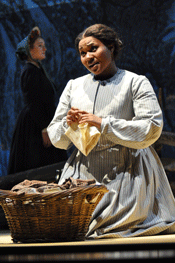 Aundi Marie Moore and Faith Sherman [Photo by David Beloff courtesy of Virgina Arts Festival]
In commissioning it, Virginia Festival director Robert Cross asked only for a work on the Civil War. What exactly it would be was up to Gordon and Campbell. “I couldn’t see a big three-act opera on the war,” Gordon says. “The challenge was to make the subject manageable — to cut it down.” Gordon brought Campbell on board, and they both started reading.
“Virginia was so central to the war — and so divided!” Gordon says. “We decided to focus on just one county in the state: Rappahannock.” The two decided on music theater as their genre, and Gordon thought in terms of a cycle of songs to be performed by a small group of singers, each of whom plays a number of roles. Although the final score is divided into five acts — one for each year of the war — they are performed without interruption. The work lasts 85 minutes. “The poems offer no cohesive narrative, they must be performed without intermission,” the composer says. “That would break the mounting intensity of the cycle.”
Campbell’s texts draw on letters, diaries and other documents from a group of people, both black and white, who experienced the impact of war first hand. The goal of the creative team was a work in which individuals speak with intimacy. “But the personal is political,” Gordon says, “and the political is personal. “The piece has the sense of a lens closing in on a spectrum of individuals and their feelings around slavery and morality in a profound and poignant way. Mark’s libretto shows what everyone has to lose — or has lost.”
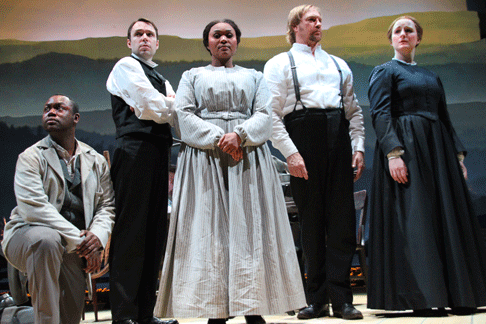 Full cast of Rappahannock County [Photo by Rachel Greenberg courtesy of Virginia Arts Festival]
The acclaim accorded Rappahannock County by the 2,200 people who packed Norfolk’s Harrison Opera House for the premiere made clear that Gordon and Campbell had achieved their goal. The work, described by Gordon as “a series of snapshots of life and loss during the war,” makes no attempt at narrative unity, but focuses rather on intensely emotional moments in the lives of 30 individuals portrayed in Norfolk by five extremely talented young singers. Indeed, soprano Aundi Marie Moore, mezzo Faith Sherman, tenor Matthew Tuell and baritones Kevin Moreno and Mark Walters were an unusually well balanced group of singers who clearly had taken the message of this stellar new work to heart. For the texts Campbell created a language magnificently suited to their contents. It reflects the period and the events described with no attempt at dialect-like coloring. Wisely, the texts were projected as supertitles during the performance.
The 17-pieces orchestra — Rob Fisher conducted Bruce Couglin’s orchestration of the score — played behind a scrim, on which were projected telling visuals designed by Wendall Harrington. They included actual photographs along with landscapes and documents that contributed much to the easy flow of the score. Gordon had wanted the songs to be performed without interruption; but, growing applause documented the increasing involvement of the audience during the premiere performance.
Costumes were by Jessica Jahn; lighting by Robert Wierzel. Kevin Newbury directed the production.
Rappahannock County is a co-commission of the 2011 Virginia Arts Festival, Virginia Opera, the University of Richmond and the University of Texas in Austin, The Norfolk production will be staged at both universities in September 2011.
*******
Next up for Jake Heggie and Gene Scheer is a commission from Houston Grand Opera for a set of songs marking the 10th anniversary of the 2001 terrorist attack on New York City. “Through music, the work will honor Houstonians affected by the attack,” said HGO general director Anthony Freud in announcing the commission. “Music, after all, has the ability to tell a story and enable people to reflect and connect with each other.”
Scheer is developing texts from — among other sources — interviews with Houston firefighters who went to New York to assist in rescue operations and from telephone messages left by a Houston-born woman on the flight that went down in Pennsylvania. Freud has asked Heggie for a “transportable” work, written for example, voice plus guitar, violins or flutes. “This will make it possible to perform it in many different venues from fire stations, city-hall foyers and hospitals,” Freud said. Plans are not yet definite. Yet, the HGO hopes to premiere the work in Houston’s Rothko Chapel. This is the eighth Heggie-Scheer collaboration.
Wes Blomster