![Mikhail Kazakov as Boris Godunov [Photo © Karen Almond, Dallas Opera]](http://www.operatoday.com/BG_13.gif)
13 Apr 2011
Dallas Boris a monument to Tarkovsky
In those dark days before VCR and DVD, knowledgeable film buffs craved the return of Solaris and Stalker to a local art house screen.
English Touring Opera are delighted to announce a season of lyric monodramas to tour nationally from October to December. The season features music for solo singer and piano by Argento, Britten, Tippett and Shostakovich with a bold and inventive approach to making opera during social distancing.
This tenth of ten Live from London concerts was in fact a recorded live performance from California. It was no less enjoyable for that, and it was also uplifting to learn that this wasn’t in fact the ‘last’ LfL event that we will be able to enjoy, courtesy of VOCES8 and their fellow vocal ensembles (more below …).
Ever since Wigmore Hall announced their superb series of autumn concerts, all streamed live and available free of charge, I’d been looking forward to this song recital by Ian Bostridge and Imogen Cooper.
Although Stile Antico’s programme article for their Live from London recital introduced their selection from the many treasures of the English Renaissance in the context of the theological debates and upheavals of the Tudor and Elizabethan years, their performance was more evocative of private chamber music than of public liturgy.
Evidently, face masks don’t stifle appreciative “Bravo!”s. And, reducing audience numbers doesn’t lower the volume of such acclamations. For, the audience at Wigmore Hall gave soprano Elizabeth Llewellyn and pianist Simon Lepper a greatly deserved warm reception and hearty response following this lunchtime recital of late-Romantic song.
For this week’s Live from London vocal recital we moved from the home of VOCES8, St Anne and St Agnes in the City of London, to Kings Place, where The Sixteen - who have been associate artists at the venue for some time - presented a programme of music and words bound together by the theme of ‘reflection’.
'Such is your divine Disposation that both you excellently understand, and royally entertaine the Exercise of Musicke.’
‘And there was war in heaven: Michael and his angels fought against the dragon; and the dragon fought and his angels, And prevailed not; neither was their place found any more in heaven … that old serpent … Satan, which deceiveth the whole world: he was cast out into the earth, and his angels were cast out with him.’
There was never any doubt that the fifth of the twelve Met Stars Live in Concert broadcasts was going to be a palpably intense and vivid event, as well as a musically stunning and theatrically enervating experience.
‘Love’ was the theme for this Live from London performance by Apollo5. Given the complexity and diversity of that human emotion, and Apollo5’s reputation for versatility and diverse repertoire, ranging from Renaissance choral music to jazz, from contemporary classical works to popular song, it was no surprise that their programme spanned 500 years and several musical styles.
The Academy of St Martin in the Fields have titled their autumn series of eight concerts - which are taking place at 5pm and 7.30pm on two Saturdays each month at their home venue in Trafalgar Square, and being filmed for streaming the following Thursday - ‘re:connect’.
The London Symphony Orchestra opened their Autumn 2020 season with a homage to Oliver Knussen, who died at the age of 66 in July 2018. The programme traced a national musical lineage through the twentieth century, from Britten to Knussen, on to Mark-Anthony Turnage, and entwining the LSO and Rattle too.
With the Live from London digital vocal festival entering the second half of the series, the festival’s host, VOCES8, returned to their home at St Annes and St Agnes in the City of London to present a sequence of ‘Choral Dances’ - vocal music inspired by dance, embracing diverse genres from the Renaissance madrigal to swing jazz.
Just a few unison string wriggles from the opening of Mozart’s overture to Le nozze di Figaro are enough to make any opera-lover perch on the edge of their seat, in excited anticipation of the drama in music to come, so there could be no other curtain-raiser for this Gala Concert at the Royal Opera House, the latest instalment from ‘their House’ to ‘our houses’.
"Before the ending of the day, creator of all things, we pray that, with your accustomed mercy, you may watch over us."
The doors at The Metropolitan Opera will not open to live audiences until 2021 at the earliest, and the likelihood of normal operatic life resuming in cities around the world looks but a distant dream at present. But, while we may not be invited from our homes into the opera house for some time yet, with its free daily screenings of past productions and its pay-per-view Met Stars Live in Concert series, the Met continues to bring opera into our homes.
Music-making at this year’s Grange Festival Opera may have fallen silent in June and July, but the country house and extensive grounds of The Grange provided an ideal setting for a weekend of twelve specially conceived ‘promenade’ performances encompassing music and dance.
There’s a “slide of harmony” and “all the bones leave your body at that moment and you collapse to the floor, it’s so extraordinary.”
“Music for a while, shall all your cares beguile.”
The hum of bees rising from myriad scented blooms; gentle strains of birdsong; the cheerful chatter of picnickers beside a still lake; decorous thwacks of leather on willow; song and music floating through the warm evening air.
In those dark days before VCR and DVD, knowledgeable film buffs craved the return of Solaris and Stalker to a local art house screen.
The films — Solaris, allegedly a reaction to Kubrick’s 2001, and Stalker, a major meditation in science fiction — were the work of Andrei Tarkovsky, then widely celebrated as the greatest genius of Russian film since Eisenstein.
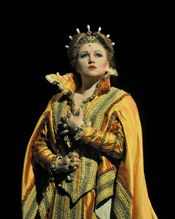 Elena Bocharova as Marina Mnishek
Today, alas, Tarkovsky seems largely forgotten despite a further pair of masterpieces made after his defection from the then-still Soviet Union: Nostalghia [sic], made in Italy in 1983, and Sacrifice, in Sweden, in 1986, the year of his death. (For the latter he had the help of several Ingmar Bergman regulars.)
It was also in 1983 that Tarkovsky directed Boris Godunov at Covent Garden, and Dallas Opera is to be praised — and thanked — for bringing this production to its Winspear Opera House to conclude its current season. Stephen Lawless, who recreated the London staging in Dallas, had been Tarkovsky’s assistant at Covent Garden. His essay in the Dallas program is a tribute — both fitting and moving — to this late master. (Tarkovsky, by the way, had been the choice of Claudio Abbado who conducted the British Boris.)
Lawless speaks of this Boris as the product of “a unique apostolic succession of Russian artists,” pointing out that while Tarkovsky was influenced by Eisenstein, Eisenstein, in turn, was inspired by the epic sweep of Boris. Mussorgsky, of course, turned for his libretto to Pushkin, the father of Russian literature who had defined the Russian language.
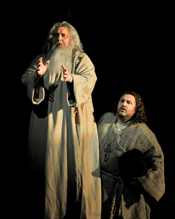 Vitaly Efanov as the monk/historian Pimen and Evgeny Akimov as Grigory
This revival of Tarkovsky’s Boris might well have run aground on so much scholarship, but — happily — it did not, thanks largely to Lawless’ understanding — and appreciation — of the heritage of which he became a part in his work with this production. For it, designer Nicholas Dvigubsky has built a single set focused on a huge arch at the rear of the stage. All action flows through it. Still a work in progress, it arises out of the debris of earlier projects.
In the Coronation Scene a bell is suspended from the arch; at other times a huge ball swings ominously behind it. The people, the helpless victims of history, reside largely in darkness before the arch. A profound expression of his views, the set magnificently complements the counterpoint of the personal and political at the heart of Tarkovsky’s concept.
Born in 1932, he experienced the worst of history: the terror and deprivation of the Stalin years, the sufferings of the Great Fatherland War — as the Russians called it — and the Orwellian machinations of the post-war era. (Small wonder that — once permitted to work in the West — the director chose not to return home, even though it meant separation from his only child for his remaining years.) His Boris is both a loving father and — no matter how he got there — a leader who would be just. But — as Bert Brecht said — “the conditions just aren’t right.” Surrounded by petty ambition on all sides, he can only fail.
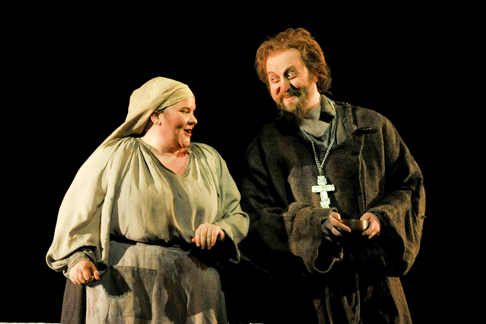 Meredith Arwady as the cheeky Hostess of the Inn shares a lighter moment with Mikhail Kolelishvili as Varlaam, a vagabond monk.
One might wish that the production — “Boris” is presented largely as Mussorgsky intended- ended with the agonized death of the tsar, but that would leave him a sympathetic — even tragic — hero. Thus the lengthy final scene with the people — defeated again in their hopes — gather around the Simpleton — a “holy fool” in Russian — who removes his hood to stare at a shining apparition of a better world high on the stage. Tarkovsky’s view of the hopelessness of history make this a shattering — and uncomfortably contemporary — experience.
This extensive description of the production — seen on many stages since it was new — in no way overlooks the musical excellence — indeed, the musical perfection — achieved in Dallas. As its conductor DO music director Graeme Jenkins has raised his orchestra to a new level of richness and technical ease, and it must be his growing international reputation that accounts for the assembly of a mostly-Russian cast without one weak link. (Most were making Dallas Opera debuts.)
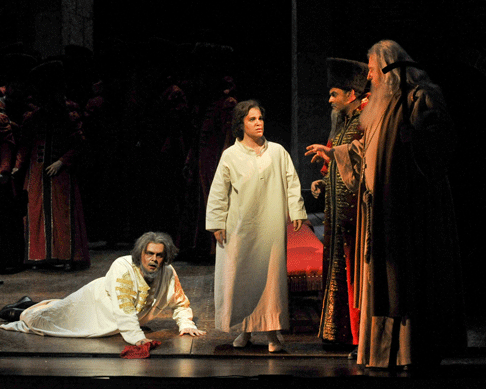 The mad Tsar Boris (Mikhail Kazakov), sensing that death is imminent, prepares his son (Rebecca Jo Loeb) to assume the throne.
Mikhail Kazarov was a Boris of unusual depth and warmth. He brought grandeur to the Coronation and made his later suffering near-palpable to the audience. Tenor Yevgeny Akimov moved the growing ambition and shifting fate of pretender Dmitri beyond theatrics, while in her selfish lust for power mezzo Elena Bocharova made Lady Macbeth an amateur. Bass Vitaly Efanov’s account of Russian history from Pimen’s chronicle radiated lyric beauty, and Sergei Leiferkus — the only member of the cast previously well known in the US- was an appropriately cunning Jesuit Rangoni. In this august constellation tenor David Cangeloni acquitted himself admirably as Shuisky, Boris’ No. 1 enemy among the Boyars. For his preparation of the many and massive chorus scenes Alexander Rom would win acclaim at the Bolshoi, and Melinda Cotton had the kids of the Opera’s Children’s Chorus singing Russian as if it were Texan slang.
In sum, an extraordinary performance of a production of Boris so earth-shaking that — one hopes — it will survive many more decades in the world’s opera houses.
Wes Blomster