Further, the setting, costumes, and gestures suggest,
alternately, the concept of the hero returning from military successes and the
accompanying domestic reconciliations which must also be confronted. The
specific associations with modern political and military conflicts, under Peter
Sellars’ direction, are, to be sure, communicated in such a way that more
elemental affects predominate. Hence although some costuming is admittedly tied
to recent struggles in Iraq, the resultant application speaks for universal
emotions beyond any single war. This dramatic success may be ascribed in part,
to the musical direction but at the same time to the extraordinary collection
of vocal talent assembled for this production.
In his attempt to shape “the piece with a view to bringing
Händel’s oratorio closer to Sophocles original play,” Mr. Sellars
divides the work into two parts rather than three acts. The sets remain
generally simple, several benches affording the performers opportunity to sit
or lie while broken columns suggest a neglected domestic court. In the overture
to the first part Harry Bicket led with agile tempos and managed the
integration of individual orchestral sections into a seamless whole. As the
first participants to appear in the initial part David Daniels as the herald
Lichas and Alice Coote as Dejanira, the wife of Hercules, inhabit their roles
with conviction and dignity. Dejanira enters as the colors on the backdrop of
the stage change to indicate day’s arrival. She seems weary and hugs
herself as if to ward off the cold, or solitude. In his comment on observing
the state of Dejanira Mr. Daniels performs the first of Lichas’s solo
pieces with skilled and tasteful decoration. His emphasis on
“relentless” in the aria “No longer, Fate” communicates
the mood of the court as mirrored in Dejanira’s gestures. Further, in his
plea to Jove, Daniels uses discreet trills alternately on “the
hero’s life” and “weeping wife” as a means to join or
contrast the two figures musically who are kept physically apart by war. In her
own self-distracted and pessimistic musing in the aria “The world, when
day’s career is run,” Coote gives appropriately expressive color to
low notes on “darkness” and “thickest gloom.” She sings
her final lines here, in echo of the sentiment of Lichas, with decorative and
emphatic trills on “absence” as key to her emotional anguish.
In the following several scenes the fate of Hercules is presented,
alternately, in negative and in optimistic lights, as the remaining characters
of the piece are introduced. At first, Hyllus, son of Hercules and Dejanira,
vows to search for his father after he consulted an oracle that predicted death
for the hero. In order to assuage his mother’s mood at this news, Hyllus
swears his conviction in the recitative and heroic aria, “Despair not
… Where congealed the northern streams.” In the role of Hyllus
Richard Croft gave a supremely assured performance of the loyal son and future
leader. His vocal embellishments, presented in the most natural manner,
describe “With advent’rous steps” the path he will tread
until discovering the fate of his father. As accompanied by the chorus’s
thoughtfully choreographed “O filial piety,” Hyllus is on the point
of leaving when Lichas interrupts with news of his master’s success.
Hercules has defeated the king of Oechalia and returns with the princess as his
captive. In Dejanira’s reaction, “Begone, my fears,” Ms.
Coote applies excited touches of decoration on “the morning ray”
and concludes with a dramatic top note at the phrase “swell my
soul” to signal her recovery.
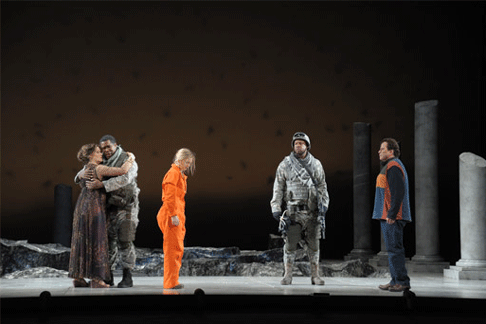 (Left to right) Alice Coote, Eric Owens, Lucy Crowe, Marckarthur Johnson and Richard Croft
In the following scene the characters Hercules and Iole, the captive
princess, enter and establish their dramatic and vocal personalities. The two
initial arias performed by Lucy Crowe as Iole were exemplars of character
portrayal and Handelian decoration. While Hyllus looked on with growing
interest Ms. Crowe performed “Daughter of Gods” with a seamless
line and flute-like, rapid high notes on “a thousand graces.” Her
saddened memories in “My father! Ah! Methinks I see” were equally
expressive with noted ornaments touchingly applied on “Dying he bites the
crimson ground.” The role of Hercules, sung by Eric Owens, remains at
this narrative juncture implicitly understated. Mr. Owens communicates the
introspection and detachment of the hero returned in “The god of battle
quits the bloody field,” while also tracing a lyrically embellished line
for the bass-baritone. From this point until the close of the first part the
growing rift between Hercules and Dejanira is detailed in the latter’s
reaction to Iole’s presence. As if to highlight her innocence, the aria
“How blest the maid” is performed by Ms. Crowe with near pastoral
effect as she uses delicate high notes with crystalline effect. By contrast,
Dejanira’s anger and jealousy are expressed by Ms. Coote’s negative
emphases in “Love dips his arrows … and sends them pointed to the
heart.” The emotional violence implied, as well as her own reactions, is
captured by Coote’s contrastive embellishments opposing her role to that
of Iole. As the chorus appropriately concludes the first part of the drama, the
participants remind with hushed tones that “Jealousy” is
“Tyrant of the human heart.”
Just as Hercules and Dejanira stand in this production at the close of Part
I at opposite sides of the stage, in order to signify their continued emotional
distance, Hyllus and Iole appear together at the start of Part II. In answer to
Iole’s protests that love between them cannot prosper, since Hercules
slew her father, Mr. Croft expresses the growing passion of Hyllus with
eloquent lyricism. His downward decorations on the first line of the aria
“From celestial sets descending” are matched by embellishments in
the thematic line “To taste the sweeter heav’n of love.” The
following scenes signal a further separation between Hercules and Dejanira, as
Coote mocks him with growing intensity in the aria “Resign thy club and
lion’s spoils.” As Hercules departs for a ceremony of honors
Dejanira recalls a method in her possession to restore a flagging love. The
dying centaur Nessus had convinced her that his blood would revivify love gone
astray. Not realizing that it is poisonous, she smears it onto a garment which
she entrusts to the herald Lichas to bring as a gift to Hercules. The horrified
report of Lichas ensues, in which the suffering and death of Hercules resulting
from the poisoned garment is related. The hero is depicted lying on a stone
slab from which Mr. Owens sings the aria “I rage” with rapid and
expressive runs in the vocal line. The following two scenes bring to a dramatic
and lyrical climax the sentiments defining both lead female characters.
Dejanira is beset by guilt which Coote declaims with moving fervor in
“Where shall I fly?” Her embellishments on the “skies”
as witness to her guilt conclude with memorable dramatic high notes on
“the pursuing furies of the mind.” Iole’s aria in response,
“My breast with tender pity swells,” reiterates the tone of
reconciliation which characterized her role in this foreign household from the
start. Ms. Crowe’s simple yet decorative trills on “breast”
and “pity” served as a means to deflect the harsh feelings of
enmity and guilt which had preceded the demise of the hero. The final duet of
love “O prince … O princess,” sung by Iole and Hyllus,
brings now full circle the constellation of emotions as survivors and chorus
pass the bier of honor with Hercules’s remains.
Salvatore Calomino
![Alice Coote as Dejanira and David Daniels as Lichas [Photo by Dan Rest courtesy of Chicago Lyric Opera]](http://www.operatoday.com/Hercules_Chicago_01.gif)