![Stefania Dovhan as Adina and Meredith Lustig as Giannetta [Photo by Carol Rosegg courtesy of New York City Opera]](http://www.operatoday.com/Elixir0001.png)
04 Apr 2011
L’Elisir d’Amore
Donizetti described to his father the premiere cast of L’Elisir in terms of lukewarm praise—the tenor only “passable” the soprano’s voice “pretty” and the bass “a little hammy.”
English Touring Opera are delighted to announce a season of lyric monodramas to tour nationally from October to December. The season features music for solo singer and piano by Argento, Britten, Tippett and Shostakovich with a bold and inventive approach to making opera during social distancing.
This tenth of ten Live from London concerts was in fact a recorded live performance from California. It was no less enjoyable for that, and it was also uplifting to learn that this wasn’t in fact the ‘last’ LfL event that we will be able to enjoy, courtesy of VOCES8 and their fellow vocal ensembles (more below …).
Ever since Wigmore Hall announced their superb series of autumn concerts, all streamed live and available free of charge, I’d been looking forward to this song recital by Ian Bostridge and Imogen Cooper.
Although Stile Antico’s programme article for their Live from London recital introduced their selection from the many treasures of the English Renaissance in the context of the theological debates and upheavals of the Tudor and Elizabethan years, their performance was more evocative of private chamber music than of public liturgy.
Evidently, face masks don’t stifle appreciative “Bravo!”s. And, reducing audience numbers doesn’t lower the volume of such acclamations. For, the audience at Wigmore Hall gave soprano Elizabeth Llewellyn and pianist Simon Lepper a greatly deserved warm reception and hearty response following this lunchtime recital of late-Romantic song.
For this week’s Live from London vocal recital we moved from the home of VOCES8, St Anne and St Agnes in the City of London, to Kings Place, where The Sixteen - who have been associate artists at the venue for some time - presented a programme of music and words bound together by the theme of ‘reflection’.
'Such is your divine Disposation that both you excellently understand, and royally entertaine the Exercise of Musicke.’
‘And there was war in heaven: Michael and his angels fought against the dragon; and the dragon fought and his angels, And prevailed not; neither was their place found any more in heaven … that old serpent … Satan, which deceiveth the whole world: he was cast out into the earth, and his angels were cast out with him.’
There was never any doubt that the fifth of the twelve Met Stars Live in Concert broadcasts was going to be a palpably intense and vivid event, as well as a musically stunning and theatrically enervating experience.
‘Love’ was the theme for this Live from London performance by Apollo5. Given the complexity and diversity of that human emotion, and Apollo5’s reputation for versatility and diverse repertoire, ranging from Renaissance choral music to jazz, from contemporary classical works to popular song, it was no surprise that their programme spanned 500 years and several musical styles.
The Academy of St Martin in the Fields have titled their autumn series of eight concerts - which are taking place at 5pm and 7.30pm on two Saturdays each month at their home venue in Trafalgar Square, and being filmed for streaming the following Thursday - ‘re:connect’.
The London Symphony Orchestra opened their Autumn 2020 season with a homage to Oliver Knussen, who died at the age of 66 in July 2018. The programme traced a national musical lineage through the twentieth century, from Britten to Knussen, on to Mark-Anthony Turnage, and entwining the LSO and Rattle too.
With the Live from London digital vocal festival entering the second half of the series, the festival’s host, VOCES8, returned to their home at St Annes and St Agnes in the City of London to present a sequence of ‘Choral Dances’ - vocal music inspired by dance, embracing diverse genres from the Renaissance madrigal to swing jazz.
Just a few unison string wriggles from the opening of Mozart’s overture to Le nozze di Figaro are enough to make any opera-lover perch on the edge of their seat, in excited anticipation of the drama in music to come, so there could be no other curtain-raiser for this Gala Concert at the Royal Opera House, the latest instalment from ‘their House’ to ‘our houses’.
"Before the ending of the day, creator of all things, we pray that, with your accustomed mercy, you may watch over us."
The doors at The Metropolitan Opera will not open to live audiences until 2021 at the earliest, and the likelihood of normal operatic life resuming in cities around the world looks but a distant dream at present. But, while we may not be invited from our homes into the opera house for some time yet, with its free daily screenings of past productions and its pay-per-view Met Stars Live in Concert series, the Met continues to bring opera into our homes.
Music-making at this year’s Grange Festival Opera may have fallen silent in June and July, but the country house and extensive grounds of The Grange provided an ideal setting for a weekend of twelve specially conceived ‘promenade’ performances encompassing music and dance.
There’s a “slide of harmony” and “all the bones leave your body at that moment and you collapse to the floor, it’s so extraordinary.”
“Music for a while, shall all your cares beguile.”
The hum of bees rising from myriad scented blooms; gentle strains of birdsong; the cheerful chatter of picnickers beside a still lake; decorous thwacks of leather on willow; song and music floating through the warm evening air.
Donizetti described to his father the premiere cast of L’Elisir in terms of lukewarm praise—the tenor only “passable” the soprano’s voice “pretty” and the bass “a little hammy.”
(Doubtful, though, is Emilia Branca’s tale that Donizetti complained of a Dulcamara with a “voice like a goat.”) Notwithstanding the shortcomings of the singers, the score won the day.
Could it have been otherwise? L’Elisir is so ingenious, so bubbly, so amusing—and at the same time so moving and heartfelt—that it proved a huge and instantaneous success. It charged confidently into the international repertory and never lost steam. Nearly two centuries later, it’s still almost impossible to botch L’Elisir beyond redemption. And so it is with New York City Opera’s production: carried by Donizetti’s brilliant music, Romani’s witty and singable verses, an attractive production, and a much more than “passable” tenor, the performance I attended delighted even as it disappointed.
To a modern audience, the American Southwest during the 1950s seems a remote and idyllic time, and Jonathan Miller’s 2006 production therefore neatly fit the spirit of the piece; every detail was skillfully thought out and Isabella Bywater’s sets and costumes were a delight. The locus is Adina’s Diner, the gathering place of choice for a desert community near a military base. Dulcamara rolls up to the gas pumps in a vintage hotrod, sporting spectator shoes; Nemorino wears mechanics togs; the chorus consists of greasers, fry cooks, soldiers and women in poodle-skirts and cat-eyed glasses. Adina is a sort of Marilyn Monroe, Giannetta a less prominent Maureen O’Hara. Belcore struts around in a Marine uniform and indulges in Elvis-like pelvic gyrations.
The direction of this revival left much to be desired, and seemed motivated more by a desire for cheap laughs than by an understanding and appreciation of the text. As Donizetti’s biographer William Ashbrook observed, the most groundbreaking feature of L’Elisir is that it is not mere slapstick, and its lieto fine occurs because Adina realizes Nemorino’s true goodness and sincerity; L’Elisir succeeds because there is real emotional depth here.
With all this in mind, let it be admitted that Nemorino is not the sharpest knife in the drawer; but for Romani he is a gullible, uneducated country lad with a big heart. In the Miller production he is painted as borderline developmentally disabled. He claps gleefully, jogs in place, bats imaginary balls and jumps up and down as if he were five years old, much of the time wearing a dopey expression. In line with disturbing current trends, excessive stage action often interferes with some of the most important musical and dramatic moments. During Adina’s solo in “Chiedi all’aura lusinghiera,” Nemorino unwittingly spills salt, tossing handfuls around as Adina tries frantically to clean it up. During her duet with Dulcamara (dramatically the turning point of the opera), Adina reaches so deeply into his pocket that his expression plainly tells us where her hand has wandered. In the women’s chorus that begins Act II, a toilet flushes as they stand in line waiting for the restroom, provoking a few nervous scatological giggles; later Nemorino, sickened by his excessive consumption of the “elixir,” runs to the same bathroom to be sick.
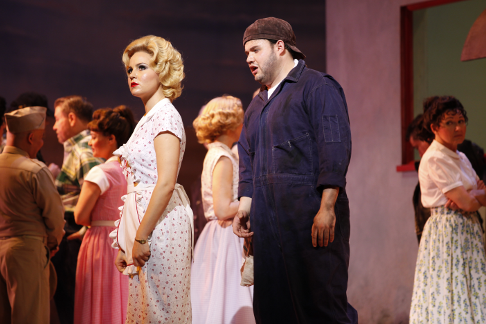 Stefania Dovhan as Adina and David Lomelí as Nemorino
This is all a shame, but even this cloud of directorial dust, tenor David Lomeli was able to show Nemorino’s passionate nature, his innocence and his vulnerability. Indeed, only his artistry raised the afternoon out of vocal mediocrity. Lomeli never lost sight of what makes Nemorino such a sympathetic character, even as he acted the fool. He sang a wistful “Quanto e bella,” and his impassioned solo passage, “Adina, credimi,” in the first act finale tugged at the heartstrings. An achingly tender, beautifully shaped “Una furtiva lagrima” earned him the loudest cheers of the evening. Lomeli has a lovely, light voice with varying colors and a good sense of how to use dynamic shading; there is a beautiful, genuine Italianate squillo there too. He warmed up quickly after a slightly underpowered start, and hit his stride with full confidence by the time of his duet with Dulcamara.
As Adina, Stefania Dovhan was less than ideal casting. She is physically very attractive, and the voice is intermittently beautiful and expressive, but on the whole it is too harsh and inflexible for the role. Her voice doesn’t have much color; her acuti, while on pitch, were rather grating, and she does not handle coloratura cleanly. Though there were isolated moments of real feeling, for the most part it was a flat, rather riskless portrayal; the shift from fickle and vindictive vixen to loving fiancée was a bit too abrupt and not very convincing.
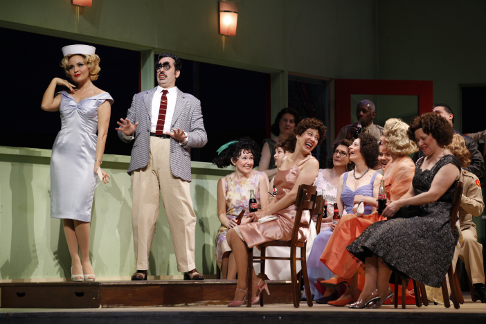 Stefania Dovhan as Adina and Marco Nisticò as Dulcamara
As for José Adán Pérez’s Belcore and Marco Nisticò’s Dulcamara, all their comic silent-movie face-pulling and pelvic thrusts couldn’t hide the fact that they sounded vocally undernourished and fudged the coloratura. In his duet with Lomeli, Nisticò’s vocal line drowned beneath his partner’s. Brad Cohen conducted a brisk if at times somewhat hurried performance. The orchestra sounded marvelous but for one horn mishap. The chorus was well-rehearsed and in fine form.
Daniel Foley