Recently in Performances
English Touring Opera are delighted to announce a season of lyric monodramas to tour nationally from October to December. The season features music for solo singer and piano by Argento, Britten, Tippett and Shostakovich with a bold and inventive approach to making opera during social distancing.
This tenth of ten Live from London concerts was in fact a recorded live performance from California. It was no less enjoyable for that, and it was also uplifting to learn that this wasn’t in fact the ‘last’ LfL event that we will be able to enjoy, courtesy of VOCES8 and their fellow vocal ensembles (more below …).
Ever since Wigmore Hall announced their superb series of autumn concerts, all streamed live and available free of charge, I’d been looking forward to this song recital by Ian Bostridge and Imogen Cooper.
Although Stile Antico’s programme article for their Live from London recital introduced their selection from the many treasures of the English Renaissance in the context of the theological debates and upheavals of the Tudor and Elizabethan years, their performance was more evocative of private chamber music than of public liturgy.
Evidently, face masks don’t stifle appreciative “Bravo!”s. And, reducing audience numbers doesn’t lower the volume of such acclamations. For, the audience at Wigmore Hall gave soprano Elizabeth Llewellyn and pianist Simon Lepper a greatly deserved warm reception and hearty response following this lunchtime recital of late-Romantic song.
For this week’s Live from London vocal recital we moved from the home of VOCES8, St Anne and St Agnes in the City of London, to Kings Place, where The Sixteen - who have been associate artists at the venue for some time - presented a programme of music and words bound together by the theme of ‘reflection’.
'Such is your divine Disposation that both you excellently understand, and royally entertaine the Exercise of Musicke.’
‘And there was war in heaven: Michael and his angels fought against the dragon; and the dragon fought and his angels, And prevailed not; neither was their place found any more in heaven … that old serpent … Satan, which deceiveth the whole world: he was cast out into the earth, and his angels were cast out with him.’
There was never any doubt that the fifth of the twelve Met Stars Live in Concert broadcasts was going to be a palpably intense and vivid event, as well as a musically stunning and theatrically enervating experience.
‘Love’ was the theme for this Live from London performance by Apollo5. Given the complexity and diversity of that human emotion, and Apollo5’s reputation for versatility and diverse repertoire, ranging from Renaissance choral music to jazz, from contemporary classical works to popular song, it was no surprise that their programme spanned 500 years and several musical styles.
The Academy of St Martin in the Fields have titled their autumn series of eight concerts - which are taking place at 5pm and 7.30pm on two Saturdays each month at their home venue in Trafalgar Square, and being filmed for streaming the following Thursday - ‘re:connect’.
The London Symphony Orchestra opened their Autumn 2020 season with a homage to Oliver Knussen, who died at the age of 66 in July 2018. The programme traced a national musical lineage through the twentieth century, from Britten to Knussen, on to Mark-Anthony Turnage, and entwining the LSO and Rattle too.
With the Live from London digital vocal festival entering the second half of the series, the festival’s host, VOCES8, returned to their home at St Annes and St Agnes in the City of London to present a sequence of ‘Choral Dances’ - vocal music inspired by dance, embracing diverse genres from the Renaissance madrigal to swing jazz.
Just a few unison string wriggles from the opening of Mozart’s overture to Le nozze di Figaro are enough to make any opera-lover perch on the edge of their seat, in excited anticipation of the drama in music to come, so there could be no other curtain-raiser for this Gala Concert at the Royal Opera House, the latest instalment from ‘their House’ to ‘our houses’.
"Before the ending of the day, creator of all things, we pray that, with your accustomed mercy, you may watch over us."
The doors at The Metropolitan Opera will not open to live audiences until 2021 at the earliest, and the likelihood of normal operatic life resuming in cities around the world looks but a distant dream at present. But, while we may not be invited from our homes into the opera house for some time yet, with its free daily screenings of past productions and its pay-per-view Met Stars Live in Concert series, the Met continues to bring opera into our homes.
Music-making at this year’s Grange Festival Opera may have fallen silent in June and July, but the country house and extensive grounds of The Grange provided an ideal setting for a weekend of twelve specially conceived ‘promenade’ performances encompassing music and dance.
There’s a “slide of harmony” and “all the bones leave your body at that moment and you collapse to the floor, it’s so extraordinary.”
“Music for a while, shall all your cares beguile.”
The hum of bees rising from myriad scented blooms; gentle strains of birdsong; the cheerful chatter of picnickers beside a still lake; decorous thwacks of leather on willow; song and music floating through the warm evening air.
Performances
![Anu Komsi [Photo by Carol Rosegg courtesy of New York City Opera]](http://www.operatoday.com/Monodramas0020.png)
04 Apr 2011
Monodramas, NYCO
New York City Opera’s evening of “Monodramas” (under that
general title) may not appeal to the opera-goer who prefers such typical fare as the company’s other offering this week, Donizetti’s L’Elisir d’amore, but I found it a devilish and delightful exploration of the depths of inner consciousness.
John Zorn’s La Machine de l’être (The Machine of Being)
began with an empty stage gradually filling with silent individuals dressed in
all-covering costumes resembling burqas. A man and a woman dressed modern
formal wear with stark white shirts and ties moved among the growing throng.
One of the burqa-d women darted away when approached, as if in fear, then
disappeared into the crowd, giving the proceedings something of the feel of a
video game. The actors in suits removed the burqas from two of the crowd to
reveal, first, a man dressed in a painfully brilliant red suit, and second, the
soprano dressed in a starkly white gown. It was unsettling to find a man under
a burqa, and he remained an uncomfortable presence on stage. A large cartoon
“speech balloon” rose out of the floor and into position just over
the head of the darting woman, adding to the video game impression. Film clips
of drawings adapted from those made by Antonin Artaud during his incarceration
in an asylum played across the balloon. These disturbing drawings complemented
the disjointed music as both became increasingly twisted and tortured. Finnish
soprano Anu Komsi, in her City Opera debut, did a fine job tossing her voice in
the air evoking a descent into madness in this free-form piece that lacked both
text and plot.
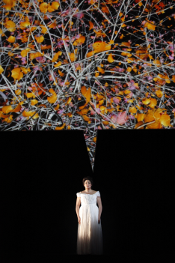 Kara Shay Thomson, soprano
During a riveting entr’acte, Jennifer Steinkamp’s
stunning video display of a stylized forest moving through the seasons played
across the cartoon balloon. The video began with a wild profusion of pink
cherry blossoms mixed with yellow flowers and moved on to greens of summer,
then orange leaves falling and blowing and leaving a gray tangle of bare
branches. I was almost disappointed when the second Monodrama began.
But the gorgeous orchestrations of Schoenberg’s Erwartung
soon enveloped the audience, pulling us into the depths of the lonely
protagonist’s consciousness. A stunning blizzard of brilliant red leaves
fell on the stage for over half of the 30-minute piece. The glittering,
tumbling red was mesmerizing against the midnight blue backdrop. A dead man lay
in the middle of the stage with a knife protruding from his chest while the
tortured ravings of the soprano, sung movingly by Kara Shay Thomson, were all
that was needed to explain the drama—but several dancers provided an
unneeded distraction throughout this beautiful and compelling operatic
piece.
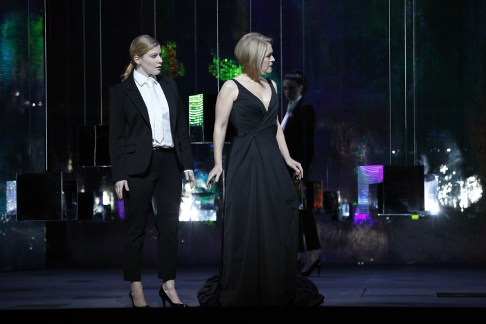 Cyndia Sieden and ensemble
The final, longest, and most abstract Monodrama of the evening was
Neither, set by composer Morton Feldman to a text by Samuel Beckett.
The mystical and complex orchestral part was richly complemented by the
continually evolving splashes of intense colors and shapes created by the laser
and holographic effects (after work by the innovative laser artist Hiro
Yamagata). Mirrored one-foot cubes moved and revolved, sending flashes of color
and penetrating lights across the house. The singer and the several dancers
reacted to and interacted with the cubes, as the singer seemed to try to find
some connection with the other people. Cyndia Sieden’s voice sailed above
the orchestra, intoning the text in a near monotone that never left the highest
extremes of the soprano range.
The City Opera is certainly to be commended for stepping beyond the
traditional operatic comfort zone to present these three fascinating and
compelling performance pieces. It bodes well for the future of opera as a
living art that this company has brought such work to its audience.
Jean Andrews