![Zeljko Lucic in the title role and Diana Damrau as Gilda [Photo by Marty Sohl courtesy of The Metropolitan Opera]](http://www.operatoday.com/Rigoletto-Met-2011-01.gif)
29 Apr 2011
Rigoletto, New York
Rigoletto is the perfect opera. Even Verdi, who wrote so many wonderful scores, never created anything more flawless.
English Touring Opera are delighted to announce a season of lyric monodramas to tour nationally from October to December. The season features music for solo singer and piano by Argento, Britten, Tippett and Shostakovich with a bold and inventive approach to making opera during social distancing.
This tenth of ten Live from London concerts was in fact a recorded live performance from California. It was no less enjoyable for that, and it was also uplifting to learn that this wasn’t in fact the ‘last’ LfL event that we will be able to enjoy, courtesy of VOCES8 and their fellow vocal ensembles (more below …).
Ever since Wigmore Hall announced their superb series of autumn concerts, all streamed live and available free of charge, I’d been looking forward to this song recital by Ian Bostridge and Imogen Cooper.
Although Stile Antico’s programme article for their Live from London recital introduced their selection from the many treasures of the English Renaissance in the context of the theological debates and upheavals of the Tudor and Elizabethan years, their performance was more evocative of private chamber music than of public liturgy.
Evidently, face masks don’t stifle appreciative “Bravo!”s. And, reducing audience numbers doesn’t lower the volume of such acclamations. For, the audience at Wigmore Hall gave soprano Elizabeth Llewellyn and pianist Simon Lepper a greatly deserved warm reception and hearty response following this lunchtime recital of late-Romantic song.
For this week’s Live from London vocal recital we moved from the home of VOCES8, St Anne and St Agnes in the City of London, to Kings Place, where The Sixteen - who have been associate artists at the venue for some time - presented a programme of music and words bound together by the theme of ‘reflection’.
'Such is your divine Disposation that both you excellently understand, and royally entertaine the Exercise of Musicke.’
‘And there was war in heaven: Michael and his angels fought against the dragon; and the dragon fought and his angels, And prevailed not; neither was their place found any more in heaven … that old serpent … Satan, which deceiveth the whole world: he was cast out into the earth, and his angels were cast out with him.’
There was never any doubt that the fifth of the twelve Met Stars Live in Concert broadcasts was going to be a palpably intense and vivid event, as well as a musically stunning and theatrically enervating experience.
‘Love’ was the theme for this Live from London performance by Apollo5. Given the complexity and diversity of that human emotion, and Apollo5’s reputation for versatility and diverse repertoire, ranging from Renaissance choral music to jazz, from contemporary classical works to popular song, it was no surprise that their programme spanned 500 years and several musical styles.
The Academy of St Martin in the Fields have titled their autumn series of eight concerts - which are taking place at 5pm and 7.30pm on two Saturdays each month at their home venue in Trafalgar Square, and being filmed for streaming the following Thursday - ‘re:connect’.
The London Symphony Orchestra opened their Autumn 2020 season with a homage to Oliver Knussen, who died at the age of 66 in July 2018. The programme traced a national musical lineage through the twentieth century, from Britten to Knussen, on to Mark-Anthony Turnage, and entwining the LSO and Rattle too.
With the Live from London digital vocal festival entering the second half of the series, the festival’s host, VOCES8, returned to their home at St Annes and St Agnes in the City of London to present a sequence of ‘Choral Dances’ - vocal music inspired by dance, embracing diverse genres from the Renaissance madrigal to swing jazz.
Just a few unison string wriggles from the opening of Mozart’s overture to Le nozze di Figaro are enough to make any opera-lover perch on the edge of their seat, in excited anticipation of the drama in music to come, so there could be no other curtain-raiser for this Gala Concert at the Royal Opera House, the latest instalment from ‘their House’ to ‘our houses’.
"Before the ending of the day, creator of all things, we pray that, with your accustomed mercy, you may watch over us."
The doors at The Metropolitan Opera will not open to live audiences until 2021 at the earliest, and the likelihood of normal operatic life resuming in cities around the world looks but a distant dream at present. But, while we may not be invited from our homes into the opera house for some time yet, with its free daily screenings of past productions and its pay-per-view Met Stars Live in Concert series, the Met continues to bring opera into our homes.
Music-making at this year’s Grange Festival Opera may have fallen silent in June and July, but the country house and extensive grounds of The Grange provided an ideal setting for a weekend of twelve specially conceived ‘promenade’ performances encompassing music and dance.
There’s a “slide of harmony” and “all the bones leave your body at that moment and you collapse to the floor, it’s so extraordinary.”
“Music for a while, shall all your cares beguile.”
The hum of bees rising from myriad scented blooms; gentle strains of birdsong; the cheerful chatter of picnickers beside a still lake; decorous thwacks of leather on willow; song and music floating through the warm evening air.
Rigoletto is the perfect opera. Even Verdi, who wrote so many wonderful scores, never created anything more flawless.
Each melody is lovely in itself (except, perhaps, for the court dances of the first scene, which are supposed to seem shallow in any case, and do), but more important each one fulfills its dramatic moment and enhances our understanding of the character who sings it. The dramatic movement is steady and inexorable—and pitiless. Step by step, each important element of the drama takes place before our eyes—nothing is concealed except the Duke’s rape of Gilda, and in some modern stagings we even get to watch that. But the current Met production, thank heavens, designed by Otto Schenk and somewhat vulgarly directed by Gregory Keller, happily spares us that particular debauch. It is a handsome, old-fashioned job, with fine architectural elements and a street in medieval Mantua that, damn it, looks like a street in medieval Mantua. The costumes are rich and attractive. It does the job.
Its third cast this season gave signs, on April 26, of insufficient rehearsal time. This was most clear in Fabio Luisi’s conducting, which throughout the first scene and on several other occasions (notably the murderers’ trio in Act III) raced along far too swiftly for the ability or the experience of the singers. Luisi just didn’t seem to be giving a thought to their vocal situations; a link that should go both ways was only open in one direction. It is not necessary for a conductor to follow his singers, but a certain degree of interaction, of appreciation of the way they are handling their roles and when they are in difficulties, is something one can hope for of a conductor leading a repertory opera of this familiarity.
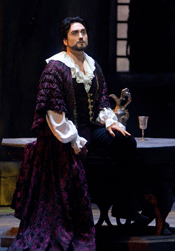 Giuseppe Filianoti as the Duke
The three leading singers all have excellent reputations to which they all, in part, lived up—the performance hit somewhere around the A-minus, B-plus range. How would this cast sound in a smaller theater, or in a studio with a more relaxed atmosphere? I suspect they’d all have done better.
Željko Lučić has one of the Met’s most beautiful baritone voices just now, but he occasionally sang flat just when one wanted to relax and enjoy it. Still: His “Cortigiani, vil razza” was a jeweled display of Verdi singing, elegantly produced. One might not have noticed, however, that this is a passionate aria, sung in an extreme situation. As an actor, Lučić has much to learn, and the Met might with profit bestir itself to teach him, and not merely how to sing a make-or-break aria with the proper intensity. For one thing, Rigoletto’s hump is not a figure of speech—he’s supposed to be visibly crippled, to have lived all his life with taunts and ill treatment for his condition, to have turned against the human race for this very reason. To stand sturdily upright while those around you mime a cripple to insult you is to miss a big point, and yet this was Lučić’s attitude all night. (His Barnaba in Gioconda omitted personality in the same way.) His joking in Act I lacked point or fury, his behavior in Act II lacked pathos. The courtiers did not toss him about, either—he never seriously tried to break through. One could admire the vocalism; one was never inspired to weep or cringe at the tragic figure. Rigoletto is one of the supreme roles of the baritone repertory; I hope Lučić, who sings it so well, will coach it with someone knowledgeable, or undertake a production with a really inspiring director.
Diana Damrau, in contrast to Mr. Lučić, can act a role and does. She’s studied the libretto as well as she’s studied the music, and she lived every shade of it: Girlish with her father, alarmed and then yielding when alone with her suitor, embarrassed and terrified by the crowd of strange men in Act II, unable to tear her unhappy eyes away, in Act III, from the Duke’s seduction of Maddalena. Her singing, too, was entirely at the service of her dramatic conception—there were vocal fadeouts, muddinesses, thinnesses that I suspect would not have been heard in a rehearsal, the product of her concentration on being Gilda. It was possible to enjoy her “Caro nome” without noticing it was—had ever been—a famous coloratura showpiece, for she made its breathless phrases an expression of girlish ecstasy. She took none of the role’s optional high E’s—which Verdi did not compose—but she also omitted the trills, which he did. Those accustomed to more power at such moments as “Si, vendetta” might also have been disappointed.
Where Rigoletto should be (but Lučić wasn’t) busy, uneasy, concocting and reflecting, the Duke should be graceful, sensuous, at home in his vicious element. Giuseppe Filianoti was a Duke who could not sit still. His pleasing tenor was all over the place, heavily stressed in the first scene, suave and pleasing in the seduction duet, hoarse in the quartet (where the direction demanded far too much activity to permit high notes), and cracking unattractively in his post-coital encore of “La donna è mobile.” He basked in his own and the audience’s affection, so that it was easy to think him a ladies’ man, more difficult to see him as the self-indulgent daydreamer of “Parmi veder.” He often ended phrases with a serene high note, only to be brought up breathlessly short. Was it the unaccommodating conductor or a graceless vision of the part that gave him pause?
One of the most impressive things I’ve ever beheld on any stage was the sight of Ruggiero Raimondi as Sparafucile, singing his lines while holding, over his shoulder, a sack containing Joan Sutherland. After he sang (and he sang well), he slid the sack ever so gently to the floor, where Sherrill Milnes did not even try to lift it, but hauled it to center stage, kicked it a few times, and—out popped Joanie, trilling away! At the next performance I attended, Ivo Vinco did not attempt to carry the sack—an assistant ruffian stood behind him to hold it. Sparafucile in this latest Rigoletto was Stefan Kocán, who sang decently and looked very sporty (hired assassins outdress courtiers in this Mantua, evidently), but whose threats I cannot take seriously—an assassin who needs an assistant to help carry petite Diana Damrau can’t be much good at his job. Kathryn Day, the substitute Giovanna, sang her few phrases with lovely clarity. Someone has told Quinn Kelsey, the Monterone, that this is the Jonathan Miller production set in Little Italy; he sings well but his moves and gestures are those of a low-class Sicilian thug. Monterone is a gentleman at a ducal court and should behave with outraged dignity, a very different thing, at least on the stage.
John Yohalem