![Giselle Allen as Tosca and Jesus Leon as Cavaradossi [Photo courtesy of NI Opera]](http://www.operatoday.com/Tosca_pic-2.gif)
08 Apr 2011
Tosca, NI Opera
“Show goes on despite fresh bomb scare”. Not exactly the sort of headline a new opera company might have dreamt of for its inaugural production.
English Touring Opera are delighted to announce a season of lyric monodramas to tour nationally from October to December. The season features music for solo singer and piano by Argento, Britten, Tippett and Shostakovich with a bold and inventive approach to making opera during social distancing.
This tenth of ten Live from London concerts was in fact a recorded live performance from California. It was no less enjoyable for that, and it was also uplifting to learn that this wasn’t in fact the ‘last’ LfL event that we will be able to enjoy, courtesy of VOCES8 and their fellow vocal ensembles (more below …).
Ever since Wigmore Hall announced their superb series of autumn concerts, all streamed live and available free of charge, I’d been looking forward to this song recital by Ian Bostridge and Imogen Cooper.
Although Stile Antico’s programme article for their Live from London recital introduced their selection from the many treasures of the English Renaissance in the context of the theological debates and upheavals of the Tudor and Elizabethan years, their performance was more evocative of private chamber music than of public liturgy.
Evidently, face masks don’t stifle appreciative “Bravo!”s. And, reducing audience numbers doesn’t lower the volume of such acclamations. For, the audience at Wigmore Hall gave soprano Elizabeth Llewellyn and pianist Simon Lepper a greatly deserved warm reception and hearty response following this lunchtime recital of late-Romantic song.
For this week’s Live from London vocal recital we moved from the home of VOCES8, St Anne and St Agnes in the City of London, to Kings Place, where The Sixteen - who have been associate artists at the venue for some time - presented a programme of music and words bound together by the theme of ‘reflection’.
'Such is your divine Disposation that both you excellently understand, and royally entertaine the Exercise of Musicke.’
‘And there was war in heaven: Michael and his angels fought against the dragon; and the dragon fought and his angels, And prevailed not; neither was their place found any more in heaven … that old serpent … Satan, which deceiveth the whole world: he was cast out into the earth, and his angels were cast out with him.’
There was never any doubt that the fifth of the twelve Met Stars Live in Concert broadcasts was going to be a palpably intense and vivid event, as well as a musically stunning and theatrically enervating experience.
‘Love’ was the theme for this Live from London performance by Apollo5. Given the complexity and diversity of that human emotion, and Apollo5’s reputation for versatility and diverse repertoire, ranging from Renaissance choral music to jazz, from contemporary classical works to popular song, it was no surprise that their programme spanned 500 years and several musical styles.
The Academy of St Martin in the Fields have titled their autumn series of eight concerts - which are taking place at 5pm and 7.30pm on two Saturdays each month at their home venue in Trafalgar Square, and being filmed for streaming the following Thursday - ‘re:connect’.
The London Symphony Orchestra opened their Autumn 2020 season with a homage to Oliver Knussen, who died at the age of 66 in July 2018. The programme traced a national musical lineage through the twentieth century, from Britten to Knussen, on to Mark-Anthony Turnage, and entwining the LSO and Rattle too.
With the Live from London digital vocal festival entering the second half of the series, the festival’s host, VOCES8, returned to their home at St Annes and St Agnes in the City of London to present a sequence of ‘Choral Dances’ - vocal music inspired by dance, embracing diverse genres from the Renaissance madrigal to swing jazz.
Just a few unison string wriggles from the opening of Mozart’s overture to Le nozze di Figaro are enough to make any opera-lover perch on the edge of their seat, in excited anticipation of the drama in music to come, so there could be no other curtain-raiser for this Gala Concert at the Royal Opera House, the latest instalment from ‘their House’ to ‘our houses’.
"Before the ending of the day, creator of all things, we pray that, with your accustomed mercy, you may watch over us."
The doors at The Metropolitan Opera will not open to live audiences until 2021 at the earliest, and the likelihood of normal operatic life resuming in cities around the world looks but a distant dream at present. But, while we may not be invited from our homes into the opera house for some time yet, with its free daily screenings of past productions and its pay-per-view Met Stars Live in Concert series, the Met continues to bring opera into our homes.
Music-making at this year’s Grange Festival Opera may have fallen silent in June and July, but the country house and extensive grounds of The Grange provided an ideal setting for a weekend of twelve specially conceived ‘promenade’ performances encompassing music and dance.
There’s a “slide of harmony” and “all the bones leave your body at that moment and you collapse to the floor, it’s so extraordinary.”
“Music for a while, shall all your cares beguile.”
The hum of bees rising from myriad scented blooms; gentle strains of birdsong; the cheerful chatter of picnickers beside a still lake; decorous thwacks of leather on willow; song and music floating through the warm evening air.
“Show goes on despite fresh bomb scare”. Not exactly the sort of headline a new opera company might have dreamt of for its inaugural production.
It’s what happened to Northern Ireland Opera, however, on day two of its Tosca staging, when a device planted by dissident terrorists (the second in five days) forced the rapid abandonment of St Columb’s Cathedral in Londonderry, the Act One venue in this site-specific staging. The show did indeed go on: Act One as a concert performance, Acts Two and Three in the city’s Guildhall and St Columb’s Hall, as scheduled. “We were prepared and decided we were going to go ahead with it anyway”, commented conductor Nicholas Chalmers stoically. “We will not be beaten”.
Artistically the production was a triumph. Its keynote was the studious avoidance of all the blowsiness and bombast which can reduce Tosca to the “shabby little shocker” of operatic legend. Oliver Mears’s staging had shock without shabbiness: in calm, clinical fashion he cut to the political quick of the drama, the raw ingredients of political struggle, state oppression, torture, murder, suicide and religion starkly anatomised in a city where for the thirty years of “The Troubles” (Northern Ireland’s vicious sectarian conflict) they were the lingua franca of everyday existence. A Tosca with contemporary relevance? Just a little…
 Oliver Mears
Act Two’s extended confrontation between Tosca and police chief Scarpia was in this respect seminal. Belfast-born Giselle Allen, in her first Tosca, delivered an already sharply modulated and nuanced reading of the part, unleashing fulsome waves of tone in the most straitened outbursts, retaining poise and focus in quieter, self-confessional passages. No surprise to learn that she is already an acclaimed Jenůfa. The Scarpia, Paul Carey Jones, was a study in restrained menace, cold, icy, vocally unhistrionic — and pretty scarifying. Mears utilised the given space (the sober wood-panelling and civic symbols of Derry City Council’s building) superbly: the attempted rape happened within touching distance of the front-row spectators, blood spurted graphically in front of their noses from the stabbing, and audience members filed past the still visible body of the butchered Scarpia, prostrate on a committee table at floor level, to get their interval refreshment. “Strong stuff”, a man next to me commented, adding a pointed reference to a notorious police interrogation centre in Northern Ireland. I said nothing.
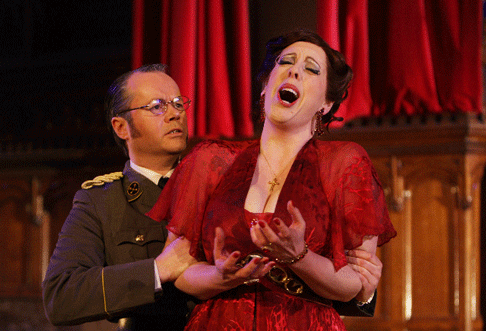 Giselle Allen as Tosca and Paul Carey Jones as Scarpia
Earlier Mears had used a completely different logistical lay-out for Act One in St Columb’s Cathedral, the orchestra deployed in a side chapel and behind the altar, the aisle a conduit for the arrival of the dramatis personae and the excellent choir of local schoolchildren who intoned the “Te Deum” lustily, encouraged by the vividly comic and firmly voiced Sacristan of Cork baritone Brendan Collins. Mexican tenor Jesús León, slightly stiffer and less stage-confident than his Tosca, had handsome features and a pleasingly sappy upper voice going for him. His Cavaradossi was brooding, perhaps a touch too interiorised for effective projection. He rose to Act Three’s “E lucevan le stelle” (in English), sung in a cramped, grubbily-tiled police execution chamber where Mears had earlier staged a shockingly literal dumb-show shooting over Puccini’s lengthy orchestral introduction. I wondered what my interval interlocutor might be thinking.
The production as a whole was the very opposite of opera as commodification: there was no desire evident to cushion the rawness of the narrative content, no truck with the idea of opera as plush, comfortable middle-class entertainment. This was Tosca as riveting political drama, visceral without being in any way artificially pumped-up or gimmicky. It made the work seem like a truly great opera, rather than one which is merely massively popular. The audience stood as one at the end, noisily acclaiming what was undoubtedly a momentous evening for Northern Ireland Opera, in a part of the United Kingdom which has been on short (often non-existent) rations operatically throughout its ninety-year history. The new company’s first full (2011-12) season is awaited with the keenest interest.
Terry Blain