![Claudio Sgura as Scarpia and Chiara Taigi as Tosca [Photo courtesy of Palm Beach Opera]](http://www.operatoday.com/ToscaTaigiSgura.gif)
03 Apr 2011
Tosca, Palm Beach
Victorien Sardou wrote the melodrama La Tosca, a play subject to all sorts of incidental drama and off-stage intrigue, for Sarah Bernhardt.
English Touring Opera are delighted to announce a season of lyric monodramas to tour nationally from October to December. The season features music for solo singer and piano by Argento, Britten, Tippett and Shostakovich with a bold and inventive approach to making opera during social distancing.
This tenth of ten Live from London concerts was in fact a recorded live performance from California. It was no less enjoyable for that, and it was also uplifting to learn that this wasn’t in fact the ‘last’ LfL event that we will be able to enjoy, courtesy of VOCES8 and their fellow vocal ensembles (more below …).
Ever since Wigmore Hall announced their superb series of autumn concerts, all streamed live and available free of charge, I’d been looking forward to this song recital by Ian Bostridge and Imogen Cooper.
Although Stile Antico’s programme article for their Live from London recital introduced their selection from the many treasures of the English Renaissance in the context of the theological debates and upheavals of the Tudor and Elizabethan years, their performance was more evocative of private chamber music than of public liturgy.
Evidently, face masks don’t stifle appreciative “Bravo!”s. And, reducing audience numbers doesn’t lower the volume of such acclamations. For, the audience at Wigmore Hall gave soprano Elizabeth Llewellyn and pianist Simon Lepper a greatly deserved warm reception and hearty response following this lunchtime recital of late-Romantic song.
For this week’s Live from London vocal recital we moved from the home of VOCES8, St Anne and St Agnes in the City of London, to Kings Place, where The Sixteen - who have been associate artists at the venue for some time - presented a programme of music and words bound together by the theme of ‘reflection’.
'Such is your divine Disposation that both you excellently understand, and royally entertaine the Exercise of Musicke.’
‘And there was war in heaven: Michael and his angels fought against the dragon; and the dragon fought and his angels, And prevailed not; neither was their place found any more in heaven … that old serpent … Satan, which deceiveth the whole world: he was cast out into the earth, and his angels were cast out with him.’
There was never any doubt that the fifth of the twelve Met Stars Live in Concert broadcasts was going to be a palpably intense and vivid event, as well as a musically stunning and theatrically enervating experience.
‘Love’ was the theme for this Live from London performance by Apollo5. Given the complexity and diversity of that human emotion, and Apollo5’s reputation for versatility and diverse repertoire, ranging from Renaissance choral music to jazz, from contemporary classical works to popular song, it was no surprise that their programme spanned 500 years and several musical styles.
The Academy of St Martin in the Fields have titled their autumn series of eight concerts - which are taking place at 5pm and 7.30pm on two Saturdays each month at their home venue in Trafalgar Square, and being filmed for streaming the following Thursday - ‘re:connect’.
The London Symphony Orchestra opened their Autumn 2020 season with a homage to Oliver Knussen, who died at the age of 66 in July 2018. The programme traced a national musical lineage through the twentieth century, from Britten to Knussen, on to Mark-Anthony Turnage, and entwining the LSO and Rattle too.
With the Live from London digital vocal festival entering the second half of the series, the festival’s host, VOCES8, returned to their home at St Annes and St Agnes in the City of London to present a sequence of ‘Choral Dances’ - vocal music inspired by dance, embracing diverse genres from the Renaissance madrigal to swing jazz.
Just a few unison string wriggles from the opening of Mozart’s overture to Le nozze di Figaro are enough to make any opera-lover perch on the edge of their seat, in excited anticipation of the drama in music to come, so there could be no other curtain-raiser for this Gala Concert at the Royal Opera House, the latest instalment from ‘their House’ to ‘our houses’.
"Before the ending of the day, creator of all things, we pray that, with your accustomed mercy, you may watch over us."
The doors at The Metropolitan Opera will not open to live audiences until 2021 at the earliest, and the likelihood of normal operatic life resuming in cities around the world looks but a distant dream at present. But, while we may not be invited from our homes into the opera house for some time yet, with its free daily screenings of past productions and its pay-per-view Met Stars Live in Concert series, the Met continues to bring opera into our homes.
Music-making at this year’s Grange Festival Opera may have fallen silent in June and July, but the country house and extensive grounds of The Grange provided an ideal setting for a weekend of twelve specially conceived ‘promenade’ performances encompassing music and dance.
There’s a “slide of harmony” and “all the bones leave your body at that moment and you collapse to the floor, it’s so extraordinary.”
“Music for a while, shall all your cares beguile.”
The hum of bees rising from myriad scented blooms; gentle strains of birdsong; the cheerful chatter of picnickers beside a still lake; decorous thwacks of leather on willow; song and music floating through the warm evening air.
Victorien Sardou wrote the melodrama La Tosca, a play subject to all sorts of incidental drama and off-stage intrigue, for Sarah Bernhardt.
In a representative case of truth at least rivaling fiction, there were dime-novel circumstances revolving around the play even before “the most famous actress the world has ever known” took the stage, the first Floria Tosca.
For one thing, the whole of the thing was set under the specter of legal issues – another author claimed that Sardou had cribbed the story (those days in theater circles, this was not an altogether uncommon accusation). The show would go on. Bernhardt saw to this herself as partial financier; she rented the theater where the play would debut in 1887.
The plot twists further when Bernhardt learns Sardou made arrangements to have another actress play La Tosca in the stateside premiere. Bernhardt’s threats to desert probably rang hollow; she was overinvested; the theater and the man (her lover) playing Baron Scarpia were hers. Bernhardt’s eventual change of heart aligned her with a calamity of fate, one joined to Floria Tosca’s own. Touring the play in Brazil, she injured herself in performance and eventually lost a limb. La Tosca, as you know, in the hands of Giacomo Puccini, would become the opera Tosca.
There were no such fractures in Palm Beach Opera’s Tosca (seen March 25th). Breaks of the dramatic variety, however, did happen.
It is unclear whether Director Massimo Gasparon’s concepts or the execution of these were faulty. One thing is clear, the acting of the principals tended towards predictable and slack, and in some cases limited in scope. Scarpia’s assault on Tosca is a case in point – more like timid mud-wrestling, the two seemed unsure of how to go about taking the actions of their respective motivations.
The troublesome stage activities seeped into the music and into the pit. Maestro Bruno Aprea showed the bearings of a trooper; through tripped-up entrances and marred text, the conductor mouthed along with singers and kept the music flowing – slowly. What is more, the orchestra pulled out very rich timbres and evenly wound textures. This instrumental balance gave way to the most sprawling soundscapes in act one: for the entire scene of Angelotti’s reappearance and the soaring lines of the duet.
The chorus – prepared by Greg Ritchey – turned in a strong vocal performance in the “Te Deum” and some often over-shadowed musical bits were gleaned from Tosca’s recital.
There were moments when Chiara Taigli seemed miscast in the role of Tosca, her voice a hair light in the middle, with but a touch of steel at top. Her “Vissi d’arte” was labored as Aprea seemed to take things slower still. At the word “assassino” in the second act, Taigli’s stage manner turned more sure and the use of her hands in the final act duet was striking.
Tenor Riccardo Massi has had some important engagements overseas of late. As Cavaradossi here, Massi’s easy high notes complimented a weighted sound that sped through “E lucevan le stelle.” Massi demonstrated he could sing a legato line though there were few instances of him doing it.
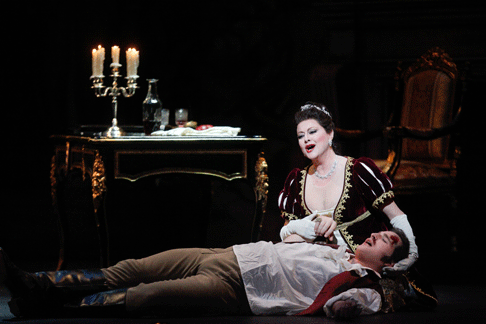 Chiara Taigi as Tosca and Riccardo Massi as Cavaradossi
Claudio Sgura appeared to be taking cues from Tito Gobbi’s acting grab bag; the baritone mainly used his eyes to convey wickedness as Scarpia. Sgura’s singing was one-dimensional, an attractive dimension though it is.
Matteo Peirone returns to PBO as Il sagrestano, with a big moment corralling choir boys just before the “Te Deum.” Mathew Burns’ played a woozy Angelotti. Young Artist Evanivaldo Correa Serrano’s Spoletta was obliging to his master Scarpia. With a sharp turn and genuflection towards his liege, as Sciarrone Young Artist Kenneth Stavert’s actions were as if half-mocking Scarpia. Gasparon has the Shepherd Boy – on this night Young Artist Greta Ball, trying her darndest to sing out of vibrato – sitting on the ramparts of Castel Sant'Angelo and shooed away by guards after his paen to the morning.
PBO borrows these sets for Tosca from Sarasota Opera; they were created by Sarasota’s resident scenic designer David P. Gordon. Gordon’s take on Castel Sant'Angelo includes a backdrop (lit by Joseph R. Oshry) view of St. Peter’s Basilica and Vatican City.
Taigli’s suspenseful swinging of her cape before diving from Sant’Angelo’s parapets ended Tosca in better dramatic form than had been the night’s pattern. Incidentally, it was on this fall that Bernhardt shattered her right knee in La Tosca.
Robert Carreras