![David Pittsinger as Don Giovanni [Photo by Gaston de Cardenas courtesy of Florida Grand Opera]](http://www.operatoday.com/DG_FGO_01.png)
21 May 2011
Don Giovanni, Florida Grand Opera
By Leporello’s count (in the “Catalogue aria”), Don Giovanni tallies over 2,000 sexual exploits.
English Touring Opera are delighted to announce a season of lyric monodramas to tour nationally from October to December. The season features music for solo singer and piano by Argento, Britten, Tippett and Shostakovich with a bold and inventive approach to making opera during social distancing.
This tenth of ten Live from London concerts was in fact a recorded live performance from California. It was no less enjoyable for that, and it was also uplifting to learn that this wasn’t in fact the ‘last’ LfL event that we will be able to enjoy, courtesy of VOCES8 and their fellow vocal ensembles (more below …).
Ever since Wigmore Hall announced their superb series of autumn concerts, all streamed live and available free of charge, I’d been looking forward to this song recital by Ian Bostridge and Imogen Cooper.
The Sixteen continues its exploration of Henry Purcell’s Welcome Songs for Charles II. As with Robert King’s pioneering Purcell series begun over thirty years ago for Hyperion, Harry Christophers is recording two Welcome Songs per disc.
Although Stile Antico’s programme article for their Live from London recital introduced their selection from the many treasures of the English Renaissance in the context of the theological debates and upheavals of the Tudor and Elizabethan years, their performance was more evocative of private chamber music than of public liturgy.
In February this year, Albanian soprano Ermonela Jaho made a highly lauded debut recital at Wigmore Hall - a concert which both celebrated Opera Rara’s 50th anniversary and honoured the career of the Italian soprano Rosina Storchio (1872-1945), the star of verismo who created the title roles in Leoncavallo’s La bohème and Zazà, Mascagni’s Lodoletta and Puccini’s Madama Butterfly.
Evidently, face masks don’t stifle appreciative “Bravo!”s. And, reducing audience numbers doesn’t lower the volume of such acclamations. For, the audience at Wigmore Hall gave soprano Elizabeth Llewellyn and pianist Simon Lepper a greatly deserved warm reception and hearty response following this lunchtime recital of late-Romantic song.
Collapsology. Or, perhaps we should use the French word ‘Collapsologie’ because this is a transdisciplinary idea pretty much advocated by a series of French theorists - and apparently, mostly French theorists. It in essence focuses on the imminent collapse of modern society and all its layers - a series of escalating crises on a global scale: environmental, economic, geopolitical, governmental; the list is extensive.
For this week’s Live from London vocal recital we moved from the home of VOCES8, St Anne and St Agnes in the City of London, to Kings Place, where The Sixteen - who have been associate artists at the venue for some time - presented a programme of music and words bound together by the theme of ‘reflection’.
'Such is your divine Disposation that both you excellently understand, and royally entertaine the Exercise of Musicke.’
Amongst an avalanche of new Mahler recordings appearing at the moment (Das Lied von der Erde seems to be the most favoured, with three) this 1991 Mahler Second from the 2nd Kassel MahlerFest is one of the more interesting releases.
‘And there was war in heaven: Michael and his angels fought against the dragon; and the dragon fought and his angels, And prevailed not; neither was their place found any more in heaven … that old serpent … Satan, which deceiveth the whole world: he was cast out into the earth, and his angels were cast out with him.’
If there is one myth, it seems believed by some people today, that probably needs shattering it is that post-war recordings or performances of Wagner operas were always of exceptional quality. This 1949 Hamburg Tristan und Isolde is one of those recordings - though quite who is to blame for its many problems takes quite some unearthing.
There was never any doubt that the fifth of the twelve Met Stars Live in Concert broadcasts was going to be a palpably intense and vivid event, as well as a musically stunning and theatrically enervating experience.
‘Love’ was the theme for this Live from London performance by Apollo5. Given the complexity and diversity of that human emotion, and Apollo5’s reputation for versatility and diverse repertoire, ranging from Renaissance choral music to jazz, from contemporary classical works to popular song, it was no surprise that their programme spanned 500 years and several musical styles.
The Academy of St Martin in the Fields have titled their autumn series of eight concerts - which are taking place at 5pm and 7.30pm on two Saturdays each month at their home venue in Trafalgar Square, and being filmed for streaming the following Thursday - ‘re:connect’.
The London Symphony Orchestra opened their Autumn 2020 season with a homage to Oliver Knussen, who died at the age of 66 in July 2018. The programme traced a national musical lineage through the twentieth century, from Britten to Knussen, on to Mark-Anthony Turnage, and entwining the LSO and Rattle too.
With the Live from London digital vocal festival entering the second half of the series, the festival’s host, VOCES8, returned to their home at St Annes and St Agnes in the City of London to present a sequence of ‘Choral Dances’ - vocal music inspired by dance, embracing diverse genres from the Renaissance madrigal to swing jazz.
Just a few unison string wriggles from the opening of Mozart’s overture to Le nozze di Figaro are enough to make any opera-lover perch on the edge of their seat, in excited anticipation of the drama in music to come, so there could be no other curtain-raiser for this Gala Concert at the Royal Opera House, the latest instalment from ‘their House’ to ‘our houses’.
"Before the ending of the day, creator of all things, we pray that, with your accustomed mercy, you may watch over us."
By Leporello’s count (in the “Catalogue aria”), Don Giovanni tallies over 2,000 sexual exploits.
Whether such a thing is possible (Wilt Chamberlain notwithstanding) or not is for others to debate. The more interesting question might be who DaPonte and Mozart had in mind as they set to work on unmasking the Spanish grandee.
Early in the 17th century, a Spanish monk by the name Tirso de Molina wrote of a certain Don Juan more reprehensible than is probable and so much less than worthy that he is cast into fiery hell pits. Scores of offshoots (Moliere, Byron, E.T.A. Hoffman, Pushkin, and Kierkegaard count among those that succeeded with adaptations) came out of Molina’s Don and it is probable that this is the historical figure from which Mozart’s Don Giovanni is derived.
About a century later, there appears on the scene Giacomo Girolamo Casanova de Seingalt. You know him simply as Casanova. Mozart’s take on Giovanni so interested Casanova — and his station as a man that set off on serial dalliances was so established - that he was said to have approached (unsolicited) DaPonte to advise him on the libretto; he may have sat in on the opera’s premiere to wit. But Casanova’s reputation was not that of a true libertine. By his own admission in his 12 volume mega-autobiography L’histoire de mon vie, he was but a mild womanizer: he lists a paltry 122 escapades and often the sole faculty he required from a woman was good conversation.
It remains that DaPonte and Mozart shaped Giovanni as a composite of these men, adding a soupcon of super-physical feats here and inflating the drollness (in the spirit of dark comedy, or drama giocosa) driving his depravity there. From this, productions and directors have room to play with the degree of redeeming value left their Giovanni. Florida Grand Opera’s production seeks to bend the picture of Giovanni to make him a more sympathetic anti-hero, to explain his actions as a function of psychodynamics and therefore something all men must trespass through: commitment-phobia or its less severe cousin, proverbial cold-feet.
The festive ambiance in the air on April 16, opening night, was the likes of which are felt when things are on an upswing and that is where FGO finds itself in recent seasons. The company’s operatic high notes peaked in 2010 with exciting new productions, interesting new talent and efforts to reach out to the opera community at large (opera luminary Ira Siff is on hand and this is John Pascoe’s Giovanni). So, opera interest is heightened this month with this Giovanni production (courtesy Washington National Opera) and, in repertory, David DiChiera’s Cyrano showing through the end of the month.
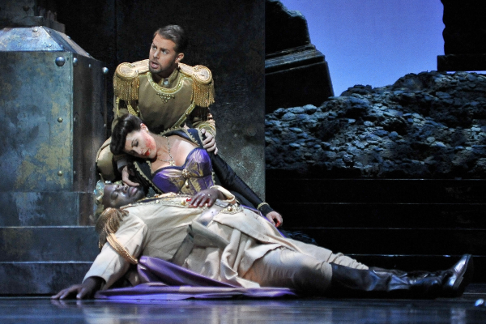 Ottavio and Anna (Bidlack and Wagner) by the fallen
Commendatore (Robinson)
Ottavio and Anna (Bidlack and Wagner) by the fallen
Commendatore (Robinson)
Before a single note played, the curtain rose to Giovanni (David Pittsinger) and the circling “ghost of girlfriends past” behind a soft screen — what resulted was a field-of-sight dark, smoky, hazy, and impressionistic — a feast for the eyes before other senses were tapped.
Pascoe’s sets (arid and rustic in flavor with corresponding studding and fittings on frames and doors), offset costumes (those of Masetto and Zerlina were especially decorative) and the wielding of revolvers gives the story extra personality and takes the audience to a Spain feeling the remnants of Ottoman influence. The final scene at Giovanni’s castle, with vault-like doors at the entrance, was another glance into Pascoe’s imagination: the Commendatore, forces of repent coursing through him, pulls Giovanni (and zaps a Leporello too close for comfort) in like a magnet. That strobe lights, so often a gimmicky excess, were trained at center of symmetrical doors had something to do with their effectiveness. Pascoe’s costumes were of gorgeously decorated heavy and reflective fabrics — in purples, blues, and blacks, embroidered and streaked in gold.
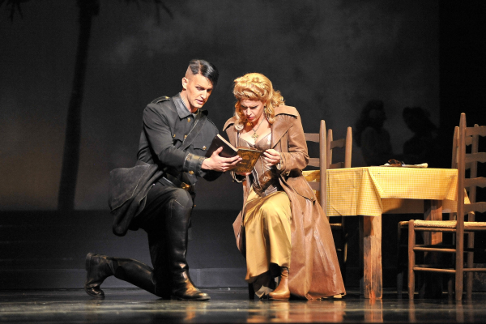 Leporello (Corbeil) recounts of Giovanni's conquest to Elvira (Jarman) in the “Catalogue Aria”
Pittsinger mostly fulfilled his promise to “inhabit” Giovanni, stylizing his performance satisfyingly. Giovanni does some pretty daft to risqué things per Pascoe — urinating on the Commendatore’s statue, performing cunnulingus on one of the members of the band in the last act — and Pittsinger went at these gamely. All the fight scenes came off well, with special kudos due the swordplay and tug-of-war (Fighting Director Bruce Lecure and Choreographer Sara Erde — in her first assignment with FGO - collaborating) with Ottavio and friends (four in total). Giovanni’s music sits very well in Pittsinger’s voice; he shaded and modulated compellingly and, at times, beautifully — his “Deh, vieni” placed in the latter category.
By the sound of it, Tom Corbeil — whose voice is phonogenic — is likely to make the switch from Leporello to Giovanni not far down the road. Corbeil had fun with Leporello’s music and the Pee-Wee Herman hairdo (Wig and Makeup by Chris Diamantides) he sported was in keeping with his anxiety-stricken servant. The Donna Elvira of Georgia Jarman was as irritating to the Don as could be imagined; Pascoe put a tool in the hand of Elvira for that purpose — evidence of the grandee’s misdeeds and complicating Giovanni’s relationship to Elvira and the Commendatore. Elvira carries a swaddled infant throughout the opera. Jarman, in her first outing with FGO, sang a “Mi tradi” with potent force and some lovely spun high notes.
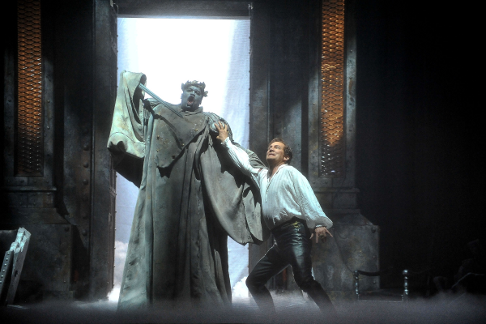 The Commendatore (Morris Robinson) runs
through Giovanni (David Pittsinger)
The Commendatore (Morris Robinson) runs
through Giovanni (David Pittsinger)
Morris Robinson is such a presence — he (and Pascoe) made the Commendatore a pivot point in this production. Right from the get go, he pulls out a pistol during the duel, grazing Giovanni on the arm (a wound that is hard to heal throughout the opera). Heard at other points in his career in other roles, Robinson’s voice is remembered for its sheer size; Mozart’s music exposes it as glorious.
In his arias, Andrew Bidlack (Don Ottavio) sang winning phrases with a pleasant sounding mid-section. As Ottavio’s betrothed Donna Anna, Jacqueline Wagner won the audience over with a strongly felt “Non mi dir.” The Masetto this evening, Jonathon G. Michie, exhibited exemplary acting, nonplussed and peeved as he was over his Zerlina’s infatuation for the Don. Brittany Ann Renee Robinson (Zerlina), in her FGO debut, was a distracted vixen with a light soprano that carried a light “Batti, batti.”
FGO resident conductor Andrew Bisantz — carrying an ultra-sensitive baton for vocalists this evening– and orchestra found their most select playing marks in the sweeping interplay of winds and strings. Caren Levine provided harpsichord continuo. FGO’s chorus (with John Keene as Chorus Master) did a fine job on all fronts — busy as they were in non-singing tasks (they riot across the stage to open the second act). Erde made things interesting for the minuet by turning the program into something of a dance school.
It’s hard to tell if Giovanni came off as more likable, or even more relatable, this time. This time, like most times, there is only one way to defrost Giovanni’s feet.
Robert Carreras