20 May 2011
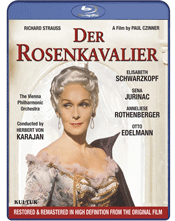
Elizabeth Schwarzkopf in Der Rosenkavalier
Classic films often receive the honor of a full “restoration,” especially when a new viewing format appears.
English Touring Opera are delighted to announce a season of lyric monodramas to tour nationally from October to December. The season features music for solo singer and piano by Argento, Britten, Tippett and Shostakovich with a bold and inventive approach to making opera during social distancing.
This tenth of ten Live from London concerts was in fact a recorded live performance from California. It was no less enjoyable for that, and it was also uplifting to learn that this wasn’t in fact the ‘last’ LfL event that we will be able to enjoy, courtesy of VOCES8 and their fellow vocal ensembles (more below …).
Ever since Wigmore Hall announced their superb series of autumn concerts, all streamed live and available free of charge, I’d been looking forward to this song recital by Ian Bostridge and Imogen Cooper.
The Sixteen continues its exploration of Henry Purcell’s Welcome Songs for Charles II. As with Robert King’s pioneering Purcell series begun over thirty years ago for Hyperion, Harry Christophers is recording two Welcome Songs per disc.
Although Stile Antico’s programme article for their Live from London recital introduced their selection from the many treasures of the English Renaissance in the context of the theological debates and upheavals of the Tudor and Elizabethan years, their performance was more evocative of private chamber music than of public liturgy.
In February this year, Albanian soprano Ermonela Jaho made a highly lauded debut recital at Wigmore Hall - a concert which both celebrated Opera Rara’s 50th anniversary and honoured the career of the Italian soprano Rosina Storchio (1872-1945), the star of verismo who created the title roles in Leoncavallo’s La bohème and Zazà, Mascagni’s Lodoletta and Puccini’s Madama Butterfly.
Evidently, face masks don’t stifle appreciative “Bravo!”s. And, reducing audience numbers doesn’t lower the volume of such acclamations. For, the audience at Wigmore Hall gave soprano Elizabeth Llewellyn and pianist Simon Lepper a greatly deserved warm reception and hearty response following this lunchtime recital of late-Romantic song.
Collapsology. Or, perhaps we should use the French word ‘Collapsologie’ because this is a transdisciplinary idea pretty much advocated by a series of French theorists - and apparently, mostly French theorists. It in essence focuses on the imminent collapse of modern society and all its layers - a series of escalating crises on a global scale: environmental, economic, geopolitical, governmental; the list is extensive.
For this week’s Live from London vocal recital we moved from the home of VOCES8, St Anne and St Agnes in the City of London, to Kings Place, where The Sixteen - who have been associate artists at the venue for some time - presented a programme of music and words bound together by the theme of ‘reflection’.
'Such is your divine Disposation that both you excellently understand, and royally entertaine the Exercise of Musicke.’
Amongst an avalanche of new Mahler recordings appearing at the moment (Das Lied von der Erde seems to be the most favoured, with three) this 1991 Mahler Second from the 2nd Kassel MahlerFest is one of the more interesting releases.
‘And there was war in heaven: Michael and his angels fought against the dragon; and the dragon fought and his angels, And prevailed not; neither was their place found any more in heaven … that old serpent … Satan, which deceiveth the whole world: he was cast out into the earth, and his angels were cast out with him.’
If there is one myth, it seems believed by some people today, that probably needs shattering it is that post-war recordings or performances of Wagner operas were always of exceptional quality. This 1949 Hamburg Tristan und Isolde is one of those recordings - though quite who is to blame for its many problems takes quite some unearthing.
There was never any doubt that the fifth of the twelve Met Stars Live in Concert broadcasts was going to be a palpably intense and vivid event, as well as a musically stunning and theatrically enervating experience.
‘Love’ was the theme for this Live from London performance by Apollo5. Given the complexity and diversity of that human emotion, and Apollo5’s reputation for versatility and diverse repertoire, ranging from Renaissance choral music to jazz, from contemporary classical works to popular song, it was no surprise that their programme spanned 500 years and several musical styles.
The Academy of St Martin in the Fields have titled their autumn series of eight concerts - which are taking place at 5pm and 7.30pm on two Saturdays each month at their home venue in Trafalgar Square, and being filmed for streaming the following Thursday - ‘re:connect’.
The London Symphony Orchestra opened their Autumn 2020 season with a homage to Oliver Knussen, who died at the age of 66 in July 2018. The programme traced a national musical lineage through the twentieth century, from Britten to Knussen, on to Mark-Anthony Turnage, and entwining the LSO and Rattle too.
With the Live from London digital vocal festival entering the second half of the series, the festival’s host, VOCES8, returned to their home at St Annes and St Agnes in the City of London to present a sequence of ‘Choral Dances’ - vocal music inspired by dance, embracing diverse genres from the Renaissance madrigal to swing jazz.
Just a few unison string wriggles from the opening of Mozart’s overture to Le nozze di Figaro are enough to make any opera-lover perch on the edge of their seat, in excited anticipation of the drama in music to come, so there could be no other curtain-raiser for this Gala Concert at the Royal Opera House, the latest instalment from ‘their House’ to ‘our houses’.
"Before the ending of the day, creator of all things, we pray that, with your accustomed mercy, you may watch over us."
Classic films often receive the honor of a full “restoration,” especially when a new viewing format appears.
The companies behind the product get another marketing opportunity, and the fans get the chance to see a beloved work of art in a state-of-the-art reproduction.
Such seems to be the promise behind a recent Kultur release of a “restored & remastered” version of Paul Czinner’s classic 1962 film of Der Rosenkavalier, from the Salzburg Festival, with Herbert von Karajan conducting the Vienna Philharmonic and a superlative cast: Elisabeth Schwarzkopf as the Marschallin, Sena Jurinac in the title role, Anneliese Rotherberger as Sophie and Otto Edlelmann as Baroc Ochs.
As compared to a drab VHS version your reviewer saw some years ago, this DVD version does indeed have sharper colors and adequate sound. However, the film quality still shows its age, and audiophiles have no special reason to rejoice. The chief advantage of this new version is the addition of subtitles — that VHS version had none. Kultur does retain the synopses that begin each act, which have a certain historic charm, although the subtitles make them superfluous. The review copy offers nothing else — a one page track listing is the only thing provided in place of a booklet.
In the end, any disappointment provoked by the above state of affairs is washed away in the glory of this impeccably classy and traditional performance. The opera of composer Richard Strauss and librettist Hugo von Hofmannsthal has depths and dark corners unexamined in this lovely 1962 presentation, and so we can be thankful for some of the more successful non-traditional productions of Der Rosenkavalier seen in recent years. Still, charm is not a negligible quality, and charm of one sort or another smiles out of almost every frame of this film.
Kultur has Schwarzkopf’s Marchallin as the cover, and she does dominate act one and the closing segment of act three. The voice undoubtedly had more plushness in earlier years, but ameliorating that loss is the mature wisdom of her understated portrayal. She knows this is no longer a stage performance, and she lets her eyes provide the acting. When she gathers her gown and departs after the trio, her visage from behind has more dramatic force than many performers manage facing the audience. Sena Jurinac neither sings nor acts convincingly as a male adolescent, but in the fairy-tale aspect of this work, her Octavian fits right in. In a role that be too cutesy by half, Annelise Rothenberger as Sophie earns our love along with Octavian’s, although one might wish for just a bit more security in the very highest notes. Otto Edelmann’s is a classically crude and obnoxious Ochs, which does make act three feel long until his disappearance (despite the fact that it is cut already). His epic last note at the end of act two won’t satisfy those who want the walls to reverberate with low vibrations, but he gets it out.
Herbert von Karajan loved to be filmed conducting, but there director Czinner keeps the camera on the stage, excepting, of course, the opening instrumental passages. Amusingly enough, Karajan does get the final bow.
So while this may not be the truest, most rewarding “restoration and remastering” imaginable, anything that puts this film on the market again deserves our thanks. Thank you, Kultur!
Chris Mullins