![Simon Keenlyside as Macbeth [Photo by Clive Barda courtesy of The Royal Opera]](http://www.operatoday.com/MACBETH.110521_0047.%20KEENLYSIDE%20AS%20MACBETH%28C%29%20BARDA%202011.png)
26 May 2011
Macbeth, Royal Opera
Phyllida Lloyd’s reading of Verdi’s Macbeth – first seen in 2002 and here revived for the second time – could certainly not be described as ‘subtle’, either dramatically or visually.
English Touring Opera are delighted to announce a season of lyric monodramas to tour nationally from October to December. The season features music for solo singer and piano by Argento, Britten, Tippett and Shostakovich with a bold and inventive approach to making opera during social distancing.
This tenth of ten Live from London concerts was in fact a recorded live performance from California. It was no less enjoyable for that, and it was also uplifting to learn that this wasn’t in fact the ‘last’ LfL event that we will be able to enjoy, courtesy of VOCES8 and their fellow vocal ensembles (more below …).
Ever since Wigmore Hall announced their superb series of autumn concerts, all streamed live and available free of charge, I’d been looking forward to this song recital by Ian Bostridge and Imogen Cooper.
Although Stile Antico’s programme article for their Live from London recital introduced their selection from the many treasures of the English Renaissance in the context of the theological debates and upheavals of the Tudor and Elizabethan years, their performance was more evocative of private chamber music than of public liturgy.
Evidently, face masks don’t stifle appreciative “Bravo!”s. And, reducing audience numbers doesn’t lower the volume of such acclamations. For, the audience at Wigmore Hall gave soprano Elizabeth Llewellyn and pianist Simon Lepper a greatly deserved warm reception and hearty response following this lunchtime recital of late-Romantic song.
For this week’s Live from London vocal recital we moved from the home of VOCES8, St Anne and St Agnes in the City of London, to Kings Place, where The Sixteen - who have been associate artists at the venue for some time - presented a programme of music and words bound together by the theme of ‘reflection’.
'Such is your divine Disposation that both you excellently understand, and royally entertaine the Exercise of Musicke.’
‘And there was war in heaven: Michael and his angels fought against the dragon; and the dragon fought and his angels, And prevailed not; neither was their place found any more in heaven … that old serpent … Satan, which deceiveth the whole world: he was cast out into the earth, and his angels were cast out with him.’
There was never any doubt that the fifth of the twelve Met Stars Live in Concert broadcasts was going to be a palpably intense and vivid event, as well as a musically stunning and theatrically enervating experience.
‘Love’ was the theme for this Live from London performance by Apollo5. Given the complexity and diversity of that human emotion, and Apollo5’s reputation for versatility and diverse repertoire, ranging from Renaissance choral music to jazz, from contemporary classical works to popular song, it was no surprise that their programme spanned 500 years and several musical styles.
The Academy of St Martin in the Fields have titled their autumn series of eight concerts - which are taking place at 5pm and 7.30pm on two Saturdays each month at their home venue in Trafalgar Square, and being filmed for streaming the following Thursday - ‘re:connect’.
The London Symphony Orchestra opened their Autumn 2020 season with a homage to Oliver Knussen, who died at the age of 66 in July 2018. The programme traced a national musical lineage through the twentieth century, from Britten to Knussen, on to Mark-Anthony Turnage, and entwining the LSO and Rattle too.
With the Live from London digital vocal festival entering the second half of the series, the festival’s host, VOCES8, returned to their home at St Annes and St Agnes in the City of London to present a sequence of ‘Choral Dances’ - vocal music inspired by dance, embracing diverse genres from the Renaissance madrigal to swing jazz.
Just a few unison string wriggles from the opening of Mozart’s overture to Le nozze di Figaro are enough to make any opera-lover perch on the edge of their seat, in excited anticipation of the drama in music to come, so there could be no other curtain-raiser for this Gala Concert at the Royal Opera House, the latest instalment from ‘their House’ to ‘our houses’.
"Before the ending of the day, creator of all things, we pray that, with your accustomed mercy, you may watch over us."
The doors at The Metropolitan Opera will not open to live audiences until 2021 at the earliest, and the likelihood of normal operatic life resuming in cities around the world looks but a distant dream at present. But, while we may not be invited from our homes into the opera house for some time yet, with its free daily screenings of past productions and its pay-per-view Met Stars Live in Concert series, the Met continues to bring opera into our homes.
Music-making at this year’s Grange Festival Opera may have fallen silent in June and July, but the country house and extensive grounds of The Grange provided an ideal setting for a weekend of twelve specially conceived ‘promenade’ performances encompassing music and dance.
There’s a “slide of harmony” and “all the bones leave your body at that moment and you collapse to the floor, it’s so extraordinary.”
“Music for a while, shall all your cares beguile.”
The hum of bees rising from myriad scented blooms; gentle strains of birdsong; the cheerful chatter of picnickers beside a still lake; decorous thwacks of leather on willow; song and music floating through the warm evening air.
Phyllida Lloyd’s reading of Verdi’s Macbeth – first seen in 2002 and here revived for the second time – could certainly not be described as ‘subtle’, either dramatically or visually.
Arresting, and at times disturbing, it may be, but the symbolism is unabashedly transparent. Red = blood; black = evil; gold = power. Thrones in gilded cages remind us that power corrupts and ambition destroys; the roadside standpipe at which Macbeth pauses to erase the blood of battle from his hands reveals man’s bleak brutality.
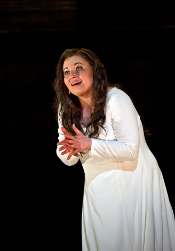 Liudmyla Monastyrska as Lady Macbeth
That’s not to say that Anthony Ward’s designs, all looming grey
stone and shadowy skies, are ineffective; indeed the stage space powerfully
suggests both the magnitude of the Macbeths’ ambitions and the increasing
claustrophobia as the net closes in. We are as mesmerised as the Scottish
thanes by the glamorous glitter of the royal couple’s eye-splitting gold
lamé gowns. Dramatic streams of light cut through the darkness of Duninsblane
Castle, threatening to expose the criminals’ handiwork, or perhaps to
represent the stabs of moral conscience which beleaguer the guilty pair, a
device employed most effectively during Macbeth’s “is this a dagger
…?” hallucination.
So, visually the intensity never wanes. And, indeed Verdi’s reading of Shakespeare’s tragedy, in which the chorus looms so large, perhaps invites hyperbole and melodrama. Why have 3 witches when you can have 25? Similarly, while we may wonder why Shakespeare insists on the presence of a third, mute, murderer, at the assassination of Banquo, Verdi gives as a whole herd of henchmen, revelling in their butchery. Lloyd promptly takes her cues and, exploiting the significantly enlarged choral forces, makes the witches’ malicious intent the driving force of the drama, their scarlet headdresses signifying their blood-thirsty intentions. They are omnipresent: they help Fleance to evade his would-be assassins; they deliver Macbeth’s letter to his wife. If they are not steering the action, they are shifting the furniture.
Moreover, the innovative orchestral score strikingly conveys dark depths and deeds, and from the opening raspings of the bassoons and brass in the prelude, Pappano whipped up and sustained a sonic canvass to match the stage vision. He superbly controlled the musico-dramatic ebbs and flows, bring great energy to the accompaniment figurations, while elegantly highlighting the significant strands within the dense textures.
Making her role debut as Lady Macbeth, Ukrainian soprano Luidmyla Monastyrska was a commanding presence. When she made an unscheduled ROH debut as Aida in March, many commentated on the sheer size of her voice, and Lloyd’s production positively invited her to exhibit her vocal muscle to the full: I don’t think I’ve ever heard a soprano ride above a large ensemble with such force and potency – indeed, one would be concerned for her vocal health and longevity had it all not seemed so effortless. She began with an astounding confidence which suggested she’d been singing the role for a lifetime; she ascended to the stratosphere with ease and fleetly navigated the coloratura, while her lower register was burnished and sensual. Verdi’s Lady Macbeth could seem monstrous – an emblem, and agent, of the witches’ designs. For example, she is actually responsible for planting the seed of the murderous plot against Banquo in her husband’s mind, whereas Shakespeare’s queen is kept in ignorance. However, in a recent interview, Monastyrska explained that she senses Lady Macbeth’s guilt troubling her, almost immediately after the death of Duncan. And it is to Monastyrska’s credit that she is able convincingly to bring some complexity to a role which could become a one-dimensional portrait of sexual power; her Sleepwalking Scene was a sensitive exploration of motivation and psychology.
Simon Keenlyside was, by contrast, all subtlety and self-interrogation, though never lacking in focus if not quite matching his wife for decibels. Pony-tailed and sporting a goatee beard, his Macbeth is a portrait of self-doubt, the elation of victory on the battlefield and elevation at court swiftly giving way to the horror of his own moral devastation. While not always mastering the span and arch of the Verdian phrases, Keenlyside’s beautiful tone, carefully nuanced, movingly suggested the anguish of every twist and turn of Macbeth’s psychological brooding, as he swung between soulless defiance and poignant regret. Seemingly inhabiting opposing moral spheres, it is not surprising that the couple are found sleeping in separate by the rebellious Scottish refugees who burst into the bed chamber in Act 4. Perhaps greater erotic tension will grow between the pair as the run proceeds.
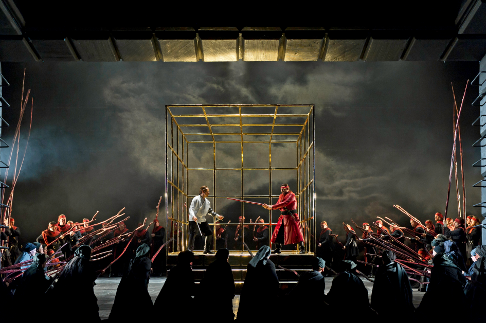 Simon Keenlyside as Macbeth and Dimitri Pittas as Macduff
Of the rest of the cast, bass Raymond Aceto was a weighty Banquo, if occasionally uneven, while Dimitri Pittas, though firmer and more consistent of tone, was a rather wooden Macduff whose intonation tended to drift sharpwards. Both would have been assisted by some more attentive direction. Elisabeth Meister, a Jette Parker Young Artist, demonstrated an intelligent appreciation of the musical and dramatic demands of the role; she’s an intelligent singer who knows when to bring forth the finer details and when to blend with the ensemble. The huge chorus co-ordinated well with the pit, and were particularly powerful in the Act 1 concertante, driven by Pappano to a stirring climax. The witches’ strange whining tone was an unnecessary distraction, though.
Overall, there were many compelling moments during the evening, not least because of some outstanding singing from Monastyrska, but the production does not entirely convince.
Claire Seymour