01 Jun 2011
Brahms Liebesliederwalzer, Wigmore Hall, London
Any performance of Brahms and Schumann four part songs is an occasion.
English Touring Opera are delighted to announce a season of lyric monodramas to tour nationally from October to December. The season features music for solo singer and piano by Argento, Britten, Tippett and Shostakovich with a bold and inventive approach to making opera during social distancing.
This tenth of ten Live from London concerts was in fact a recorded live performance from California. It was no less enjoyable for that, and it was also uplifting to learn that this wasn’t in fact the ‘last’ LfL event that we will be able to enjoy, courtesy of VOCES8 and their fellow vocal ensembles (more below …).
Ever since Wigmore Hall announced their superb series of autumn concerts, all streamed live and available free of charge, I’d been looking forward to this song recital by Ian Bostridge and Imogen Cooper.
Although Stile Antico’s programme article for their Live from London recital introduced their selection from the many treasures of the English Renaissance in the context of the theological debates and upheavals of the Tudor and Elizabethan years, their performance was more evocative of private chamber music than of public liturgy.
Evidently, face masks don’t stifle appreciative “Bravo!”s. And, reducing audience numbers doesn’t lower the volume of such acclamations. For, the audience at Wigmore Hall gave soprano Elizabeth Llewellyn and pianist Simon Lepper a greatly deserved warm reception and hearty response following this lunchtime recital of late-Romantic song.
For this week’s Live from London vocal recital we moved from the home of VOCES8, St Anne and St Agnes in the City of London, to Kings Place, where The Sixteen - who have been associate artists at the venue for some time - presented a programme of music and words bound together by the theme of ‘reflection’.
'Such is your divine Disposation that both you excellently understand, and royally entertaine the Exercise of Musicke.’
‘And there was war in heaven: Michael and his angels fought against the dragon; and the dragon fought and his angels, And prevailed not; neither was their place found any more in heaven … that old serpent … Satan, which deceiveth the whole world: he was cast out into the earth, and his angels were cast out with him.’
There was never any doubt that the fifth of the twelve Met Stars Live in Concert broadcasts was going to be a palpably intense and vivid event, as well as a musically stunning and theatrically enervating experience.
‘Love’ was the theme for this Live from London performance by Apollo5. Given the complexity and diversity of that human emotion, and Apollo5’s reputation for versatility and diverse repertoire, ranging from Renaissance choral music to jazz, from contemporary classical works to popular song, it was no surprise that their programme spanned 500 years and several musical styles.
The Academy of St Martin in the Fields have titled their autumn series of eight concerts - which are taking place at 5pm and 7.30pm on two Saturdays each month at their home venue in Trafalgar Square, and being filmed for streaming the following Thursday - ‘re:connect’.
The London Symphony Orchestra opened their Autumn 2020 season with a homage to Oliver Knussen, who died at the age of 66 in July 2018. The programme traced a national musical lineage through the twentieth century, from Britten to Knussen, on to Mark-Anthony Turnage, and entwining the LSO and Rattle too.
With the Live from London digital vocal festival entering the second half of the series, the festival’s host, VOCES8, returned to their home at St Annes and St Agnes in the City of London to present a sequence of ‘Choral Dances’ - vocal music inspired by dance, embracing diverse genres from the Renaissance madrigal to swing jazz.
Just a few unison string wriggles from the opening of Mozart’s overture to Le nozze di Figaro are enough to make any opera-lover perch on the edge of their seat, in excited anticipation of the drama in music to come, so there could be no other curtain-raiser for this Gala Concert at the Royal Opera House, the latest instalment from ‘their House’ to ‘our houses’.
"Before the ending of the day, creator of all things, we pray that, with your accustomed mercy, you may watch over us."
The doors at The Metropolitan Opera will not open to live audiences until 2021 at the earliest, and the likelihood of normal operatic life resuming in cities around the world looks but a distant dream at present. But, while we may not be invited from our homes into the opera house for some time yet, with its free daily screenings of past productions and its pay-per-view Met Stars Live in Concert series, the Met continues to bring opera into our homes.
Music-making at this year’s Grange Festival Opera may have fallen silent in June and July, but the country house and extensive grounds of The Grange provided an ideal setting for a weekend of twelve specially conceived ‘promenade’ performances encompassing music and dance.
There’s a “slide of harmony” and “all the bones leave your body at that moment and you collapse to the floor, it’s so extraordinary.”
“Music for a while, shall all your cares beguile.”
The hum of bees rising from myriad scented blooms; gentle strains of birdsong; the cheerful chatter of picnickers beside a still lake; decorous thwacks of leather on willow; song and music floating through the warm evening air.
Any performance of Brahms and Schumann four part songs is an occasion.
They aren’t performed live as often as they should be because they need four singers, two pianists and plenty of flair.
At this recital in London’s Wigmore Hall, the singers were Bernarda Fink, Sylvia Schwartz, Michael Schade and Robert Holl. The pianists were Malcolm Martineau and Justus Zeyen.
Appropriately, the evening began with Schumann’s Spanische Liebeslieder op 138 (1849) for they use the same forces as Brahms was to use in his two Liebeslieder Walzer op 52 and 65. Although Schumann’s song are set to Emanuel Giebell’s translations of Spanish and Portuguese texts, they’re not overtly Iberian. These charming songs would have been performed quite happily by talented amateur ensembles. This is sociable music, ideal for discreet flirations, perhaps. Weh, wie zornig ist das Mädchen, the men sing in mock alarm, in a song about an angry girl rushing off in a huff to the mountains. Then Fink sings Hoch, hoch sind die Berge about a girl upset because her lover’s headed for the hills. Joyful repartee, perfectly in order.
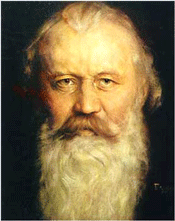
Brahms would have known the Schumann songs well, but, as Richard Stokes writes in his programme notes, they are not a “prototype” for the songs Brahms was to write twenty and twenty five years later. Brahms takes the concept of part song to an altogether more sophisticated level. Solo voices alternate with full ensemble, or divide into pairs. Voices sing in harmony, then suddenly revert to polyphony. Intervals and rhythms change. Sometimes the singers sing rounds, sometimes they weave intricate patterns around each other. In really good performances, the singing seems to almost levitate with energy. Significantly, Brahms called these songs Walzer, not Gesänge. They’re waltzes for the voice.
Moods change from the gruff, mock bucolic humour of O die Frauen to the elegant, arched lines of Wie des Abends where the female voices throw the words. “Einem, einem” and “Sonder, Ende, Wonne, sprühn” as if the vowels were garlands. Notice how Brahms pairs songs as partners to one another, and creates long cotillions, where songs move in formation, without a break between them.
Brahms doesn’t merely paint text, he works meaning into form itself. In Die grüne Hopfenranke, the four voices trill and entwine like the tendrils of the vine they’re singing about.
In this repertoire, Bernarda Fink was superlative. Her voice dances brightly, like the belle of the ball. When she needs depth, her voice darkens expressively. In Wahre, wahre, deinen Sohn, her voice becomes the witch/seductress who’ll kill if she can’t get her man. It’s an important song, for its adds menace to what on the surface seems a light hearted, lilting series of songs.
Robert Holl, too, was superb. Although he’s no longer in the first flush of youth, his technique is so good that he can bring agility to his voice which is rich and veers towards the darker range of his fach. He uses it well for dramatic effect, but here he moderated himself at times to blend in unison. That’s a sign of his artistic integrity. A lesser man might want to shine at the expense of the group. Holl knows that it’s ensemble that counts in these songs, not showmanship per se. He was a last minute substitute for Thomas Quasthoff, who was unwell, but Holl’s so experienced and so impressive, that it was no loss.
Some of the finest songs in both Brahms sets are written to showcase the tenor, and Michael Schade delivered well. Since the programme was devised around Quasthoff (the main pianist, Justus Zeyen, is Quasthoff’s regular partner), a Schreier or Prégardien would distract from the baritone part. Schade is good, though, providing a nice balance with Holl’s almost basso resonance.
The soprano was Sylvia Schwartz, a new name to me. She’s been in ensemble at the Deutsche Staatsoper, Berlin where her roles have included Zerlina. She doesn’t quite have the experience as the others and at times sounded pinched and exposed. It was heartening, though, to hear how Fink shielded Schwartz, giving her room so she could build confidence. Another sign of an artist who puts music before ego. Indeed, this is why part-songs like these are so enjoyable. Just as in a string quartet, the whole is greater than the sum of its parts.
Anne Ozorio
Programme:
Robert Schumann: Spanische Liebeslieder op 138
Johannes Brahms: Liebeslieder Walzer op 52, An die Heimat, Der Abend, O schöne Nacht, Abendlied Neue Liebeslieder Walzer op 65,