![Donald Maxwell as Don Pasquale [Photo by Fritz Curzon courtesy of Opera Holland Park]](http://www.operatoday.com/Don-P_0016_lzn.gif)
20 Jun 2011
Don Pasquale, Opera Holland Park
As it turned out, it was a mild and mainly dry evening.
English Touring Opera are delighted to announce a season of lyric monodramas to tour nationally from October to December. The season features music for solo singer and piano by Argento, Britten, Tippett and Shostakovich with a bold and inventive approach to making opera during social distancing.
This tenth of ten Live from London concerts was in fact a recorded live performance from California. It was no less enjoyable for that, and it was also uplifting to learn that this wasn’t in fact the ‘last’ LfL event that we will be able to enjoy, courtesy of VOCES8 and their fellow vocal ensembles (more below …).
Ever since Wigmore Hall announced their superb series of autumn concerts, all streamed live and available free of charge, I’d been looking forward to this song recital by Ian Bostridge and Imogen Cooper.
Although Stile Antico’s programme article for their Live from London recital introduced their selection from the many treasures of the English Renaissance in the context of the theological debates and upheavals of the Tudor and Elizabethan years, their performance was more evocative of private chamber music than of public liturgy.
Evidently, face masks don’t stifle appreciative “Bravo!”s. And, reducing audience numbers doesn’t lower the volume of such acclamations. For, the audience at Wigmore Hall gave soprano Elizabeth Llewellyn and pianist Simon Lepper a greatly deserved warm reception and hearty response following this lunchtime recital of late-Romantic song.
For this week’s Live from London vocal recital we moved from the home of VOCES8, St Anne and St Agnes in the City of London, to Kings Place, where The Sixteen - who have been associate artists at the venue for some time - presented a programme of music and words bound together by the theme of ‘reflection’.
'Such is your divine Disposation that both you excellently understand, and royally entertaine the Exercise of Musicke.’
‘And there was war in heaven: Michael and his angels fought against the dragon; and the dragon fought and his angels, And prevailed not; neither was their place found any more in heaven … that old serpent … Satan, which deceiveth the whole world: he was cast out into the earth, and his angels were cast out with him.’
There was never any doubt that the fifth of the twelve Met Stars Live in Concert broadcasts was going to be a palpably intense and vivid event, as well as a musically stunning and theatrically enervating experience.
‘Love’ was the theme for this Live from London performance by Apollo5. Given the complexity and diversity of that human emotion, and Apollo5’s reputation for versatility and diverse repertoire, ranging from Renaissance choral music to jazz, from contemporary classical works to popular song, it was no surprise that their programme spanned 500 years and several musical styles.
The Academy of St Martin in the Fields have titled their autumn series of eight concerts - which are taking place at 5pm and 7.30pm on two Saturdays each month at their home venue in Trafalgar Square, and being filmed for streaming the following Thursday - ‘re:connect’.
The London Symphony Orchestra opened their Autumn 2020 season with a homage to Oliver Knussen, who died at the age of 66 in July 2018. The programme traced a national musical lineage through the twentieth century, from Britten to Knussen, on to Mark-Anthony Turnage, and entwining the LSO and Rattle too.
With the Live from London digital vocal festival entering the second half of the series, the festival’s host, VOCES8, returned to their home at St Annes and St Agnes in the City of London to present a sequence of ‘Choral Dances’ - vocal music inspired by dance, embracing diverse genres from the Renaissance madrigal to swing jazz.
Just a few unison string wriggles from the opening of Mozart’s overture to Le nozze di Figaro are enough to make any opera-lover perch on the edge of their seat, in excited anticipation of the drama in music to come, so there could be no other curtain-raiser for this Gala Concert at the Royal Opera House, the latest instalment from ‘their House’ to ‘our houses’.
"Before the ending of the day, creator of all things, we pray that, with your accustomed mercy, you may watch over us."
The doors at The Metropolitan Opera will not open to live audiences until 2021 at the earliest, and the likelihood of normal operatic life resuming in cities around the world looks but a distant dream at present. But, while we may not be invited from our homes into the opera house for some time yet, with its free daily screenings of past productions and its pay-per-view Met Stars Live in Concert series, the Met continues to bring opera into our homes.
Music-making at this year’s Grange Festival Opera may have fallen silent in June and July, but the country house and extensive grounds of The Grange provided an ideal setting for a weekend of twelve specially conceived ‘promenade’ performances encompassing music and dance.
There’s a “slide of harmony” and “all the bones leave your body at that moment and you collapse to the floor, it’s so extraordinary.”
“Music for a while, shall all your cares beguile.”
The hum of bees rising from myriad scented blooms; gentle strains of birdsong; the cheerful chatter of picnickers beside a still lake; decorous thwacks of leather on willow; song and music floating through the warm evening air.
As it turned out, it was a mild and mainly dry evening.
Opera festivals — indeed, all outdoor or semi-outdoor activities — in the UK are in thrall to the vagaries of the weather, and as I write this review in early June I am sitting in my living-room, listening to the rain battering on the window and hoping it might clear up by the time I have to go to Glyndebourne in two days’ time.
For Opera Holland Park, whose theatre is ultimately a tent (albeit a highly sophisticated one) in which the sounds and light quality of the outside world are an inevitable part of the show, director Stephen Barlow has harnessed the characteristic changeable gloom of the British summer to create a modern and very British Don Pasquale that will resonate with anybody used to taking seaside holidays in this country. It is an ingenious treatment, finely honed by the work of lighting designer Mark Jonathan, which I cannot imagine would work as well in any other theatre. It almost made a virtue of the frequent noises-off from aeroplanes passing overheard and children playing elsewhere in the park.
The opera is sung in the original Italian, and Pasquale’s drab, tatty beach café is arbitrarily Italian (in the surtitles, Pasquale refers to it throughout as his ‘casa’). Its menu, however, consists of fish and chips or pie and mash, and there is no question that we are on the British coast — a world of striped awnings, deckchairs for hire, pensioners picnicking on benches with home-made sandwiches and a Thermos. Crucially, it’s the world of another phenomenon with its roots in Italian culture but adopted by the British as their own — the end-of-pier Punch and Judy show, an idea which, while never overtly suggested, Barlow recreates in spirit with a staging which served this peculiarly mean-spirited opera well with a combination of broad visual comedy and vicious humour.
None of the characters in Don Pasquale are obviously sympathetic. Even Ernesto, for all he’s been given the best of Donizetti’s lyrical melody to in which to bewail his uncle’s attempt to disinherit him, is ultimately a lazy freeloader who has grown too used to taking advantage of his old uncle’s generosity. While Pasquale is unquestionably in need of being taught a lesson in respect of his view of women, the bullying he suffers at the hands of everybody else in the cast goes much too far and you can’t help but feel sorry for the old man. It’s cynical, cruel and unashamedly selfish.
The visual humour was plentiful, with some laugh-out-loud moments. The fresh-from-the-convent “Sofronia” whipped off a full nun’s habit to reveal a sexy scarlet number, and in Act 3 was “revealed” in a more grotesquely extravagant get-up still, draped across the counter of her newly refurbished “Café Corneti” like a swimwear model across the bonnet of a sports car.
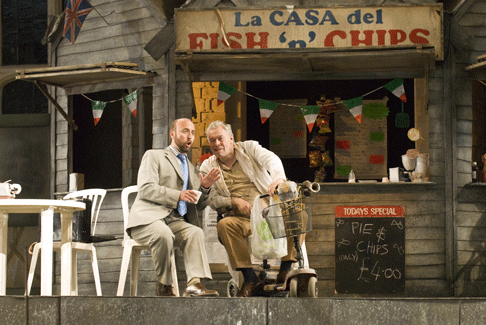 Donald Maxwell as Don Pasquale and Richard Burkhard as Dr Malatesta
Meanwhile, a series of peripheral gags involving walk-on characters from the chorus further highlighted the general tone of the production. Don Pasquale’s outdated attitudes are underlined by his gleefully lascivious reaction to the sight of two scantily-clad young lady joggers, and disapproving glances towards a male gay couple with a baby (they are later revealed not to be a couple at all, but the partners of the joggers). Meanwhile, a casual user of a coin-operated telescope on the seafront has his gaze distracted by the sight of the snazzily-attired Norina provocatively applying sun lotion to her décolleté, much to the annoyance of his long-suffering pregnant wife.
Top vocal honours went to the Ernesto, the South African tenor Colin Lee who is now deservedly enjoying a high-profile international career. He has a personable stage presence, and a voice at the more substantially rounded end of the flexible bel canto tenor spectrum, with bright liquid tone which pings right to the back of the auditorium. In the title role, opera buffa veteran Donald Maxwell was highly entertaining when the action demanded, but on the whole he was more sympathetic and genuine than most, offering a rare degree of balance. Richard Burkhard’s Malatesta had a well-schooled voice and engaging personality.
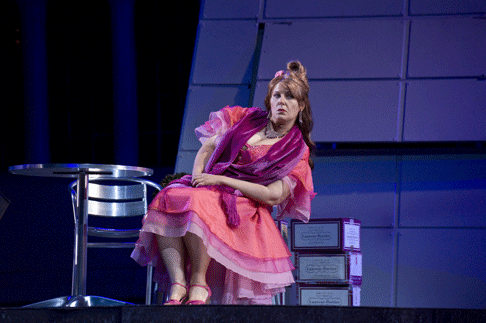 Majella Cullagh as Norina
I have admired Majella Cullagh in numerous Donizetti roles in the past, but sadly felt that she was miscast as Norina; her light, vinegary soprano did open up somewhat as the evening progressed, but she remained overpowered by her colleagues during the ensembles. And as spirited and entertaining as her performance was, she made rather a matronly heroine — believable perhaps as the scheming merry widow (there’s no reason at all why Ernesto’s lover shouldn’t be somewhat older than him), but hardly convincing as the nubile young bride who the lecherous Pasquale believes is the embodiment of his fantasies.
In the pit was bel canto’s supreme champion, Richard Bonynge, looking spry and conducting with poised lyricism.
All in all a strong, entertaining and memorable opening to Opera Holland Park’s 2011 season, and one which turns this unique theatre’s many idiosyncrasies to its advantage. One of next year’s operas is Falstaff, which has immense potential in a theatre which loses natural daylight as the performance progresses; let us hope the director makes the most of it.
Ruth Elleson © 2011