![Chad Shelton as the Prince, Katherine Rohrer as Princess Clarisse and Nicolas Testé as Leandro [Photo by Yunus Durukan courtesy of Grand Théâtre de Genève]](http://www.operatoday.com/Three_oranges_Geneva_03.gif)
20 Jun 2011
Geneva’s Juicy Oranges
Need something remedial for “what ails you?”
English Touring Opera are delighted to announce a season of lyric monodramas to tour nationally from October to December. The season features music for solo singer and piano by Argento, Britten, Tippett and Shostakovich with a bold and inventive approach to making opera during social distancing.
This tenth of ten Live from London concerts was in fact a recorded live performance from California. It was no less enjoyable for that, and it was also uplifting to learn that this wasn’t in fact the ‘last’ LfL event that we will be able to enjoy, courtesy of VOCES8 and their fellow vocal ensembles (more below …).
Ever since Wigmore Hall announced their superb series of autumn concerts, all streamed live and available free of charge, I’d been looking forward to this song recital by Ian Bostridge and Imogen Cooper.
Although Stile Antico’s programme article for their Live from London recital introduced their selection from the many treasures of the English Renaissance in the context of the theological debates and upheavals of the Tudor and Elizabethan years, their performance was more evocative of private chamber music than of public liturgy.
Evidently, face masks don’t stifle appreciative “Bravo!”s. And, reducing audience numbers doesn’t lower the volume of such acclamations. For, the audience at Wigmore Hall gave soprano Elizabeth Llewellyn and pianist Simon Lepper a greatly deserved warm reception and hearty response following this lunchtime recital of late-Romantic song.
For this week’s Live from London vocal recital we moved from the home of VOCES8, St Anne and St Agnes in the City of London, to Kings Place, where The Sixteen - who have been associate artists at the venue for some time - presented a programme of music and words bound together by the theme of ‘reflection’.
'Such is your divine Disposation that both you excellently understand, and royally entertaine the Exercise of Musicke.’
‘And there was war in heaven: Michael and his angels fought against the dragon; and the dragon fought and his angels, And prevailed not; neither was their place found any more in heaven … that old serpent … Satan, which deceiveth the whole world: he was cast out into the earth, and his angels were cast out with him.’
There was never any doubt that the fifth of the twelve Met Stars Live in Concert broadcasts was going to be a palpably intense and vivid event, as well as a musically stunning and theatrically enervating experience.
‘Love’ was the theme for this Live from London performance by Apollo5. Given the complexity and diversity of that human emotion, and Apollo5’s reputation for versatility and diverse repertoire, ranging from Renaissance choral music to jazz, from contemporary classical works to popular song, it was no surprise that their programme spanned 500 years and several musical styles.
The Academy of St Martin in the Fields have titled their autumn series of eight concerts - which are taking place at 5pm and 7.30pm on two Saturdays each month at their home venue in Trafalgar Square, and being filmed for streaming the following Thursday - ‘re:connect’.
The London Symphony Orchestra opened their Autumn 2020 season with a homage to Oliver Knussen, who died at the age of 66 in July 2018. The programme traced a national musical lineage through the twentieth century, from Britten to Knussen, on to Mark-Anthony Turnage, and entwining the LSO and Rattle too.
With the Live from London digital vocal festival entering the second half of the series, the festival’s host, VOCES8, returned to their home at St Annes and St Agnes in the City of London to present a sequence of ‘Choral Dances’ - vocal music inspired by dance, embracing diverse genres from the Renaissance madrigal to swing jazz.
Just a few unison string wriggles from the opening of Mozart’s overture to Le nozze di Figaro are enough to make any opera-lover perch on the edge of their seat, in excited anticipation of the drama in music to come, so there could be no other curtain-raiser for this Gala Concert at the Royal Opera House, the latest instalment from ‘their House’ to ‘our houses’.
"Before the ending of the day, creator of all things, we pray that, with your accustomed mercy, you may watch over us."
The doors at The Metropolitan Opera will not open to live audiences until 2021 at the earliest, and the likelihood of normal operatic life resuming in cities around the world looks but a distant dream at present. But, while we may not be invited from our homes into the opera house for some time yet, with its free daily screenings of past productions and its pay-per-view Met Stars Live in Concert series, the Met continues to bring opera into our homes.
Music-making at this year’s Grange Festival Opera may have fallen silent in June and July, but the country house and extensive grounds of The Grange provided an ideal setting for a weekend of twelve specially conceived ‘promenade’ performances encompassing music and dance.
There’s a “slide of harmony” and “all the bones leave your body at that moment and you collapse to the floor, it’s so extraordinary.”
“Music for a while, shall all your cares beguile.”
The hum of bees rising from myriad scented blooms; gentle strains of birdsong; the cheerful chatter of picnickers beside a still lake; decorous thwacks of leather on willow; song and music floating through the warm evening air.
Need something remedial for “what ails you?”
You would do no better than to scurry to the Grand Theatre of Geneva where this first rate ensemble is producing a snazzy, energetic, in-your-face production of Prokofiev’s The Love for Three Oranges. Just like the opera’s hapless Prince we all could use a therapeutic laugh, and this the Swiss company decidedly delivers.
Although it is billed as a “co-production” with Deutsche Oper am Rhein and La Fenice, in truth, the physical design is so definitively reproductive of the Venice Theatre’s architectural elements that is is hard to consider this re-mounting as more than a “rental.” Consider this: the massive masking “legs” stage right and left are photographic copies of the boxes in La Fenice, clearly meant to “extend” that ‘teatro’s’ structure onto the stage. Too, the ‘stage-within-a-stage’ up center has a replica of the Fenice grand drape, and the stucco elements in the backdrop are derived from those in the Italian house. While it does not wholly matter, it does seem to stifle any of the ‘local’ resonance that was clearly intended.
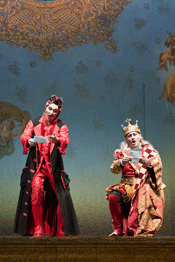 Heikki Kilpeläinen and Jean Teitgen as the King
That said, Ezio Toffolutti’s scenery functioned well, was handsome to look at, and contributed a smooth-moving parade of inventive visual delights required by the libretto. I did wish that the “stage” had not been so far upstage as it served to distance us visually, if not aurally, from the two-thirds of the action that was played there. There was just that big empty expanse of prime “real” stage area unused for much of the time. Maybe shuttering the lighting to more tightly encompass the false stage might have focused the action more and edited the dead space out, although I found Volker Weinhart’s varied lighting design quite well-judged, with good area isolation, effective specials, smooth cross-fades and on the whole, very tightly cued.
Patricia Toffolutti’s fashion parade of meaty, varied, multi-faceted costumes (a ‘char-couture-y’?) provided constant colorful delight. Moreover, her creations were character-specific, greatly helping the actors in embodying their (largely) stock characters. The stage direction by Benno Besson and Ezio Toffolutti managed the large crowd scenes well enough, although the traffic patterns became repetitive. The pair seemed less interested in directorial distinction in the more personal scenes where they contented themselves with getting characters on and offstage with ease and pace. Power loves a vacuum, and absent a scintillating directorial hand, the cast filled in the dramatic blanks with savvy and imagination.
The hardest-working cast member had to be Emilio Pons, whose Truffaldino was not only a master of invention, but also was exceedingly well sung. Mr. Pons is almost never still as he leaps, kicks his heels, spins, cowers, beseeches, minces, and prances with more infectious energy than a Billy Blanks Tae-Bo session. His fearless, manic, even demented, cavorting during the playing of the famous March was a scintillating high point. Too, Emilio deployed his secure lyric tenor to fine effect, pouring out secure, arching phrases on demand, and ‘speechifying’ with good purpose, presence and diction on the many parlando passages. A definitive impersonation from this talented young tenor.
Chad Shelton gave us first a sympathetic and, later, a self-assured Prince. Mr. Shelton has just a hint of a ‘bite’ in his well-schooled tenor which stood him in good stead as the phrases got higher-flying and the instrumental density ratcheted up. His tireless, solid upper extension recalled the young Chris Merritt, and his command of the stage is already even better. On the distaff side, it was a distinct pleasure for me to encounter anew the (apparently) ageless mezzo of Jeanne Piland. I first took notice of Ms. Piland at New York City Opera as Orisini and Smeton in the year…well…we were all younger then. I caught up with her a few years ago as a riveting Sara in Munich’s Roberto Devereux. And here she was again engaging us with a real star turn as Fata Morgana, her rich, plummy voice in fine estate and skillfully deployed; still treading the boards as if born to the stage; still glamorous and vibrant. This was luxury casting and the opening nighters responded enthusiastically.
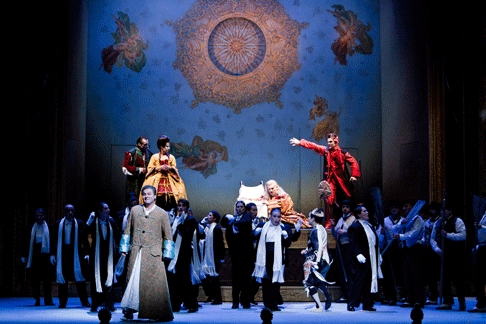 Chad Shelton as the Prince, Katherine Rohrer as Princess Clarisse, Nicolas Testé as Leandro and Michail Milanov as Tchelio
Jean Teitgen was a positively splendid King of Clubs. His rich, mature bass rolled out line after line of imposing phrases. And Mr. Teitgen devised an exceptionally well-rounded characterization, one moment amusing us as the exasperated buffoon-royal, and the next truly breaking our hearts after his son slaps him — a moment every bit as genuine and touching as the Pasquale equivalent.
Katherine Rohrer (Princess Clarice) and Nicolas Testé (Leandro) sang with solid panache, and prowled the environment with suitable relish of their evil intent. Smeraldina was as over-the-top and vibrant as her co-conspirators, but Carine Séchaye’s sizable mezzo-soprano, when pressed at forte, was occasionally marred by an overly generous vibrato that resulted in approximation of pitches above the staff. Heikki Kilpeläinen was a reliable Pantalone, Thomas Dear stood out with his virile baritone and committed stage action as Farfarello, and Christopher Stamboglis made a strong impression as the Cook. Some artists would be content to let the drag costume do all the work, but Mr. Stamboglis not only sang the role beautifully with a soft grained, weighty bass, but also imbued the part with considerable sensitivity.
The Princesses Linette, Nicolette and Ninette are usually as individual as Huey, Dewey and Louie. Here however, there was good distinction offered by three young sopranos: Susanne Gritschneder with her limpid, lyric Linette; Agnieszka Adamczak with a slightly darker, urgent Nicolette; and Clémence Tilquin in the more extended role of Linette. Ms. Tilquin was just lovely — slim as a ballerina, but with a sizable soprano with a hint of metal that sailed over the orchestra and proved a good partner to Mr. Shelton’s pointed tenor.
The seasoned bass Michail Milanov may not be producing the most fresh-voiced or roundly sung performance of the evening. But, damn if his demonstrative Tchelio didn’t score every point as he brought his years of experience to bear, husbanding his resources to make the most of every dramatic statement. The Geneva public lavished Mr. Milanov with a warmly appreciative ovation for his efforts.
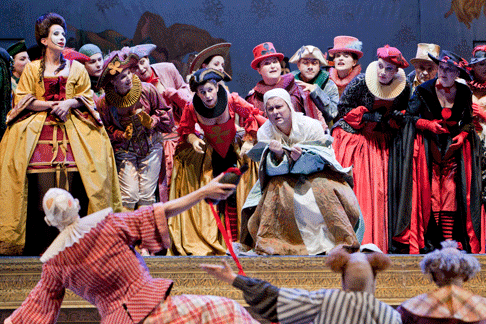 Chad Shelton as the Prince and Katherine Rohrer as Princess Clarisse
Arguably the star of the evening was conductor Michail Jurowski. Never have I heard such fire in this score tempered by such nuance. Maestro Jurowski not only had all the angular, rhythmic flash and dazzle abundantly in place, but he also lovingly inspired contrasting moments of transparency, tenderness, and mellow rumination. This was as deeply felt, stylistically impeccable, personalized and persuasive a reading as you might be lucky enough to encounter once every ten years. The Maestro was ably abetted by Ching-Lien Wu’s meticulously prepared chorus.
James Sohre