![Barbara Dobrzanska [Photo by Jochen Klenk]](http://www.operatoday.com/Dobrzanska.gif)
09 Jun 2011
Karlsruhe “Gioconda” Unintentionally ‘Konzertant’
It was a lucky happenstance that glorious vocalism characterized Badisches Staatstheater’s La Gioconda, for effective stagecraft was nowhere in evidence…but, oh, what singing!
English Touring Opera are delighted to announce a season of lyric monodramas to tour nationally from October to December. The season features music for solo singer and piano by Argento, Britten, Tippett and Shostakovich with a bold and inventive approach to making opera during social distancing.
This tenth of ten Live from London concerts was in fact a recorded live performance from California. It was no less enjoyable for that, and it was also uplifting to learn that this wasn’t in fact the ‘last’ LfL event that we will be able to enjoy, courtesy of VOCES8 and their fellow vocal ensembles (more below …).
Ever since Wigmore Hall announced their superb series of autumn concerts, all streamed live and available free of charge, I’d been looking forward to this song recital by Ian Bostridge and Imogen Cooper.
Although Stile Antico’s programme article for their Live from London recital introduced their selection from the many treasures of the English Renaissance in the context of the theological debates and upheavals of the Tudor and Elizabethan years, their performance was more evocative of private chamber music than of public liturgy.
Evidently, face masks don’t stifle appreciative “Bravo!”s. And, reducing audience numbers doesn’t lower the volume of such acclamations. For, the audience at Wigmore Hall gave soprano Elizabeth Llewellyn and pianist Simon Lepper a greatly deserved warm reception and hearty response following this lunchtime recital of late-Romantic song.
For this week’s Live from London vocal recital we moved from the home of VOCES8, St Anne and St Agnes in the City of London, to Kings Place, where The Sixteen - who have been associate artists at the venue for some time - presented a programme of music and words bound together by the theme of ‘reflection’.
'Such is your divine Disposation that both you excellently understand, and royally entertaine the Exercise of Musicke.’
‘And there was war in heaven: Michael and his angels fought against the dragon; and the dragon fought and his angels, And prevailed not; neither was their place found any more in heaven … that old serpent … Satan, which deceiveth the whole world: he was cast out into the earth, and his angels were cast out with him.’
There was never any doubt that the fifth of the twelve Met Stars Live in Concert broadcasts was going to be a palpably intense and vivid event, as well as a musically stunning and theatrically enervating experience.
‘Love’ was the theme for this Live from London performance by Apollo5. Given the complexity and diversity of that human emotion, and Apollo5’s reputation for versatility and diverse repertoire, ranging from Renaissance choral music to jazz, from contemporary classical works to popular song, it was no surprise that their programme spanned 500 years and several musical styles.
The Academy of St Martin in the Fields have titled their autumn series of eight concerts - which are taking place at 5pm and 7.30pm on two Saturdays each month at their home venue in Trafalgar Square, and being filmed for streaming the following Thursday - ‘re:connect’.
The London Symphony Orchestra opened their Autumn 2020 season with a homage to Oliver Knussen, who died at the age of 66 in July 2018. The programme traced a national musical lineage through the twentieth century, from Britten to Knussen, on to Mark-Anthony Turnage, and entwining the LSO and Rattle too.
With the Live from London digital vocal festival entering the second half of the series, the festival’s host, VOCES8, returned to their home at St Annes and St Agnes in the City of London to present a sequence of ‘Choral Dances’ - vocal music inspired by dance, embracing diverse genres from the Renaissance madrigal to swing jazz.
Just a few unison string wriggles from the opening of Mozart’s overture to Le nozze di Figaro are enough to make any opera-lover perch on the edge of their seat, in excited anticipation of the drama in music to come, so there could be no other curtain-raiser for this Gala Concert at the Royal Opera House, the latest instalment from ‘their House’ to ‘our houses’.
"Before the ending of the day, creator of all things, we pray that, with your accustomed mercy, you may watch over us."
The doors at The Metropolitan Opera will not open to live audiences until 2021 at the earliest, and the likelihood of normal operatic life resuming in cities around the world looks but a distant dream at present. But, while we may not be invited from our homes into the opera house for some time yet, with its free daily screenings of past productions and its pay-per-view Met Stars Live in Concert series, the Met continues to bring opera into our homes.
Music-making at this year’s Grange Festival Opera may have fallen silent in June and July, but the country house and extensive grounds of The Grange provided an ideal setting for a weekend of twelve specially conceived ‘promenade’ performances encompassing music and dance.
There’s a “slide of harmony” and “all the bones leave your body at that moment and you collapse to the floor, it’s so extraordinary.”
“Music for a while, shall all your cares beguile.”
The hum of bees rising from myriad scented blooms; gentle strains of birdsong; the cheerful chatter of picnickers beside a still lake; decorous thwacks of leather on willow; song and music floating through the warm evening air.
It was a lucky happenstance that glorious vocalism characterized Badisches Staatstheater’s La Gioconda, for effective stagecraft was nowhere in evidence…but, oh, what singing!
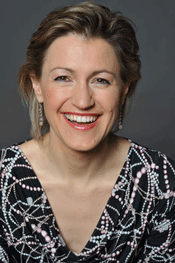
Barbara Dobrzanksa continues to go from strength to considerable strength in the title role, with her secure soprano now assuming all the trappings of a thrilling spinto performer. Let’s cut to the chase: The Divine Miss D scored a triumph — personal, professional, artistic, musical — think of a category, and she nailed it. Her searing top notes rang out in the house, the chest tones were dramatic and solid, and her floated phrases and occasional messa di voce effects were nigh unto faultless. This supremely intelligent artist commands a reliable technique that not only allows for great nuance of utterance and phrasing, but also finds her as fresh-voiced at the finale as when the show began. When has any Gioconda tossed off the sudden coloratura flirting with Barnaba in the closing pages with such self-assured élan? (Pace, Maria.)
Let me go out on a limb here: there is possibly no singer currently performing the part that is in quite the same league as this Karlsruhe star. Why the theatre feels it must bring in Violeta Urmana (whom I do like) for an upcoming “gala” performance is beyond me. Barbara could probably be singing this and many other roles on world stages any time she wants. The local Publikum should (and does) rejoice in the fact that their Diva is a home body.
Her accomplishment was wonderfully partnered by Keith Ikaia-Purdy’s ringing Enzo. But stentorian singing of the high order is not his only asset, for Mr. I-P is above all else a supremely sensitive interpreter of the multi-faceted moods of the text. Without crooning he can scale back his sizable tenor to craft phrases of melting beauty, infused with great meaning. Moreover, his Italianate styling is well-judged and idiomatic. It is bittersweet to note that this run of Gioconda’s will mark Keith’s final scheduled appearances with the company. He will be missed in Karlsruhe. In the meantime, we reveled in his professionalism and craft, including a lovingly shaped, haunting “Cielo e Mar.”
 Sabina Willeit [Photo by Jochen Klenk]
The evening’s true show stopping set piece, however, belonged to Dobrzanska and her Laura, the glamorous mezzo Sabina Willeit. Their heated Act I duet escalated to a fever pitch of sizzling singing and supremely bitchy confrontation, and the audience erupted like a group of opera-crazed Italians in an appreciative response. That ovation might be going on still had the conductor not finally urged things along. Ms. Willeit is another fine company asset, possessed of a throbbing, communicative instrument, somewhat bright with a wide range and considerable allure. As her husband Alvise, house favorite Konstantin Gorny did not disappoint. His familiar orotund bass rolled out to blanket the auditorium, and his sensible phrasing and reliable musicianship provided all that was wanted.
Anna Maria Dur contributed an affecting Cieca. Though not particularly matronly in demeanor (like Chookasian) nor voice (like Dunn), Ms. Dur suggested a frail, quirky mother eerily in the mold of “Six Feet Under’s” Frances Conroy. Her meaty mezzo was by turns plangent, urgent, and excitable as required and she found much variety in her relatively brief stage time. Walter Donati is a sturdy and stirring Barnaba. Mr. Donati’s career is somewhat a marvel, since he began as a successful tenor, switching mid-point to baritone and bringing with that an exceptional clarity of tone all the while having found a true baritonal core and timbre. And at 70+, he sounds more youthful and vibrant than most singers half his age. This is not the bullying, blustering Barnaba often encountered, but rather intensely focused and beautifully couched for maximum Slime Factor and dramatic impact.
Any house would be proud to have fielded this top notch sextet of soloists, who almost performed the feat of making you forget that when it came to the production, there was no “there” there. Sometimes a spare scenic design can focus the drama, and sometimes, as here, “less” is just “less.” Actually, make that…”least.”
Is there any locale more atmospheric and evocative than Venice. (That was rhetorical: No. Except maybe Bruges.) And yet set designer Siegfried E. Mayer found “gar nichts” to suggest the slightest hint of La Serenissima. In fact, let me be blunt. All he came up with was a butt-ugly set of orchestra risers surrounded by a box set of reflective walls that had all the beauty of a fading 50’s concert hall in Brno, and all the charm of a bus terminal in Tenafly. Mr. Mayer shared credit with Annegret Ritzel for a hodge-podge of costumes that seemed to have Fascist leanings, a look that was already tired out in German theatres in the 80’s.
Gioconda’s get-up was a cross between Sally Bowles in a trench coat and Lotte Lenya in Pierrette drag. Enzo (who is supposed to be incognito) sported a can’t-miss-him dazzling white sailor uniform that made him look like Pinkerton took a wrong turn from the dressing room. Poor Barnaba fared worst, looking as sinister as a Fasching reveler with a costume thrown together from the closet: flowered muumuu culottes, tux jacket with clownish white satin lapels, and a bird’s head hat like the god Horus as interpreted by South Park. And he was in white face. Laura first sported a black tailored jacket and Frederick’s of Hollywood metallic slip, then a flowered gown that just didn’t hang right (was it backwards?). Why the chorus women were look-alike Jean Harlow’s in Act IV is anybody’s guess.
Nor were any of these visuals helped in any way by Gerd Meier’s dismal lighting plot which seemed to have been created to keep the singers’ faces in as much darkness as possible. Alvise sang his entire second aria un-illuminated except by back-light until the final two bars when he wandered (by mistake?) into an area light down right. (I had the feeling that Herr Meier was somewhere hissing “My God, fools, his face is lit! Turn that light off! Turn it off!”) Note to all “designers:” it is not about you! The design elements should only exist to help the performers create their characters, and to tell the author’s story. Not “your” story…”the” story. When a light design robs the performer of the ability to communicate with the audience (“Two eyes to two eyes” as Martha Graham said) then you have made a bad lighting design. When you make the sinister baritone look like an inexplicable buffoon, you have made a bad costume design. When you fail to visually evoke any sense of time or place or intent, you have made a bad set design. Punkt!
Flavio Salamanka’s eccentric choreography of the famous “Dance of the Hours” was enthusiastically applauded, although its overall impact somewhat eluded me. The Karlsruhe corps boasts wonderful young female dancers to be sure and they threw themselves with skill and gusto into the concept of having an Adonis-like (sole) ballerino invading their regimented world. The scenario “seemed” to be about eschewing totalitarianism. As the girls stripped away their regimental jackets, and then their long black tulle skirts they did so with considerable more dramatic propulsion than was otherwise present in the longish evening. But while the steps and combinations were clever enough, and the groupings and intent sincere, the overall impact of the piece seemed pleasantly generic but dramatically neutral.
Ulrich Wagner’s chorus was polished and full-throated but did the entire group have to be trapped on stage for virtually the whole show for no good reason? They sat around on the risers in various vague groupings, trying to look interested, trying to stay in character and ultimately failing at both pursuits. Sorry to say Annegret Ritzel proved to be a better costume designer than director, for while her attire was variable it at least showed that she had made some choices. In her unfocused direction she seemed to avoid choices at all costs. Characters wandered at will. Actors didn’t look at each other or relate. Scenes meant to have characters in close proximity found them on opposite sides of the stage. And then there was the omnipresent bored chorus for the soloists to navigate around. I had the distinct feeling the experienced principals were doing their damndest to fill in the vast directorial blanks.
Attilio Tomasello took over the baton for the rest of the run with largely excellent results. The Karlsruhe pit is peopled by a superb group of musicians, and they had a very good night indeed. Maestro Tomasello deviated from a few standard choices of tempi with this phrase a bit slower, that phrase a bit faster, and yet another passage a lot slower, etc. but he partnered well enough with his singers and displayed secure control of the many large ensembles. I found the polished reading just shy of the passionate Italianate incisiveness that would have taken this Ponchielli pot-boiler to the ultimate level, with the strings, though assured, a little cool.
All told, it is always a pleasure to encounter this seldom-performed piece, especially a performance with such an exceptional International-level cast. But really, if you are going to go to such great lengths to make it look for all the world like a half-baked concert version, for God’s sake get all the crap out of the way, put the accomplished band, chorus and soloists on the stage and … just plain do it as a concert version. We would have been far better off.
James Sohre