![Tamara Mumford as Phaedra [Photo by Kelly & Massa Photography courtesy of Opera Company of Philadelphia]](http://www.operatoday.com/fullres_2011_06_01_KM0262.gif)
06 Jun 2011
Phaedra in Philadelphia
The U.S. premiere of Hans Werner Henze’s Phaedra at the Opera Company of Philadelphia may well be the most important and ambitious new work presented by any American company this season.
English Touring Opera are delighted to announce a season of lyric monodramas to tour nationally from October to December. The season features music for solo singer and piano by Argento, Britten, Tippett and Shostakovich with a bold and inventive approach to making opera during social distancing.
This tenth of ten Live from London concerts was in fact a recorded live performance from California. It was no less enjoyable for that, and it was also uplifting to learn that this wasn’t in fact the ‘last’ LfL event that we will be able to enjoy, courtesy of VOCES8 and their fellow vocal ensembles (more below …).
Ever since Wigmore Hall announced their superb series of autumn concerts, all streamed live and available free of charge, I’d been looking forward to this song recital by Ian Bostridge and Imogen Cooper.
Although Stile Antico’s programme article for their Live from London recital introduced their selection from the many treasures of the English Renaissance in the context of the theological debates and upheavals of the Tudor and Elizabethan years, their performance was more evocative of private chamber music than of public liturgy.
Evidently, face masks don’t stifle appreciative “Bravo!”s. And, reducing audience numbers doesn’t lower the volume of such acclamations. For, the audience at Wigmore Hall gave soprano Elizabeth Llewellyn and pianist Simon Lepper a greatly deserved warm reception and hearty response following this lunchtime recital of late-Romantic song.
For this week’s Live from London vocal recital we moved from the home of VOCES8, St Anne and St Agnes in the City of London, to Kings Place, where The Sixteen - who have been associate artists at the venue for some time - presented a programme of music and words bound together by the theme of ‘reflection’.
'Such is your divine Disposation that both you excellently understand, and royally entertaine the Exercise of Musicke.’
‘And there was war in heaven: Michael and his angels fought against the dragon; and the dragon fought and his angels, And prevailed not; neither was their place found any more in heaven … that old serpent … Satan, which deceiveth the whole world: he was cast out into the earth, and his angels were cast out with him.’
There was never any doubt that the fifth of the twelve Met Stars Live in Concert broadcasts was going to be a palpably intense and vivid event, as well as a musically stunning and theatrically enervating experience.
‘Love’ was the theme for this Live from London performance by Apollo5. Given the complexity and diversity of that human emotion, and Apollo5’s reputation for versatility and diverse repertoire, ranging from Renaissance choral music to jazz, from contemporary classical works to popular song, it was no surprise that their programme spanned 500 years and several musical styles.
The Academy of St Martin in the Fields have titled their autumn series of eight concerts - which are taking place at 5pm and 7.30pm on two Saturdays each month at their home venue in Trafalgar Square, and being filmed for streaming the following Thursday - ‘re:connect’.
The London Symphony Orchestra opened their Autumn 2020 season with a homage to Oliver Knussen, who died at the age of 66 in July 2018. The programme traced a national musical lineage through the twentieth century, from Britten to Knussen, on to Mark-Anthony Turnage, and entwining the LSO and Rattle too.
With the Live from London digital vocal festival entering the second half of the series, the festival’s host, VOCES8, returned to their home at St Annes and St Agnes in the City of London to present a sequence of ‘Choral Dances’ - vocal music inspired by dance, embracing diverse genres from the Renaissance madrigal to swing jazz.
Just a few unison string wriggles from the opening of Mozart’s overture to Le nozze di Figaro are enough to make any opera-lover perch on the edge of their seat, in excited anticipation of the drama in music to come, so there could be no other curtain-raiser for this Gala Concert at the Royal Opera House, the latest instalment from ‘their House’ to ‘our houses’.
"Before the ending of the day, creator of all things, we pray that, with your accustomed mercy, you may watch over us."
The doors at The Metropolitan Opera will not open to live audiences until 2021 at the earliest, and the likelihood of normal operatic life resuming in cities around the world looks but a distant dream at present. But, while we may not be invited from our homes into the opera house for some time yet, with its free daily screenings of past productions and its pay-per-view Met Stars Live in Concert series, the Met continues to bring opera into our homes.
Music-making at this year’s Grange Festival Opera may have fallen silent in June and July, but the country house and extensive grounds of The Grange provided an ideal setting for a weekend of twelve specially conceived ‘promenade’ performances encompassing music and dance.
There’s a “slide of harmony” and “all the bones leave your body at that moment and you collapse to the floor, it’s so extraordinary.”
“Music for a while, shall all your cares beguile.”
The hum of bees rising from myriad scented blooms; gentle strains of birdsong; the cheerful chatter of picnickers beside a still lake; decorous thwacks of leather on willow; song and music floating through the warm evening air.
The U.S. premiere of Hans Werner Henze’s Phaedra at the Opera Company of Philadelphia may well be the most important and ambitious new work presented by any American company this season.
Henze started composing when Arnold Schoenberg and Richard Strauss were still alive; he is the last living link to a continuous tradition of German opera reaching back for centuries. Yet his Phaedra, composed in 2007 when the composer was in his early 80s, is as vital and moving as any of his dozen previous operas. Presented by a brilliant and committed young cast, it marks a special occasion for any serious music-lover.
Phaedra retells the Greek myth of a step-mother’s fatally incestuous love for her son—a theme that has fascinated playrights from Euripides to O’Neill and composers from Rameau to Britten. Act One in Henze’s libretto follows Euripides. When Hippolytus rejects Phaedra’s love, it turns to hate. She plots his murder, then commits suicide out of shame. In the background, goddesses make sport of men, with Aphrodite goading on Phaedra and Artemis backing Hippolytus. In Henze’s Act Two, drawn loosely on Ovid, Hippolytus is resurrected by Artemis, loses his memory, is imprisoned in a cage and a cave, but in the end regains both freedom and identity.
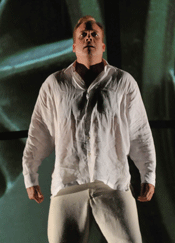 William Burden as Hippolytus
The work contains autobiographical resonances. Henze, in the classic mode of German Romantics, moved in later life to Italy—by chance, close to the spot where these mythical events are said to have occurred. He had finished Act One when he suddenly fell into a coma for several months. He was expected to die, but suddenly recovered. Seemingly revitalized, he wrote Act Two, with its theme of reincarnation.
All this is reflected in Henze’s luminous, precisely constructed score. Those familiar with his most famous operas, written in the 1960s when he was engaged in broader social and intellectual causes, will note that the mode of expression here is more private. One encounters neither the intricate and dramatic interactions among the characters in Elegy for Young Lovers, nor the symphonic sweep and struggle with implacable fate before a Greek chorus of Die Bassariden. The characters in Phaedra barely take notice of one another or the society around them. The dramatic focus lies instead on their interior monologues.
Consistent with its private, existential emphasis, Phaedra is delicately scored for five singers and an orchestra of 23 players. Yet it is miraculously varied, evocative and often sensuous writing of a mature master. The style is influenced, as always with Henze, by the second Viennese school—one key reference being Alban Berg’s Lulu—with clearly audible elements of Schönberg’s serialism, Stravinsky’s neo-classicism, Britten’s sound-world, and Weill.
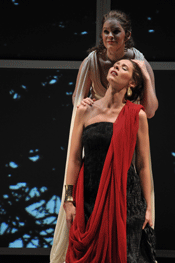 Elizabeth Reiter (standing) as Aphrodite with mezzo-soprano Tamara Mumford (kneeling) as Phaedra
Henze makes this all distinctively his own, creating unforgettable moments. Phaedra and Hippolytus’s early dawn wanderings in the forest are introduced by a sinuous duet for alto saxophone and English horn. The apex of the opera, when Hippolytus questions his identity, is followed by the most magically subtle suggestion of an orchestral storm: a brooding cello, swirling woodwinds, and a light, almost Japanese, rainstorm of solo percussion. The final scene, expressing the moral that we should dance our way through life rather than hunting (or being hunted) in the labyrinth, wittily echoes the finales of classic Baroque or Mozart opera.
Such writing imposes enormous technical and interpretive demands. Complex, largely atonal passages, subtle shifts in dynamics and meter, and a wide range of refined timbres must be performed in a limpid and fluid manner.
In Philadelphia, four outstanding young American singers take the leads. Phaedra is movingly sung by young mezzo-soprano Tamara Mumford. Her uncommonly expressive voice has increased in size since her successful Lucretia in Philadelphia two years ago—almost to the limits of the role—yet retains its plangent edge. Her elegant physical beauty perfectly suits aristocratic women in uncomfortable circumstances, such as Lucretia and Phaedra.
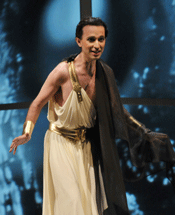 Anthony Roth Costanzo as Artemis
Anthony Roth Costanzo, the leading American countertenor of his generation, assumes the role of Artemis with clarity, precision and occasionally seductive charm. His voice has also grown in recent years, perhaps—as with Mumford—the result of singing at the Met.
William Burden, another returnee from the 2009 Lucretia, sings Hippolytus with passion, musicality, and dramatic impact. To be sure, some might object that the role of Hippolytus calls for less virility and a cooler and more focused tone production—John Mark Ainsley sang the European premiere to perfection—but Burden slims down to a ravishing “mixed voice” when it matters most, as in the Act II scene starting “Bin ich ein Vogel…”
Henze’s meandering, atonal phrases are murderously difficult to sing precisely on pitch. Only Elizabeth Reiter, who sings Aphrodite, is fully up to the task (though Costanzo comes close). Singing spot on pitch, she brings the music suddenly into focus, revealing its Mozartian naturalness and grace. It is hard to believe Reiter is a still a graduate student at Curtis—albeit one already boasting Tanglewood, Carnegie Hall, and European credits. Jeremy Milner is vocally and physically imposing in the cameo role of the Minotaur.
For all the vocal splendor—reinforced by the small confines of the Kimmel Center’s Perelman Theater—the musical preparation is not uniformly idiomatic. Both singers and orchestral players might take fuller advantage of extensive dynamic markings in the score. And only Costanzo consistently communicates of the eclectic pedigree of this music: where, for example, are the Cabaret influences in Phaedra’s Weill-inspired Act II seduction scene? German diction, though uniformly intelligible, remains uneven. Vocal trills go missing. Some questionable orchestral intonation mars Act II, and orchestral detail under Music Director Corrado Rovaris is lost. Yet such issues may resolve themselves out during the 5-performance run of what is an extremely difficult work.
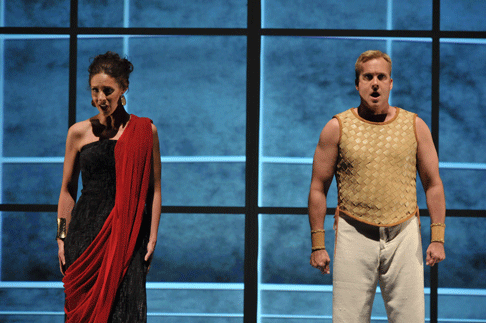 Tamara Mumford as Phaedra with tenor William Burden as Hippolytus
A more serious problem is that the visual treatment falls well short of the high musical standard. The basic concept of the production is promising: abstract, geometrical panels on which projections appear and in front of which a large cage descends in Act Two to entrap Hippolytus. Yet the costumes, make-up and stage direction fail to capture the mysterious essence of this opera. In part this is because much of the production does not engage Henze’s explicit instructions. One would never know that in the finale of Act One, Henze’s score brutally confronts the audience with Phaedra’s death: “The bang of a trap door. Phaedra hangs from a rope.” In the final scene of Act Two, the stage directions read: “In the background, the Minotaur dances,” evoking the archaic strangeness of the libretto, as well as its aspiration to reconceive two millennia of the Western tradition.
Such instructions need not be followed to the letter, but the lowest-common-denominator realism of the Philadelphia staging—characters in realistic costumes, little make-up and no masks, with pictures of birds and trees behind them—seems banal and earthbound in a way fundamentally at odds with the opera’s spirit. Expressionism or abstraction might better convey that Henze’s characters are not, in the end, real people, but archetypes engaged with central issues of Western culture.
Ultimately, however, the Opera Company of Philadelphia has rightly chosen to emphasize first and foremost the music. Phaedra is a miraculous musical achievement that combines the freshness of youth with the wisdom and skill of old age. An opportunity to hear voices of this quality in a work of this significance should not be missed.
Andrew Moravcsik