![Brindley Sherratt as Jacopo Fiesco [Photo by Mike Hoban courtesy of English National Opera]](http://www.operatoday.com/Simon-Boccanegra_Brindley-S.gif)
14 Jun 2011
Simon Boccanegra, ENO
It would seem that in his preparations for this new production of Simon Boccanegra, the acclaimed Russian director, Dmitri Tcherniakov, has been familiarising himself Jonathan Miller’s previous ENO efforts.
English Touring Opera are delighted to announce a season of lyric monodramas to tour nationally from October to December. The season features music for solo singer and piano by Argento, Britten, Tippett and Shostakovich with a bold and inventive approach to making opera during social distancing.
This tenth of ten Live from London concerts was in fact a recorded live performance from California. It was no less enjoyable for that, and it was also uplifting to learn that this wasn’t in fact the ‘last’ LfL event that we will be able to enjoy, courtesy of VOCES8 and their fellow vocal ensembles (more below …).
Ever since Wigmore Hall announced their superb series of autumn concerts, all streamed live and available free of charge, I’d been looking forward to this song recital by Ian Bostridge and Imogen Cooper.
The Sixteen continues its exploration of Henry Purcell’s Welcome Songs for Charles II. As with Robert King’s pioneering Purcell series begun over thirty years ago for Hyperion, Harry Christophers is recording two Welcome Songs per disc.
Although Stile Antico’s programme article for their Live from London recital introduced their selection from the many treasures of the English Renaissance in the context of the theological debates and upheavals of the Tudor and Elizabethan years, their performance was more evocative of private chamber music than of public liturgy.
In February this year, Albanian soprano Ermonela Jaho made a highly lauded debut recital at Wigmore Hall - a concert which both celebrated Opera Rara’s 50th anniversary and honoured the career of the Italian soprano Rosina Storchio (1872-1945), the star of verismo who created the title roles in Leoncavallo’s La bohème and Zazà, Mascagni’s Lodoletta and Puccini’s Madama Butterfly.
Evidently, face masks don’t stifle appreciative “Bravo!”s. And, reducing audience numbers doesn’t lower the volume of such acclamations. For, the audience at Wigmore Hall gave soprano Elizabeth Llewellyn and pianist Simon Lepper a greatly deserved warm reception and hearty response following this lunchtime recital of late-Romantic song.
Collapsology. Or, perhaps we should use the French word ‘Collapsologie’ because this is a transdisciplinary idea pretty much advocated by a series of French theorists - and apparently, mostly French theorists. It in essence focuses on the imminent collapse of modern society and all its layers - a series of escalating crises on a global scale: environmental, economic, geopolitical, governmental; the list is extensive.
For this week’s Live from London vocal recital we moved from the home of VOCES8, St Anne and St Agnes in the City of London, to Kings Place, where The Sixteen - who have been associate artists at the venue for some time - presented a programme of music and words bound together by the theme of ‘reflection’.
'Such is your divine Disposation that both you excellently understand, and royally entertaine the Exercise of Musicke.’
Amongst an avalanche of new Mahler recordings appearing at the moment (Das Lied von der Erde seems to be the most favoured, with three) this 1991 Mahler Second from the 2nd Kassel MahlerFest is one of the more interesting releases.
‘And there was war in heaven: Michael and his angels fought against the dragon; and the dragon fought and his angels, And prevailed not; neither was their place found any more in heaven … that old serpent … Satan, which deceiveth the whole world: he was cast out into the earth, and his angels were cast out with him.’
If there is one myth, it seems believed by some people today, that probably needs shattering it is that post-war recordings or performances of Wagner operas were always of exceptional quality. This 1949 Hamburg Tristan und Isolde is one of those recordings - though quite who is to blame for its many problems takes quite some unearthing.
There was never any doubt that the fifth of the twelve Met Stars Live in Concert broadcasts was going to be a palpably intense and vivid event, as well as a musically stunning and theatrically enervating experience.
‘Love’ was the theme for this Live from London performance by Apollo5. Given the complexity and diversity of that human emotion, and Apollo5’s reputation for versatility and diverse repertoire, ranging from Renaissance choral music to jazz, from contemporary classical works to popular song, it was no surprise that their programme spanned 500 years and several musical styles.
The Academy of St Martin in the Fields have titled their autumn series of eight concerts - which are taking place at 5pm and 7.30pm on two Saturdays each month at their home venue in Trafalgar Square, and being filmed for streaming the following Thursday - ‘re:connect’.
The London Symphony Orchestra opened their Autumn 2020 season with a homage to Oliver Knussen, who died at the age of 66 in July 2018. The programme traced a national musical lineage through the twentieth century, from Britten to Knussen, on to Mark-Anthony Turnage, and entwining the LSO and Rattle too.
With the Live from London digital vocal festival entering the second half of the series, the festival’s host, VOCES8, returned to their home at St Annes and St Agnes in the City of London to present a sequence of ‘Choral Dances’ - vocal music inspired by dance, embracing diverse genres from the Renaissance madrigal to swing jazz.
Just a few unison string wriggles from the opening of Mozart’s overture to Le nozze di Figaro are enough to make any opera-lover perch on the edge of their seat, in excited anticipation of the drama in music to come, so there could be no other curtain-raiser for this Gala Concert at the Royal Opera House, the latest instalment from ‘their House’ to ‘our houses’.
"Before the ending of the day, creator of all things, we pray that, with your accustomed mercy, you may watch over us."
It would seem that in his preparations for this new production of Simon Boccanegra, the acclaimed Russian director, Dmitri Tcherniakov, has been familiarising himself Jonathan Miller’s previous ENO efforts.
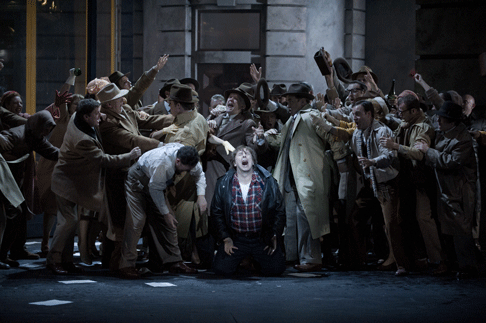
Not only did the set for the prologue, a town square in 1960s mafia-controlled Genoa, follow Miller’s Rigoletto in drawing on Edward Hopper’s ‘Nighthawks’, but it was also an urban variation of the desert diner design of Miller’s 2009 L’elisir d’amore.
As trench-coated gangster, trilbies inclined to mask their plotting and intriguing, gathered in a night-time café, and Graham-Greene-esque figures lurked menacingly on street corners, a stylish car rolled in from stage right, and then proceeded to flash its lights unceasingly — and headache-inducingly — for the entire prologue.
Certainly the designs for this prologue were by far the most engaging, and dramatically relevant, of the evening. When we whizzed on twenty-five years (or, in this production, perhaps forty years) for Act 1, minimalism took over from realism — although the assault on the audience’s eyes continued, this time in the form of a glaring white square on the bleak, black back wall. The Grimaldi household was a sparse and modernist affair: one white arm-chair, one wall painting. In fact, the latter had occasioned the most surprising and exciting moment of the production, when the final tableau of the Genoan street scene was electronically transferred to a stage drop and electronically shrunk, rapidly receding only to reappear as a pictorial memory of the past on the wall of the family home.
In the final two acts, a featureless, grey, rather underequipped committee room, in a bland corporate command centre, replaced the majestic Doge’s place of the original scenario. The fully functioning wall clock suggested a countdown to crisis, but why did the various stages of action commence at seeming random hours thereby destroying the realism? There were many other non sequiturs: doors which were immovably fixed, but then swung freely open; a text (translation by James Fenton) which spoke of ‘swords’ as the gangsters brandished their steel hand guns. Motifs and ideas were introduced but not developed: so, having decided to update the action almost to the modern day, Tcherniakov seemed to lost interest in pursuing real-life parallels after the prologue — a pity, as there is plenty of potential for highlighting modern-day coups d’état , given recent history and even the contemporary ‘Arab Spring’. Moreover, the costumes did little to add to the impression that this was a serious attempt to portray political power struggles: Adorno’s biker’s leathers and Amelia’s grungy Doc-Martens jarred with the endless grey suits, and I’d be grateful for an explanation as to why Boccanegra sported a ludicrous paper hat on his head during his final decline?
I’m not sure that Tcherniakov was really interesting in engaging his audience. He frequently placed his characters to the rear or edges of the stage, or with their backs to the auditorium; and, it was unclear at times whether characters sharing the stage could or couldn’t see/hear each other. Add some inexplicable stage business — the desperate wrestling over Maria’s dead body which was almost ripped apart in a tug-of-war between Boccanegra and the patriacians; Paolo’s cartoonish writhing and squirming when, alone on stage at the end of Act 1 Scene 1, he bitterly conjures up his dastardly plot; the final tussle between Amelia and her new husband, Adorno, with the plebs joining in the fisticuffs as the curtain fell — and the overall vision was incomprehensible.
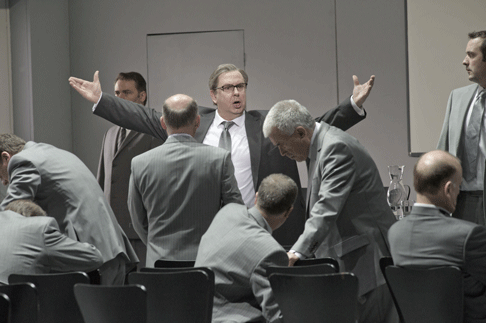
Perhaps Tcherniakov thought that because the plot is so notoriously complicated that such details would not matter. Indeed, he tried to help us follow the action by projecting the unfolding readout of a tele-printer onto the stage drop before each act or scene. These were indeed useful at times, but, presumably to cover a tricky scene stage, an overly explanation after the prologue caused the action to stagnate, diminishing the musico-dramatic momentum which has been so skilfully built by conductor, Edward Gardner. And, there are inherent dangers in highlighting the libretto’s more ridiculous moments: an inevitable audience chuckle accompanied the bald statements, in successful sentences, that Amelia had been abducted, but … she had now managed to escape. There are many awkward ‘fudges’ in the text, and they are probably best ignored — the music should make the narrative and emotional drama clear.
Thank goodness, then, that the music and much of the singing were top notch. As the eponymous champion of the people, Bruno Caproni — after an underwhelming start during which an over-indulgent vibrato muddled the intonation — grew in stature, and in his final poignant portrayal of regret revealed an expressive, flexible voice of pleasing tone. His diction was superb throughout, even when he was placed in the margins or at the rear of the stage. Roland Wood, as Paolo, also took some time to get into his stride, but produced a strong performance in the final Act. Peter Auty and Rena Harms were musically effective but not entirely suited dramatically to their roles as Adorno and Ameila. Both exhibited brightness and lightness at the top of their registers, but lacked some of the gravity required; Harms struggled to convey the developing complexities of Amelia’s character as her knowledge and understanding of her past and present increase, while Auty had tuning some problems during his big moments.
Best of the bunch was Brindley Sharratt’s Fiesco; although Fiesco was clutching an asthmatic’s inhaler, he clearly suffered no problems with his lungs, and produced a powerful tone which carried the clearly articulated to the farthest reaches of the house. Despite his vengeful plotting, with its tragic consequences, Sharratt won the audience’s sympathy, and the final duet between Fiesco and the faltering Boccanegra was immensely moving.
But the loudest applause of the night was deservedly awarded to Edward Gardner and the ENO orchestra. Gardner gradually ratcheted up the musical and dramatic tension, controlling the broader structures with a masterful sweep. The way he whipped the chorus from pianissimos to fiery climaxes was astounding. Sensitive to the needs of the drama, and individual singers, he also allowed the instrumentalists free rein when it was the turn of the score to carry the responsibility for the expressive drama. It was a relief that at least someone was able to make a coherent unity of the work.
Claire Seymour