03 Jun 2011
The Metropolitan Opera HD Live on DVD
Since 2006, movie cineplexes across the USA have attracted a somewhat unlikely crowd for Saturday matinees, from fall to spring.
English Touring Opera are delighted to announce a season of lyric monodramas to tour nationally from October to December. The season features music for solo singer and piano by Argento, Britten, Tippett and Shostakovich with a bold and inventive approach to making opera during social distancing.
This tenth of ten Live from London concerts was in fact a recorded live performance from California. It was no less enjoyable for that, and it was also uplifting to learn that this wasn’t in fact the ‘last’ LfL event that we will be able to enjoy, courtesy of VOCES8 and their fellow vocal ensembles (more below …).
Ever since Wigmore Hall announced their superb series of autumn concerts, all streamed live and available free of charge, I’d been looking forward to this song recital by Ian Bostridge and Imogen Cooper.
The Sixteen continues its exploration of Henry Purcell’s Welcome Songs for Charles II. As with Robert King’s pioneering Purcell series begun over thirty years ago for Hyperion, Harry Christophers is recording two Welcome Songs per disc.
Although Stile Antico’s programme article for their Live from London recital introduced their selection from the many treasures of the English Renaissance in the context of the theological debates and upheavals of the Tudor and Elizabethan years, their performance was more evocative of private chamber music than of public liturgy.
In February this year, Albanian soprano Ermonela Jaho made a highly lauded debut recital at Wigmore Hall - a concert which both celebrated Opera Rara’s 50th anniversary and honoured the career of the Italian soprano Rosina Storchio (1872-1945), the star of verismo who created the title roles in Leoncavallo’s La bohème and Zazà, Mascagni’s Lodoletta and Puccini’s Madama Butterfly.
Evidently, face masks don’t stifle appreciative “Bravo!”s. And, reducing audience numbers doesn’t lower the volume of such acclamations. For, the audience at Wigmore Hall gave soprano Elizabeth Llewellyn and pianist Simon Lepper a greatly deserved warm reception and hearty response following this lunchtime recital of late-Romantic song.
Collapsology. Or, perhaps we should use the French word ‘Collapsologie’ because this is a transdisciplinary idea pretty much advocated by a series of French theorists - and apparently, mostly French theorists. It in essence focuses on the imminent collapse of modern society and all its layers - a series of escalating crises on a global scale: environmental, economic, geopolitical, governmental; the list is extensive.
For this week’s Live from London vocal recital we moved from the home of VOCES8, St Anne and St Agnes in the City of London, to Kings Place, where The Sixteen - who have been associate artists at the venue for some time - presented a programme of music and words bound together by the theme of ‘reflection’.
'Such is your divine Disposation that both you excellently understand, and royally entertaine the Exercise of Musicke.’
Amongst an avalanche of new Mahler recordings appearing at the moment (Das Lied von der Erde seems to be the most favoured, with three) this 1991 Mahler Second from the 2nd Kassel MahlerFest is one of the more interesting releases.
‘And there was war in heaven: Michael and his angels fought against the dragon; and the dragon fought and his angels, And prevailed not; neither was their place found any more in heaven … that old serpent … Satan, which deceiveth the whole world: he was cast out into the earth, and his angels were cast out with him.’
If there is one myth, it seems believed by some people today, that probably needs shattering it is that post-war recordings or performances of Wagner operas were always of exceptional quality. This 1949 Hamburg Tristan und Isolde is one of those recordings - though quite who is to blame for its many problems takes quite some unearthing.
There was never any doubt that the fifth of the twelve Met Stars Live in Concert broadcasts was going to be a palpably intense and vivid event, as well as a musically stunning and theatrically enervating experience.
‘Love’ was the theme for this Live from London performance by Apollo5. Given the complexity and diversity of that human emotion, and Apollo5’s reputation for versatility and diverse repertoire, ranging from Renaissance choral music to jazz, from contemporary classical works to popular song, it was no surprise that their programme spanned 500 years and several musical styles.
The Academy of St Martin in the Fields have titled their autumn series of eight concerts - which are taking place at 5pm and 7.30pm on two Saturdays each month at their home venue in Trafalgar Square, and being filmed for streaming the following Thursday - ‘re:connect’.
The London Symphony Orchestra opened their Autumn 2020 season with a homage to Oliver Knussen, who died at the age of 66 in July 2018. The programme traced a national musical lineage through the twentieth century, from Britten to Knussen, on to Mark-Anthony Turnage, and entwining the LSO and Rattle too.
With the Live from London digital vocal festival entering the second half of the series, the festival’s host, VOCES8, returned to their home at St Annes and St Agnes in the City of London to present a sequence of ‘Choral Dances’ - vocal music inspired by dance, embracing diverse genres from the Renaissance madrigal to swing jazz.
Just a few unison string wriggles from the opening of Mozart’s overture to Le nozze di Figaro are enough to make any opera-lover perch on the edge of their seat, in excited anticipation of the drama in music to come, so there could be no other curtain-raiser for this Gala Concert at the Royal Opera House, the latest instalment from ‘their House’ to ‘our houses’.
"Before the ending of the day, creator of all things, we pray that, with your accustomed mercy, you may watch over us."
Since 2006, movie cineplexes across the USA have attracted a somewhat unlikely crowd for Saturday matinees, from fall to spring.
Instead of adolescents or youngsters and their parents shambling in to see the latest animated feature or some popular action/horror movie, a polite, more “senior” audience appears (often quite early) for a live simulcast in high-definition from the Metropolitan Opera’s home in Lincoln Center. Earlier attempts of this sort of media exploration had never really been much of a success, making the “Met Live in HD” venture something of a risk. In this case, the bet has paid off, and the so-called moviecasts have become a phenomenon, at least in the world of opera. The number of presentations has increased, the number of theaters hosting the shows has multiplied, and later “encore” showings are part of the program now as well. That first live moviecast remains the biggest draw, as most anyone who has attended one of the movie theater showings can attest that somehow at least some of the energy and atmosphere of the actual live performance manages to get conveyed, even in some suburban multiplex hundreds and hundreds of miles from NYC.
The fact that these moviecasts end up on PBS within a few months (although erratically scheduled) and then eventually on store shelves in DVD format has done nothing to slow the program’s expansion and success. Viewing five of the Met Live in HD moviecasts in their DVD equivalents offers reasons for that. Although the DVDs have at least some of the intermission features and begin with the backstage introductions by one or another of the Met’s singing stars, a true “live” feeling is absent once the opera proper begins. The viewer is left with somewhat ordinary operatic DVD viewing — with the expected variable successes in singing, production, and musical performance. The optimal way to enjoy these performances would have been to see them at Lincoln Center, but the definite next best would be the live HD moviecast. After that, the magic dissipates.
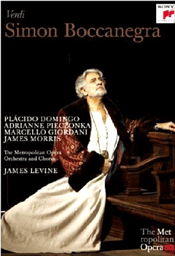
Start with the Sony DVD of the Met Live in HD series’s Simon Boccanegra, filmed on February 6, 2010. In a brief interview conducted by Renee Fleming, conductor James Levine speaks of his high regard for the opera and suggests it is no surprise to him that tenor Placido Domingo would, at this point in his career, take on the title role, which Verdi wrote for a baritone. For all the talk of the “baritonal” timbre of Domingo’s voice, what is striking about his vocalism as Boccanegra is how bright and high-placed he makes so much of the music for his character sound. Duets with a low voice such as that of James Morris, as Boccanegra’s adversary Fiesco, have a tint of Otello and Iago facing off. What cannot be questioned is Domingo’s identification with the role, where he is able to indulge his passion for enduring emotional, if not physical, pain on stage. He projects dignity at all times, however, which strengthens his portrayal. Up against a wily veteran such as Morris, Domingo raises this performance to a high level. The rest of the cast does not reach that elevation. A fine soprano, Adrianne Pieczonka is miscast as Amelia, her solid, hefty soprano sounding blustery and forced. A favorite tenor of the Met, Marcello Giordani is at his best when he can power through a role, and the male ingénue role of Gabriele Adorno gives him few such opportunities. The production of Giancarlo del Monaco would have been at home at the Metropolitan a quarter century ago. Handsome, detailed, almost monolithic in its high walls and expanse, it would be perfectly appropriate for an opera with a more believable narrative. The greatness of the opera, however, is not in its plot but in its score, which Levine and his orchestra play with taste and expertise. Still, when Morris and Domingo are not on stage, the performance drags.
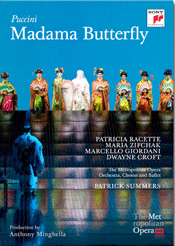
Not dragging at all is the Madama Butterfly in the late Anthony Minghella’s acclaimed production. Here a viewer can regret the TV director’s propensity for close-ups, as the total stage picture offers the greatest reward. Minghella, lighting designer Peter Mumford and set designer Michael Levine put on a master class of how to create dramatically cogent and visually arresting stage pictures on a stark set, through color and effective use of minimal props. The one controversy of the production centered on the decision to use a puppet for Sorrow, Butterfly’s child (puppet theater being a cultural and theatrical tradition in Japan). Viewers will make up their own minds about this, but for your reviewer, the puppet fits perfectly into the theatrical techniques of the entire show and has an impact often absent from productions which use an older child than the libretto indicates.
A strong cast exhibits high professionalism, if lacking in the aura on inspiration that makes for truly great performances. Patricia Racette’s soprano can begin to wobble under pressure, and your reviewer, like some others, finds something external, or generic, about her acting. But this is one of her best total performances, no doubt. Much the same goes for Marcello Giordani, who gives us a strong portrayal of the classic very-Italian B. F Pinkerton. Dwayne Croft’s Sharpless and Maria Zifchak as Suzuki give fine support. Reliability would seem to be the key word for conductor Patrick Summers, but one only has to endure one less than reliably conducted performance to understand the virtues of a conductor such as Summers. He does well by Puccini’s magnificent score.
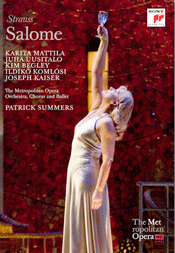
Summers has the baton again for the October 11th, 2008 recording of Richard Strauss’s Salome. One might have hoped for some more distinctive musical leadership. When Karita Mattila first took on this role at the Met in Jürgen Flimm’s spooky, modern dress staging, she sang for Valery Gergiev, and the radio broadcast gave evidence of the visceral excitement of those performances. Years later, in 2008, Mattila is working with slightly less secure vocal resources, but the brazen aggression of her princess still makes for a startling show. She also had Bryn Terfel as her Jochannan in that earlier run. Here Juha Uusitalo takes the role, and he cannot match the stage charisma or vocal authority of Terfel. Some viewers may be grateful that neither Kim Begley as Herod nor Ildikó Komlósi as Herodias overact in their roles, as singers in many another production have, but sometimes it is that extra element of risk that adds to the total frenzy a great Salome can produce. This production, therefore, ranks as respectable, rather than great. Too bad the cameras were not there in 2002, for that first run.
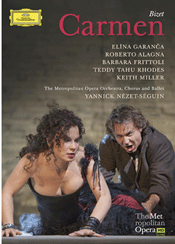
A strongly conducted performance appears in the Carmen, with Yannick Nézet-Séguin bringing out distinct colors and etching a sharp rhythmic profile. He has two superior leads — the well-established exuberance and commitment of tenor Roberto Alagna as Don José, and the warm, sensuous tones of mezzo Elīna Garanča. Often one reads references to the “clichés” of a Carmen portrayal, but any performance that doesn’t acknowledge what the libretto establishes — the sensuality and wildness that make Carmen stand out — won’t pass muster. Garanča herself, even in a dark wig, doesn’t have to stretch to evoke this reputation, and the intelligence with which she sings the role cuts against any cry of “cliché.” In the key supporting role, Barbara Frittoli manages to be beautiful and yet clearly not much competition for the Carmen, especially as the soprano needs time to warm up and even then, a persistent beat appears in higher lines.
Richard Eyre’s staging was new to the Metropolitan when filmed in January 2010, and while far from innovative or evocative, the sets establish the sultry, threatening mood of the piece, and scene changes are easily accomplished. A performance of this quality reminds everyone of why this masterpiece never loses its appeal.
For all the above titles, numerous competitors on DVD might lay claim to being superior in one category or another. For John Adams’s Dr. Atomic, the only DVD competition also features Gerald Finley in the title role — the Peter Sellars staging of the premiere production (originally seen at San Francisco Opera, later filmed at De Nederlandse Opera). For the Metropolitan Opera , Penny Woodcock took over the production responsibility. Her work is more formal and naturalistic than what Sellars opted for, but it has enough stylization to support the atmospheric effects of Adams’s score. Seeing this opera again (your reviewer caught the premiere run in San Francisco, twice), the strengths seem just as distinctive as ever, but the weaknesses only grow more persistent. The libretto seems to be modeled on Nixon in China, with Oppenheimer a more sympathetic figure than Nixon, but just as troubled and conflicted, and with Kitty Oppenheimer (Sasha Cooke) being the equivalent of Nixon’s sadly sympathetic Pat Nixon. There is even a comic villain character to match Nixon’s Kissinger in General Leslie Groves (an excellent Eric Owens here), with tints of that same color in Richard Paul Fink’s Edward Teller. But Sellars’s libretto remains a mish-mash of various prose and verse texts, so that unity Alice Goodman brought to the Nixon libretto fails to appear.
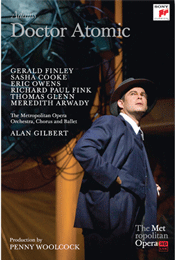
Whatever one’s opinion about Dr. Atomic, the DVD has to be seen to catch Finley’s great performance of the title role, caught at its zenith at the end of act one, in the solo of Donne’s “Batter My Heart.” New York Philharmonic conductor Alan Gilbert crossed the plaza to conduct, and he finds all the idiosyncratic power of Adams’s score. Your reviewer has his doubts about the long-term prospects for the work, but Finley’s performance will always be worth viewing.
The 2010-2011 Metropolitan Opera season of Met in HD moviecasts will undoubtedly all be out on DVD soon enough. However, the real treat lies ahead, when the 2011-2012 season opens in movie theaters — that’s where the glory of this venture lies.
Chris Mullins