![Martina Serafin as Tosca [Photo by Catherine Ashmore courtesy of Royal Opera House]](http://www.operatoday.com/TOSCA.2484ashm_0265.gif)
12 Jun 2011
Tosca, Covent Garden
The current Tosca at the Royal Opera House is something of a classic, revived four times in five years. It’s now being filmed for cinema to be released in November 2011.
English Touring Opera are delighted to announce a season of lyric monodramas to tour nationally from October to December. The season features music for solo singer and piano by Argento, Britten, Tippett and Shostakovich with a bold and inventive approach to making opera during social distancing.
This tenth of ten Live from London concerts was in fact a recorded live performance from California. It was no less enjoyable for that, and it was also uplifting to learn that this wasn’t in fact the ‘last’ LfL event that we will be able to enjoy, courtesy of VOCES8 and their fellow vocal ensembles (more below …).
Ever since Wigmore Hall announced their superb series of autumn concerts, all streamed live and available free of charge, I’d been looking forward to this song recital by Ian Bostridge and Imogen Cooper.
The Sixteen continues its exploration of Henry Purcell’s Welcome Songs for Charles II. As with Robert King’s pioneering Purcell series begun over thirty years ago for Hyperion, Harry Christophers is recording two Welcome Songs per disc.
Although Stile Antico’s programme article for their Live from London recital introduced their selection from the many treasures of the English Renaissance in the context of the theological debates and upheavals of the Tudor and Elizabethan years, their performance was more evocative of private chamber music than of public liturgy.
In February this year, Albanian soprano Ermonela Jaho made a highly lauded debut recital at Wigmore Hall - a concert which both celebrated Opera Rara’s 50th anniversary and honoured the career of the Italian soprano Rosina Storchio (1872-1945), the star of verismo who created the title roles in Leoncavallo’s La bohème and Zazà, Mascagni’s Lodoletta and Puccini’s Madama Butterfly.
Evidently, face masks don’t stifle appreciative “Bravo!”s. And, reducing audience numbers doesn’t lower the volume of such acclamations. For, the audience at Wigmore Hall gave soprano Elizabeth Llewellyn and pianist Simon Lepper a greatly deserved warm reception and hearty response following this lunchtime recital of late-Romantic song.
Collapsology. Or, perhaps we should use the French word ‘Collapsologie’ because this is a transdisciplinary idea pretty much advocated by a series of French theorists - and apparently, mostly French theorists. It in essence focuses on the imminent collapse of modern society and all its layers - a series of escalating crises on a global scale: environmental, economic, geopolitical, governmental; the list is extensive.
For this week’s Live from London vocal recital we moved from the home of VOCES8, St Anne and St Agnes in the City of London, to Kings Place, where The Sixteen - who have been associate artists at the venue for some time - presented a programme of music and words bound together by the theme of ‘reflection’.
'Such is your divine Disposation that both you excellently understand, and royally entertaine the Exercise of Musicke.’
Amongst an avalanche of new Mahler recordings appearing at the moment (Das Lied von der Erde seems to be the most favoured, with three) this 1991 Mahler Second from the 2nd Kassel MahlerFest is one of the more interesting releases.
‘And there was war in heaven: Michael and his angels fought against the dragon; and the dragon fought and his angels, And prevailed not; neither was their place found any more in heaven … that old serpent … Satan, which deceiveth the whole world: he was cast out into the earth, and his angels were cast out with him.’
If there is one myth, it seems believed by some people today, that probably needs shattering it is that post-war recordings or performances of Wagner operas were always of exceptional quality. This 1949 Hamburg Tristan und Isolde is one of those recordings - though quite who is to blame for its many problems takes quite some unearthing.
There was never any doubt that the fifth of the twelve Met Stars Live in Concert broadcasts was going to be a palpably intense and vivid event, as well as a musically stunning and theatrically enervating experience.
‘Love’ was the theme for this Live from London performance by Apollo5. Given the complexity and diversity of that human emotion, and Apollo5’s reputation for versatility and diverse repertoire, ranging from Renaissance choral music to jazz, from contemporary classical works to popular song, it was no surprise that their programme spanned 500 years and several musical styles.
The Academy of St Martin in the Fields have titled their autumn series of eight concerts - which are taking place at 5pm and 7.30pm on two Saturdays each month at their home venue in Trafalgar Square, and being filmed for streaming the following Thursday - ‘re:connect’.
The London Symphony Orchestra opened their Autumn 2020 season with a homage to Oliver Knussen, who died at the age of 66 in July 2018. The programme traced a national musical lineage through the twentieth century, from Britten to Knussen, on to Mark-Anthony Turnage, and entwining the LSO and Rattle too.
With the Live from London digital vocal festival entering the second half of the series, the festival’s host, VOCES8, returned to their home at St Annes and St Agnes in the City of London to present a sequence of ‘Choral Dances’ - vocal music inspired by dance, embracing diverse genres from the Renaissance madrigal to swing jazz.
Just a few unison string wriggles from the opening of Mozart’s overture to Le nozze di Figaro are enough to make any opera-lover perch on the edge of their seat, in excited anticipation of the drama in music to come, so there could be no other curtain-raiser for this Gala Concert at the Royal Opera House, the latest instalment from ‘their House’ to ‘our houses’.
"Before the ending of the day, creator of all things, we pray that, with your accustomed mercy, you may watch over us."
The current Tosca at the Royal Opera House is something of a classic, revived four times in five years. It’s now being filmed for cinema to be released in November 2011.
The film will feature Angela Gheorghiu, Bryn Terfel and Jonas Kaufmann, all of whom have sung in this production before — Gheorghiu and Terfel together in 2006 and 2009, and Kaufmann for the first time in 2008.
The current season started, however, with an alternate cast — Marcelo Giordano, Juha Uusitalo and Martina Serafin. Giordano sang Cavaradossi in 2006, and with Gheorghiu and Terfel in 2009, so he’s experienced in the role. On the first night of the run, he had intonation problems to start with, but settled well, only to have his voice break badly in the crucial Act Three arias. No-one regrets it more than the singer himself, when “E muoio disperato!” comes out more desperate than it should be. But such things happen, even to very experienced singers. In any case, this audience didn’t seem to mind and applauded him warmly. Tosca is such a glorious opera that it’s always a good night out even when it’s not perfect.
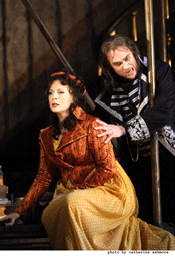 Martina Serafin as Tosca and Juha Uusitalo as Scarpia
Juha Uusitalo was making his Royal Opera House debut, though he’s appeared all over Europe and in the US, and in concert performances in London. His Scarpia is interesting, more subtle and introspective than some, but that’s a perfectly valid interpretation of the role. Tosca wears her heart on her sleeve, but Scarpia has risen to power by concealing his. Scarpia is a cold-blooded hunter who doesn’t reveal himself, but Uusitalo’s tightly controlled phrases and brisk intonation suggest the tension that might lie within the charcater.He’s so used to being in command that he can silence the commotion in church by a swift glance and a sarcastic phrase “Bel rispetto!”. Uusitalo ‘s stage presence carries authority even when he’s not singing.
Martina Serafin has created Tosca in Vienna, Rome and Taormina. She’s charming and the London audience delighted in her coquettish Act One jealousy. Tosca, however, is a much more complex personality, and the jealousy can be a glimpse of much greater violence in the character. Whether it’s Serafin or the revival direction (Duncan Macfarlane) the murder scene is a curious anticlimax. The orchestra wells up, as the music’s expressing extreme alarm. Serafin leans against Uusitalio, but so politely that if you didn’t know, you’d wonder why he drops to the ground in agony.
In contrast, Jeremy White’s Sacristan was very animated, reflecting the subtle changes in mood as the Sacristan interacts with different people. As whole mayhem breaks out around him, the Sacristan is anchored, sensitive to others, but sensible. Another contrast to Tosca, but without Scarpia’s menace,
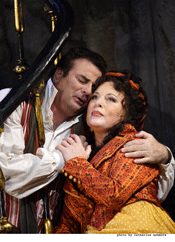 Marcello Giordani as Cavaradossi and Martina Serafin as Tosca
Hubert Francis’s Spoletta worked well with Uusitalo’s discreet Scarpia. Angelotti was Lukas Jakobski and Sciarrone was Zhengzhong Zhou, both members of the Jette Parker Young Artists Programme. The Shepherd Boy, William Payne, was a delight.
Usually, Antonio Pappano’s Puccini is superb, as he has the Puccini spirit in his soul, but at the first night performance even his irrepressible energy seemed to have deserted him. Just as the direction on stage seemed lifeless, the orchestral playing sounded like a rehearsal. Nonetheless, Pappano and the Royal Opera House orchestra are very good even when under par. In other houses this would have been fine, but we’re so used to excellence that average doesn’t excite.
One compensation was that it was an opportunity to study the scenery, which you can’t when performances are white hot. The scene in the church is brightly lit, with candles everywhere. On stage, attention is dissipated, but the scene could film well. Scarpia’s chambers reflect the grandeur of his status. Magnificent statues dwarf the singers, just as the opulence of the music shows up the tawdry proceedings in the plot.
The Final Act is most impressive of all. Gone are the trappings of worldly splendour. Cavaradossi now inhabits a stark no man’s land. The music gets to work its sinister magic without distraction. A man is seen getting dressed. He looks human and vulnerable, but when he’s in uniform he becomes a killing machine. The set is plain, but eloquent, for now there’s no room for manoeuvre. Even if Cavaradossi escaped, he wouldn’t be safe when news gets out of Scarpia’s death. Poor Tosca goes off the wall, in more ways than the obvious.
Tosca runs at the Royal Opera House, London until 17th July. Filming with the second cast starts on 14th July. For more information please see the Royal Opera House site.
Anne Ozorio