Recently in Performances
English Touring Opera are delighted to announce a season of lyric monodramas to tour nationally from October to December. The season features music for solo singer and piano by Argento, Britten, Tippett and Shostakovich with a bold and inventive approach to making opera during social distancing.
This tenth of ten Live from London concerts was in fact a recorded live performance from California. It was no less enjoyable for that, and it was also uplifting to learn that this wasn’t in fact the ‘last’ LfL event that we will be able to enjoy, courtesy of VOCES8 and their fellow vocal ensembles (more below …).
Ever since Wigmore Hall announced their superb series of autumn concerts, all streamed live and available free of charge, I’d been looking forward to this song recital by Ian Bostridge and Imogen Cooper.
Although Stile Antico’s programme article for their Live from London recital introduced their selection from the many treasures of the English Renaissance in the context of the theological debates and upheavals of the Tudor and Elizabethan years, their performance was more evocative of private chamber music than of public liturgy.
Evidently, face masks don’t stifle appreciative “Bravo!”s. And, reducing audience numbers doesn’t lower the volume of such acclamations. For, the audience at Wigmore Hall gave soprano Elizabeth Llewellyn and pianist Simon Lepper a greatly deserved warm reception and hearty response following this lunchtime recital of late-Romantic song.
For this week’s Live from London vocal recital we moved from the home of VOCES8, St Anne and St Agnes in the City of London, to Kings Place, where The Sixteen - who have been associate artists at the venue for some time - presented a programme of music and words bound together by the theme of ‘reflection’.
'Such is your divine Disposation that both you excellently understand, and royally entertaine the Exercise of Musicke.’
‘And there was war in heaven: Michael and his angels fought against the dragon; and the dragon fought and his angels, And prevailed not; neither was their place found any more in heaven … that old serpent … Satan, which deceiveth the whole world: he was cast out into the earth, and his angels were cast out with him.’
There was never any doubt that the fifth of the twelve Met Stars Live in Concert broadcasts was going to be a palpably intense and vivid event, as well as a musically stunning and theatrically enervating experience.
‘Love’ was the theme for this Live from London performance by Apollo5. Given the complexity and diversity of that human emotion, and Apollo5’s reputation for versatility and diverse repertoire, ranging from Renaissance choral music to jazz, from contemporary classical works to popular song, it was no surprise that their programme spanned 500 years and several musical styles.
The Academy of St Martin in the Fields have titled their autumn series of eight concerts - which are taking place at 5pm and 7.30pm on two Saturdays each month at their home venue in Trafalgar Square, and being filmed for streaming the following Thursday - ‘re:connect’.
The London Symphony Orchestra opened their Autumn 2020 season with a homage to Oliver Knussen, who died at the age of 66 in July 2018. The programme traced a national musical lineage through the twentieth century, from Britten to Knussen, on to Mark-Anthony Turnage, and entwining the LSO and Rattle too.
With the Live from London digital vocal festival entering the second half of the series, the festival’s host, VOCES8, returned to their home at St Annes and St Agnes in the City of London to present a sequence of ‘Choral Dances’ - vocal music inspired by dance, embracing diverse genres from the Renaissance madrigal to swing jazz.
Just a few unison string wriggles from the opening of Mozart’s overture to Le nozze di Figaro are enough to make any opera-lover perch on the edge of their seat, in excited anticipation of the drama in music to come, so there could be no other curtain-raiser for this Gala Concert at the Royal Opera House, the latest instalment from ‘their House’ to ‘our houses’.
"Before the ending of the day, creator of all things, we pray that, with your accustomed mercy, you may watch over us."
The doors at The Metropolitan Opera will not open to live audiences until 2021 at the earliest, and the likelihood of normal operatic life resuming in cities around the world looks but a distant dream at present. But, while we may not be invited from our homes into the opera house for some time yet, with its free daily screenings of past productions and its pay-per-view Met Stars Live in Concert series, the Met continues to bring opera into our homes.
Music-making at this year’s Grange Festival Opera may have fallen silent in June and July, but the country house and extensive grounds of The Grange provided an ideal setting for a weekend of twelve specially conceived ‘promenade’ performances encompassing music and dance.
There’s a “slide of harmony” and “all the bones leave your body at that moment and you collapse to the floor, it’s so extraordinary.”
“Music for a while, shall all your cares beguile.”
The hum of bees rising from myriad scented blooms; gentle strains of birdsong; the cheerful chatter of picnickers beside a still lake; decorous thwacks of leather on willow; song and music floating through the warm evening air.
Performances
![Nicky Spence [Photo by Richard Hubert Smith courtesy of English National Opera]](http://www.operatoday.com/Two_Boys_14.gif)
26 Jun 2011
Two Boys, ENO
You would have had to be deaf and blind — or perhaps just a very wise
monkey — not to have been aware that a young American composer called
Nico Muhly was about to open at the English National Opera in London last night
with a work called Two Boys.
Since late last year, it seems that the
personable and obviously multi-talented Muhly has been (pardon the allusion)
pushed down our throats from every media-angle, and by too many London hacks
anxious to maintain their street-cred in Twitter-land. This kind of media blitz
is obviously a two-edged sledgehammer: if the show bombs then everybody looks
somewhat foolish, if it achieves critical and/or box-office success (I suspect
the latter in this case) then we’ll probably get bombarded again all too
soon with the next wonder-kid of modern music. Ah well.
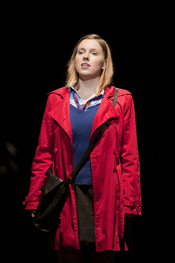 Mary Bevan
At the world premiere of Two Boys last night, (cleverly being
opened here and not at its co-pro alma mater of the Met) you would have been
forgiven for thinking that you had missed the date and wandered into London
Fashion Week. Everyone who had read all the supplements, all the tweets, all
the blogs and listened to the podcasts — or even just came on spec
because everyone else said they should — was there. It was achingly hip.
Never mind — we all want opera extending its audience so why not? It
probably swelled the coffers of the ENO champagne bar.
So how was it? Well, perhaps one should score it in TV Talent Show style and
take it from there:
Story: 6/10, Music: 6/10, Production: 6/10........you get the idea I expect.
Singers? Definitely 8/10, if only for commitment to the work, vocal
characterisation, and damn good acting within the limits of the production.
Craig Lucas has written a libretto that is based on a true news story of
some years ago about two boys, internet chat rooms, assumed identities and
attempted murder and this story — slight as it is in dramatic terms
— worked to a point. What was lacking was any depth of characterisation,
any motivations or emotional developments to give the piece structure. Maybe
that was part of the plan: certainly the waves of music that swirled and pulsed
and counterpointed the long articulated lines of speech/song didn’t
suggest much in the way of dramatic development or journey. Muhly’s work
is difficult to describe; his music is like high-class mood-music, or perhaps
those compositions carefully constructed and “written to picture”
for an expensive nature documentary. It doesn’t challenge the listener,
nor does it repel — but I doubt it delighted or surprised many either.
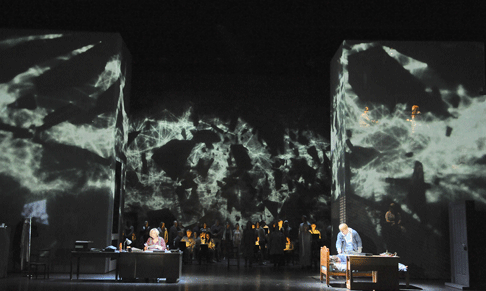 Susan Bickley and Nicky Spence
The singers were universally good: the core of the story lies with the
investigating police officer played by Susan Bickley (does she ever
disappoint?) who has demons of her own to confront as a stranger in the strange
land of her suspect’s virtual world of net friends. Her diction was
excellent and character well-drawn. That suspect, who we know as
“Brian”, is sung by young tenor Nicky Spence with a tremendous
empathy for this pathetic, unintelligent, bullied young man who’s flashes
of desperate anger at his uncomprehending parents just reinforce his weakness
and lack of self esteem. That excellent work was matched by the amazingly
confident performance of boy treble Joseph Beesley — one just hopes that
the calculated evil inherent in his character doesn’t leave too much of a
shadow. The many supporting roles were equally well presented and sung without
a single unhappy choice — and singers and orchestra (under Rumon Gamba)
seemed well-rehearsed and remarkably slick considering this was a first night
of an entirely new work.
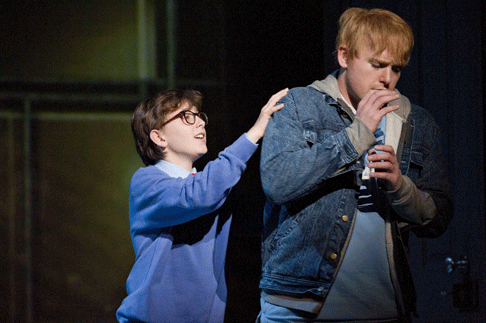 Joseph Beesley and Nicky Spence
On the production side, a few good ideas were made much of but could have
been given more emphasis — the video backdrops of world-wide internet
“chatting” — words repeating, and reappearing, and often
mirroring the actual sung words. Some of the best dramatic moments came with
the chorus spread around and above the stage suggesting the vast numbers of
internet chatters communicating endlessly and pointlessly from their sad
individual bedrooms. The graphic video work was good — but again could
have been so much more; in fact the whole production just felt as if it were
treading far too carefully, too “nicely” and was afraid of
upsetting anyone. All a bit anodyne, in essence. Perhaps they will push the
boat out a bit more for its New York premiere? Somehow, I doubt it.
Sue Loder.
Six more performances through June and July: see www.eno.org