![Antonio Vivaldi: La verità in cimento [Photo by Johan Persson courtesy of Garsington Opera Festival 2011]](http://www.operatoday.com/LaVeritainCimento_06.gif)
26 Jun 2011
Viva Vivaldi — Garsington Opera 2011
Garsington Opera — in its superb new home on the Wormsley estate in rural Oxfordshire — has yet again confirmed the merit of its decision to promote Vivaldi’s long-ignored operas.
English Touring Opera are delighted to announce a season of lyric monodramas to tour nationally from October to December. The season features music for solo singer and piano by Argento, Britten, Tippett and Shostakovich with a bold and inventive approach to making opera during social distancing.
This tenth of ten Live from London concerts was in fact a recorded live performance from California. It was no less enjoyable for that, and it was also uplifting to learn that this wasn’t in fact the ‘last’ LfL event that we will be able to enjoy, courtesy of VOCES8 and their fellow vocal ensembles (more below …).
Ever since Wigmore Hall announced their superb series of autumn concerts, all streamed live and available free of charge, I’d been looking forward to this song recital by Ian Bostridge and Imogen Cooper.
Although Stile Antico’s programme article for their Live from London recital introduced their selection from the many treasures of the English Renaissance in the context of the theological debates and upheavals of the Tudor and Elizabethan years, their performance was more evocative of private chamber music than of public liturgy.
Evidently, face masks don’t stifle appreciative “Bravo!”s. And, reducing audience numbers doesn’t lower the volume of such acclamations. For, the audience at Wigmore Hall gave soprano Elizabeth Llewellyn and pianist Simon Lepper a greatly deserved warm reception and hearty response following this lunchtime recital of late-Romantic song.
For this week’s Live from London vocal recital we moved from the home of VOCES8, St Anne and St Agnes in the City of London, to Kings Place, where The Sixteen - who have been associate artists at the venue for some time - presented a programme of music and words bound together by the theme of ‘reflection’.
'Such is your divine Disposation that both you excellently understand, and royally entertaine the Exercise of Musicke.’
‘And there was war in heaven: Michael and his angels fought against the dragon; and the dragon fought and his angels, And prevailed not; neither was their place found any more in heaven … that old serpent … Satan, which deceiveth the whole world: he was cast out into the earth, and his angels were cast out with him.’
There was never any doubt that the fifth of the twelve Met Stars Live in Concert broadcasts was going to be a palpably intense and vivid event, as well as a musically stunning and theatrically enervating experience.
‘Love’ was the theme for this Live from London performance by Apollo5. Given the complexity and diversity of that human emotion, and Apollo5’s reputation for versatility and diverse repertoire, ranging from Renaissance choral music to jazz, from contemporary classical works to popular song, it was no surprise that their programme spanned 500 years and several musical styles.
The Academy of St Martin in the Fields have titled their autumn series of eight concerts - which are taking place at 5pm and 7.30pm on two Saturdays each month at their home venue in Trafalgar Square, and being filmed for streaming the following Thursday - ‘re:connect’.
The London Symphony Orchestra opened their Autumn 2020 season with a homage to Oliver Knussen, who died at the age of 66 in July 2018. The programme traced a national musical lineage through the twentieth century, from Britten to Knussen, on to Mark-Anthony Turnage, and entwining the LSO and Rattle too.
With the Live from London digital vocal festival entering the second half of the series, the festival’s host, VOCES8, returned to their home at St Annes and St Agnes in the City of London to present a sequence of ‘Choral Dances’ - vocal music inspired by dance, embracing diverse genres from the Renaissance madrigal to swing jazz.
Just a few unison string wriggles from the opening of Mozart’s overture to Le nozze di Figaro are enough to make any opera-lover perch on the edge of their seat, in excited anticipation of the drama in music to come, so there could be no other curtain-raiser for this Gala Concert at the Royal Opera House, the latest instalment from ‘their House’ to ‘our houses’.
"Before the ending of the day, creator of all things, we pray that, with your accustomed mercy, you may watch over us."
The doors at The Metropolitan Opera will not open to live audiences until 2021 at the earliest, and the likelihood of normal operatic life resuming in cities around the world looks but a distant dream at present. But, while we may not be invited from our homes into the opera house for some time yet, with its free daily screenings of past productions and its pay-per-view Met Stars Live in Concert series, the Met continues to bring opera into our homes.
Music-making at this year’s Grange Festival Opera may have fallen silent in June and July, but the country house and extensive grounds of The Grange provided an ideal setting for a weekend of twelve specially conceived ‘promenade’ performances encompassing music and dance.
There’s a “slide of harmony” and “all the bones leave your body at that moment and you collapse to the floor, it’s so extraordinary.”
“Music for a while, shall all your cares beguile.”
The hum of bees rising from myriad scented blooms; gentle strains of birdsong; the cheerful chatter of picnickers beside a still lake; decorous thwacks of leather on willow; song and music floating through the warm evening air.
Garsington Opera — in its superb new home on the Wormsley estate in rural Oxfordshire — has yet again confirmed the merit of its decision to promote Vivaldi’s long-ignored operas.
The most recent offering is his La Verità in cimento (Truth put to the test) and Garsington have a hit on their hands if the first two performances are anything to go by. The plot is absurd, convoluted and comes down to the effect of one decision, years ago, to switch two babies (and therefore their inheritance) which in turn drives this drama of human love, greed and cold-blooded power seeking. The characters are a dysfunctional royal family whose ruling Sultan is a well-meaning tyrant who makes that one big decision but then lives to regret it as his extended family start to tear each other’s throats out when they learn of the deception as the boys come of age.
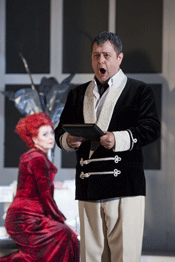
This is high-baroque opera, written by the canny Red Priest in 1720, and it is interesting to note that like his near-contemporary Handel, Vivaldi finds the moral (and immoral) dilemmas of the ruling classes of the utmost interest and worthy of his finest musical expression — after all they were his paymasters and themselves much concerned with the problems of succession, inheritance and political marriage. Unlike Handel however, the Venetian composer doesn’t tend to investigate his character’s deepest emotional conflicts with an extensive series of formal arias in classic da capo form — his music is lighter, fleeter and less organised. And yes, let’s face it, less memorable. However, there are some stand-out moments in this charming and melodic score which reveal some very un-Handel -like trios and ensemble numbers which seem to prefigure an altogether different genre of opera writing still very much on the horizon.
As the machinations of this sumptuously-dressed family unfold (much fur, leather and silk worn by all in a clever mix of styles) there is little action per se other than inside each character’s head — so all credit to director David Freeman for making the most of a delightfully outré set designed by Duncan Hayler which offers us an icy palace of glass, metal and white fur rugs with a gleaming, huge white tree dominating as a centre piece. The tree, whose two main branches sweep to the far sides of the stage, presumably symbolises the two warring factions of the two sons and their respective mothers (Sultana Rustena and Mistress Damira) but it also acts as a refuge, love-nest, and lair with its varying levels of platforms and steps. This is clever use of space, and together with the rear and side exits this configuration helps the story zip along as effectively and wittily as does the music from the pit below, directed (and, it would sometimes seem, driven almost physically) by a bobbing, sweeping and multi-tasking Laurence Cummings.
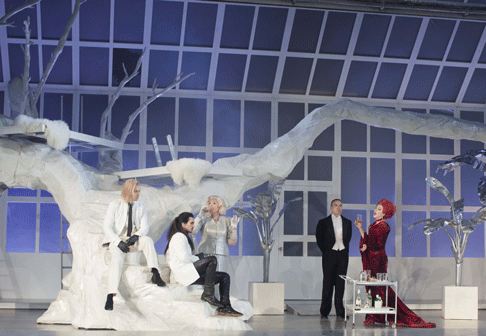
With all the emphasis on the emotions and thoughts of the characters and little physical action or change of location, it is obviously supremely important to have the right bunch of performers and once again Garsington must be congratulated on getting it right. The casting splits into two near-equal halves of the three older generation characters of Sultan, his Sultana, and his long-established Mistress and the three main young characters of his two sons and a visiting Princess who they both (naturally) fall for. Paul Nilon, Jean Rigby and Diana Montague fulfil those elder roles with enormous energy, musicianship and effortless virtuosity: Nilon’s flexible and expressive tenor and stagecraft are as good as ever as the Sultan, Jean Rigby’s (Sultana Rustena) dark mezzo soprano lends itself to her character’s emotional highs and lows (she has a gorgeous slow aria of despair “Fragil fior”, with recorder obbligato, that drew deserved applause), and Diana Montague (Damira, mezzo soprano) was stunning in her portrayal of the wronged Mistress who plans revenge — elegant and fluent coloratura mixed with effortless long-lined phrasing which mirrored her equally elegant couture gowns. These seasoned performers were the musical core of the production, holding everything together with an easy command of the idiom.
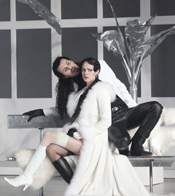
Flying higher above them, musically at least, were the younger generation of singers and characters and here the casting was almost as sure-footed. The young soprano Ida Falk Winland (winner of the Song Prize in the 2008 Ferrier competition) divides her time between her native Sweden and the UK at the moment and has an attractive voice with both a bit of weight to it and an obvious facility for Vivaldi’s ornate lines. She was often singing with either one or both of her “suitors”, the two half-brother princes who, in this production (unlike in the original of 1720, )are sung by countertenors Yaniv d’Or and James Laing, and as it often the way with this voice type the soprano out-sang both in terms of sheer volume. This did tend to unbalance the music somewhat which was a shame as there is a terrific trio for the three which could have been stunning, and perhaps needed a little adjustment on the part of the young Swede for the greater good of the ensemble sound. Yaniv d’Or, ( Melindo), who is not well known in this country, sang and acted with commitment and verve but his voice is not one that immediately attracts. James Laing (Zelim) has a sweet tone, more even and polished than his stage-brother, and I liked his easy top and legato in his more reflective arias. Two non-speaking roles of butler and gardener (the latter oddly placed throughout at the side of the stage busily tying and untying bunches of herbs and flowers — your guess is as good as mine) are uncredited in the programme book.
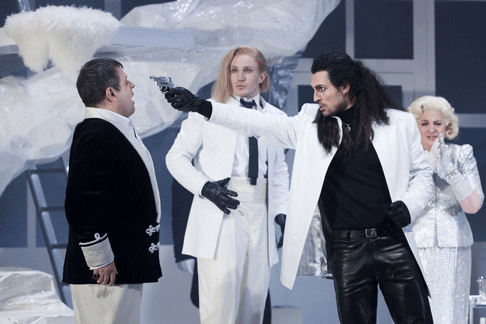
This might not be world-class opera seria (or buffo) but it is fun, it’s musically fleet-footed and charming , it’s cleverly-produced and directed, and the singers are well-cast and attractive: what more does one need for a high-summer’s evening entertainment in the lush green of an English rural estate? Here’s to Garsington’s next exposé of Vivaldi’s “lost” operas — they are setting themselves a high standard.
Sue Loder
Next performances: 25th, 29th June and 1st, 4th, July. Garsington (at Wormsley), Oxfordshire, UK.